The problem was getting home. In the 1980s, J.B. Hunt could send trucks west carrying consumer goods, food and paper. Finding freight for the journey back was harder. A loaded truck arriving in California looked like success. A truck stranded there, waiting for an eastbound load, made the accounting rather less cheerful.
- Rail handles distance; trucks connect the doors.
- Customers can buy a shipment, a managed fleet or a home delivery.
- The advantage depends on keeping equipment and people moving.
That return trip helps explain J.B. Hunt Transport Services, Inc. The company moves freight, but its interesting decisions concern the gaps between movements: an empty trailer, an idle tractor, a shipment nobody can see. Its history is a succession of attempts to make those gaps smaller.
The return trip was the problem
Johnnie Bryan and Johnelle Hunt began in 1961 with rice hulls. He had found a use for the discarded material as poultry bedding; she kept the books. Trucking followed in 1969, with five trucks and seven trailers. There is something pleasingly unglamorous about this origin. The raw material was already there. Someone needed to put it to work.
“The first 10 years of the trucking company were really a struggle.”
Johnelle Hunt, recalling the early business
The same practical instinct later met the West Coast imbalance. In November 1989, Hunt rode a train with Santa Fe president Mike Haverty. Their agreement joined businesses accustomed to competing. Trucks would connect customers to the railroad; trains could carry the long-distance portion. Hunt could sell a journey without putting a driver behind a windshield for every mile.
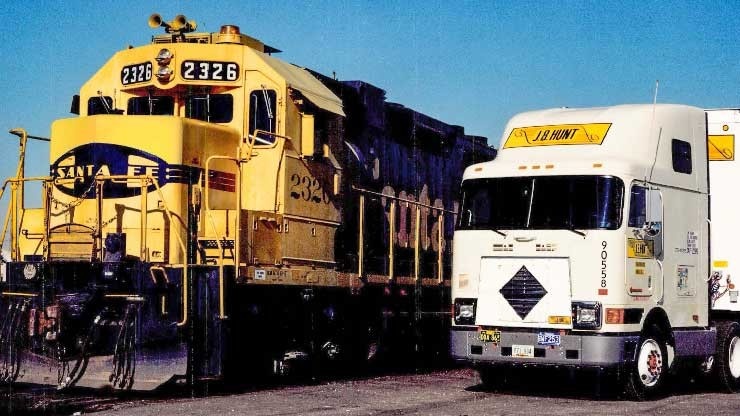
The crucial changes included priority loading and access at rail terminals. In the company’s account, executives wanted their own gate, rather than a location miles away. This is where the story becomes useful beyond trucking: an attractive partnership still needs someone to fix the entrance.
The vehicle changes. The customer still needs one dependable arrival.
Five ways to sell a journey
Today, intermodal sits beside four other reporting segments. Dedicated Contract Services supplies customers with fleets, drivers and on-site management. A manufacturer or distributor can outsource the daily work of running trucks. Integrated Capacity Solutions brokers transportation through outside carriers. Truckload includes 360box, which lets a shipper load a dropped trailer before a tractor arrives to collect it.
Final Mile Services takes the network into homes and jobsites, including assembly and installation options for bulky products. Furniture brand Joybird is a named customer. A sofa introduces a different sort of logistics test: the journey has to work at the customer’s doorway.
Walmart shows the other end of the scale. In February 2024, it signed a multiyear intermodal agreement increasing volume and capacity commitments; J.B. Hunt also agreed to buy Walmart’s operational container and chassis fleets. The arrangement tied equipment ownership to a continuing customer relationship.
The business earns transportation and service revenue. Some work uses owned equipment; some buys space on railroads or capacity from other trucking companies. Compared with a pure broker, Hunt brings a substantial physical network. Against a highway-only carrier, it offers another way across the map. Hub Group, Schneider and C.H. Robinson overlap with different parts of that proposition.
The $500 million booking problem
By April 2022, J.B. Hunt said it had invested $500 million in technology over five years. The spending covered operating systems, cloud infrastructure and integrations as well as its digital freight marketplace. Shippers could enter load details and compare quotes; carriers could search for work and make offers.
J.B. Hunt 360 now supports quoting, booking and tracking, with API and EDI connections. Carrier 360 offers load recommendations and a free load board. The appeal is straightforward: fewer calls to discover where freight is and who can move it. The software serves a transportation business whose outcome is a delivered load.
People remain attached to that promise. Shelley Simpson joined in 1994 as an hourly customer service representative, helped establish the brokerage unit and led the platform’s launch. She became CEO in July 2024. Her progression gives the technology story an operational thread: she had worked with the customers whose bookings the software would handle.

Quantum, introduced with BNSF in 2023, pushes coordination further. Staff from both companies work together in Fort Worth, planning capacity and watching shipments around the clock. It is premium intermodal for freight with tighter service requirements, with pricing tailored to the job. In May 2025, the partners and GMXT launched Quantum de México.
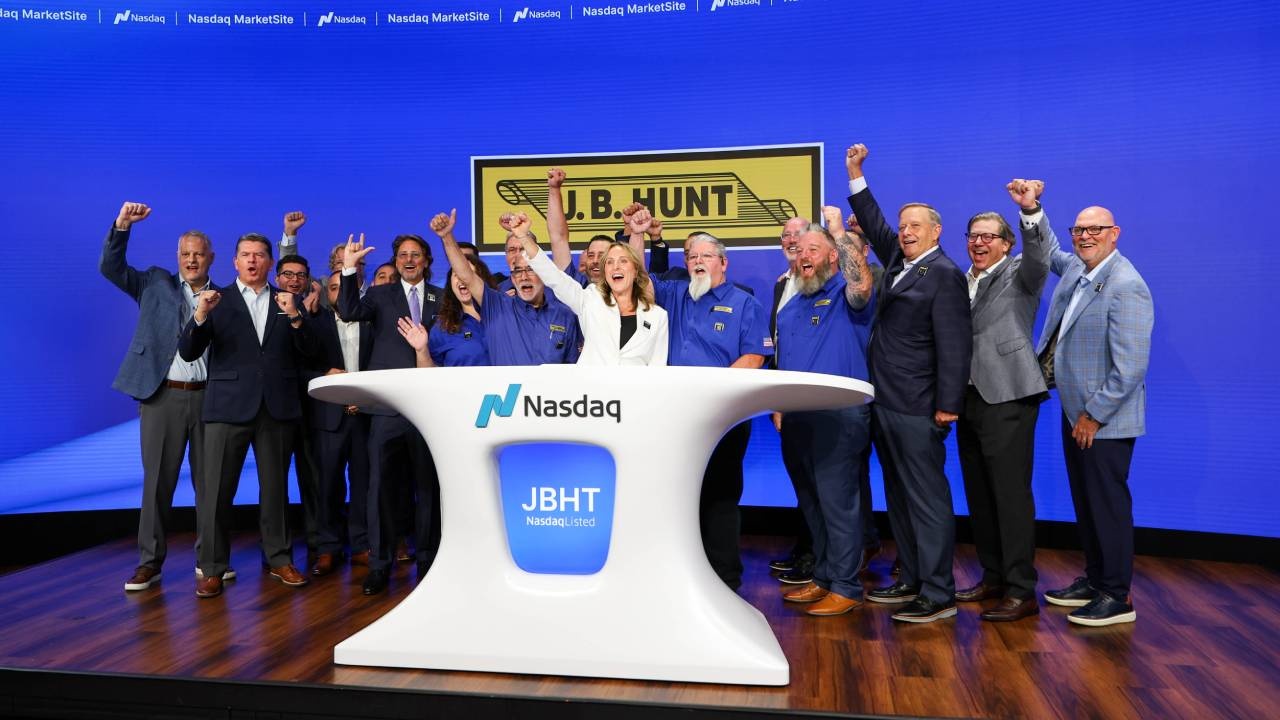
The numbers still have wheels
There are bills behind the coordination. J.B. Hunt reported $575 million in net capital expenditures in 2025. Its 2023 brokerage acquisition from BNSF Logistics carried an $85 million purchase price before working-capital adjustments. That year, the brokerage segment lost $44 million as revenue and margins fell and integration added costs. Software did not exempt it from a weak freight market.
Revenue: $3.68 billion. Operating income: $247.1 million. Revenue excluding fuel surcharges rose 13%.
The latest quarter makes the point again. Third-quarter 2026 revenue rose 20%, while operating income rose 2%. Higher transportation, driver and other expenses absorbed much of the increase. More freight revenue does not automatically produce a matching increase in profit.
For a shipper, the sensible starting point is a lane, a delivery window and the complete bill. Rail needs suitable terminal access and timing; extra road miles or handling can consume its savings. An urgent shipment may belong on the highway. These are shipment decisions, not declarations of loyalty to a transport mode.
The transferable lesson is to measure the whole journey, including the empty return, then put responsibility at the handoffs. Ask which partner can do each leg economically. J.B. Hunt’s consequential move was being willing to let a train carry business that a truck could carry. The customer still had somewhere to send it.
Follow the freight
Company website ↗ · Intermodal services ↗ · Latest results ↗ · Company blog ↗
LinkedIn ↗ · X ↗ · Instagram ↗ · Facebook ↗
J.B. Hunt on YouTube ↗ · Listen: Shelley Simpson’s path to CEO ↗