A single MacBook is a modest foundation for a software company. It is also a practical arrangement: there is very little equipment to argue about. In 2010, Ronak Patel and Yash Patel began Sunflower Lab with one, turning an interest in Apple's platform into a business. The beginning involved New Jersey, a friendship, and late nights spent writing code. The work would eventually spread across continents. First, there was an app to make.
That first iPad application was called Forbes Top 100. The name belongs to the early chapter of a company that would go on to build custom software for other businesses and, later, sell expertise in automation and AI. Patel's career has followed that movement from the screen in front of him to the organization behind it. His public conversations now cover both software capabilities and how people work.
Today, he is Sunflower Lab's co-founder and CEO, based in Hilliard, Ohio. The distance from those coding sessions to a company appearing on successive Inc. 5000 lists is measurable. The more revealing distance is between getting an application to run and getting a business to run better.
The engineer before the company
Patel graduated in 2001 and began his career as a software engineer. His education at UVPCE was in information technology, leading to a Bachelor of Engineering. Learning the tools occupied hours of his early professional life. The attraction was technical, but the question that emerged was commercial and human: which problem deserved all that effort?
Sunflower Lab took shape around that question. New Jersey supplied the setting, and Sunflower Road supplied the name. Ronak and Yash were friends before they were co-founders. Their early interest in Apple development gave them a specific place to begin, rather than requiring them to explain every possible application of software before they had shipped anything.
The partnership remains visible in the company's leadership: Ronak as CEO, Yash as co-founder and vice president of product and strategy. Their titles now occupy different parts of the business. Their shared history predates the organization chart.
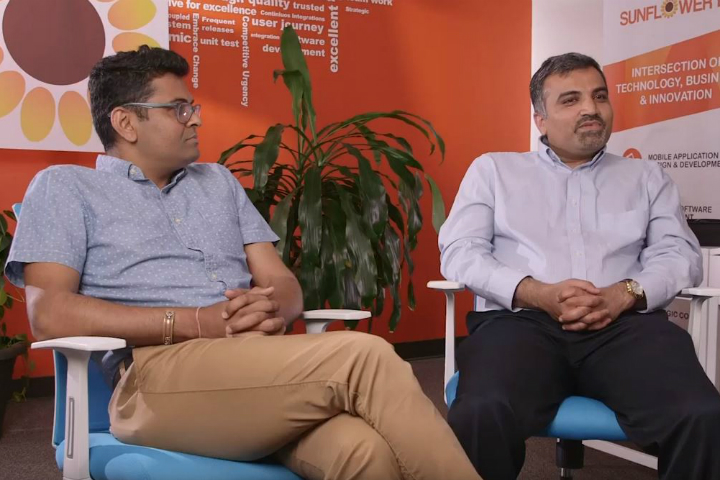
In a founders' video published in June 2019, the pair make fun of each other, discuss pet peeves, and offer advice to people starting companies. It is a welcome adjustment of scale. A business can acquire offices, clients, and a vocabulary full of acronyms while its founders still know precisely how to annoy each other. Long acquaintance has its uses.
Forty people, two continents, plenty of coordination
By December 2017, Sunflower Lab described a team of more than 40 professionals, with offices in Ohio, New Jersey, and India. Its work covered mobile and web applications, custom software, cloud deployment, and automation. A company that began with two people sharing a machine was now dealing with the decidedly less compact problem of organizing expertise across locations.
Its model combined people working close to clients with a distributed technical team. Patel's responsibilities included marketing and brand recognition, alongside the technical and commercial decisions that come with running a development business. Writing software had become only one part of getting software made.
That same year, he was discussing DevOps: bringing development and operations into closer collaboration, supported by automated testing and changes in working culture. This was an early expression of a recurring interest. Tools matter, but so do the arrangements between the people using them. A faster handoff can be useful. A handoff that no longer needs to happen can be more useful still.
The work had consequences for the person at the top, too. Patel was becoming an interpreter between business intentions and engineering choices. That role requires enough technical familiarity to question a proposal and enough patience to understand why the client wanted it in the first place.
The hiring numbers he chose to celebrate
At the end of 2019, Patel's review of the year began with hiring. Employee numbers had grown 40%. He said the company had doubled the number of women on its team, and described a deliberate effort to diversify recruitment. He also thanked employees who had referred candidates.
The internship figures were another point of pride: 66% of that summer's interns had become full-time employees. Most had engineering backgrounds. In a company selling technical ability, giving graduates a route into the work is a concrete way to build more of it.
Two measures from Patel's 2019 year in review. A historical snapshot, rather than today's hiring rate.
His review also described engineers earning AWS certifications in DevOps and architecture. Training appears repeatedly in the way he talks about the company. For a services business, the connection is direct: the expertise available for the next project depends partly on what people are learning during this one.
Sunflower Lab was also experimenting with owning products. One was GrooveHQ, an e-commerce and customer relationship management platform for live-event ticketing. Patel explained that creating, launching, and marketing products would deepen the company's understanding of the work it did for clients. It is a useful form of homework, especially when the homework also has customers.
Before the build, an awkwardly useful question
In 2019, his appearance on A Shark's Perspective explored the work before development: uncovering underlying problems, making a product distinctive, measuring returns after a roadmap, and reaching one milestone before charging toward another. Those subjects describe a founder increasingly occupied with deciding what should be built.
His Enterprise Radio conversation with Eric Dye that September covered SaaS applications and custom CRM systems. These are different buying decisions, but both require a company to make its needs explicit. A feature list can be long while the explanation for needing it remains surprisingly short.
Patel has described his own involvement as overseeing new projects, helping clients define an initial roadmap, and overseeing marketing. Asked about client satisfaction, his answer was plain: “The best practices are understanding and honesty.” It is an unglamorous sentence, which is part of its appeal. Honesty is particularly useful when someone is paying to discover that their original brief needs revision.
“The best practices are understanding and honesty.”
Ronak Patel, on working with clients
The spreadsheet gets a supporting actor
By October 2024, Patel was discussing AI with Jim Schleckser on The Lazy CEO Podcast. Their conversation concerned machine learning in business processes, including customer service, human resources, and finance. The emphasis was on helping people accomplish more with the systems around them.
A later example he shared makes that position tangible. A finance team was spending substantial time reconciling spreadsheets. Sunflower Lab built an AI agent to reconcile data, flag mismatches, and prepare reports. Patel reported more than 40 hours saved per month and $20,000 recovered monthly. These are his figures for that particular engagement, rather than a forecast for every finance department.
What he lingered on was the team's response. He said the change happened without anyone losing their job. The people remained; the work around them changed. In his account, a successful implementation included the users' relief as well as the arithmetic. The spreadsheet, that dependable generator of extra work, had acquired an assistant of its own.
The example gives his interest in AI a practical boundary. A useful system has a defined task, an existing process to improve, and people who can tell whether it helped. That makes the conversation easier to evaluate than a promise to transform everything by Friday.
Three steps before a larger promise
Patel's public automation framework puts discovery first. The sequence is process mapping, feasibility analysis, then a return-on-investment projection and pilot plan. He describes a 30-day pilot as a way to demonstrate value. It is a short enough interval to make the discussion answerable to actual work.
The order is instructive. A company has to describe how a process works before deciding which parts should be automated. It then has to establish whether a proposed solution is feasible before attaching savings to it. The pilot puts those assumptions somewhere they can be tested.
This is a recognizable continuation of the earlier engineer's concern with solving the right problem. The machinery has changed. His attention still returns to the gap between a technology's capabilities and the work a customer actually needs done.
What the growth leaves on the desk
Sunflower Lab's Inc. 5000 positions were 4,384 in 2023, 3,376 in 2024, and 3,350 in 2025. The 2023 Power Partner recognition added another marker. These are company achievements under Patel's leadership, shared with his co-founder and the people doing the work.
The company's current offering includes AI agents, Microsoft's Power Platform and Dynamics 365, and custom software. Its own account describes more than 200 engineers and AI specialists and more than 250 applications launched. The inventory has expanded considerably since Forbes Top 100.
For Patel, the connecting thread is the usefulness of what gets delivered. Early on, that meant turning late-night coding into an iPad app. Later it meant hiring engineers, coordinating a distributed team, and learning the responsibilities of owning products. Now it includes deciding where an AI agent can take a repetitive task off someone's desk. The MacBook was a beginning. The desk, with all its unfinished work, keeps supplying the next question.