A senior title comes with certain conveniences. Someone else can book the meeting, prepare the paperwork, or pursue the next task. Starting a company has a way of withdrawing these privileges at once. Rakesh Dahiya entered that education in 2011, when he and Nisha Shoukath founded People10. They brought experience in banking technology and invested their own money. The customer list began empty. A business card, however handsome, is a remarkably poor substitute for a customer.
Dahiya had been director and India head of corporate and investment banking technology at Société Générale. Earlier, he worked at NIIT Technologies. His education included an MBA from Durham Business School. These were substantial qualifications for understanding technology inside an organization. People10 would require another set of abilities: finding buyers, explaining an unfamiliar company, and learning which work the founders now had to do themselves.
The title stays behind
Shoukath’s account of their beginning describes a frustration familiar to anyone who has bought professional services. The vendors they encountered offered standard services when the business needed more inventive answers. The founders saw an opening for a company organized around software quality and agile delivery. They had managed business units; they wanted to build something of their own.
The adjustment reached beyond engineering. Shoukath describes the difficulty of moving from senior positions, with the ability to delegate, into a business where the founders handled everything. The mental transition took almost a year. Sales and marketing became subjects to learn by doing. Her recollection gives the founding date some texture: 2011 marked the beginning of a company and a change in what being experienced actually meant.
Shoukath puts a concrete number on the early commercial progress: she says People10 brought in 18 international clients and reached breakeven within its first year. That recollection belongs beside the empty customer list at the beginning. It records how quickly the founders had to turn their experience into something a buyer could recognize and commission. They were learning the business while already having to deliver the work.
There is a particular awkwardness in being accomplished and a beginner at the same time. Dahiya’s banking background belonged to an established institution. People10 had to earn its own recognition. The founders could understand a client’s technology problem and still face the separate challenge of persuading that client to trust a new supplier. Competence needs an introduction. Sometimes it needs several.
co-found People10
Engineering a route to the buyer
By October 2014, Dahiya was describing a business that had grown organically over the preceding years. People10 secured early-stage investment through Ideaworks Partners, a network backed by US-based high-net-worth individuals. The purpose was specific: build out sales, alliances, and marketing in the United States. The company was seeking access to a market as well as the resources to serve it.
The timing matters. Outside capital entered a story already several years old. The founders had first put their own resources behind the venture. The next stage required more deliberate commercial reach. It is a useful correction to the assumption that an engineering company’s next problem must always be an engineering problem. Sometimes the next problem is getting into the right room.
For Dahiya, growth therefore included work beyond software delivery. A US expansion plan needed relationships, visibility, and an explanation of why a buyer should choose People10. Funding could support that effort, but the explanation still had to hold up in conversation. The founders’ original complaint about standard services had become a promise they now had to make intelligible to other people.
The human part of the system
Dahiya’s writing offers a way to understand how he thinks about those other people. In a 2012 essay on enterprise agility, he organizes change around technology, processes, and people. The last of these receives particular attention. A company can buy tools and revise procedures while the people expected to use them remain unconvinced.
“People fear change.”
Rakesh Dahiya, writing on enterprise agility
His recommendations concern confidence, permission to fail, coaching, and the authority to act. He also allows for unlearning: an employee may need to give up an established habit before acquiring a useful new one. That is a more demanding proposition than announcing a new workflow. It asks the organization to consider what the change feels like to the person receiving it.
The founder who had left a senior corporate role was writing about the difficulty of changing how work gets done. The connection is suggestive, though he does not present the essay as autobiography. His practical preference is for smaller milestones tied to business outcomes. The method gives people visible progress to assess, rather than asking them to take the entire transformation on faith.
A conceptual reading of Dahiya’s enterprise-agility framework.
The bill that arrives after launch
Another early People10 article credits Dahiya with an idea and illustration about total cost of ownership. Shoukath is the author. Their collaboration moves attention from the initial development budget to the expense of living with an application: fixing it, changing it, and keeping it useful after release. Launch day has excellent publicity. Maintenance has the longer appointment.
The argument favors preventive engineering work during development, including automated testing and regular refactoring. Those activities cost time before launch. The proposed benefit appears later, when a team needs to make changes without fighting accumulated technical debt. The illustration makes a commercial argument about quality: decisions in development can shape the bills that arrive long afterward.
It also helps explain why Dahiya’s contribution matters in a services business. A buyer can compare the price of building an application more readily than the future cost of maintaining it. Bringing the latter into view changes the conversation. The immediate budget remains real, but it sits inside a longer ownership period. The article’s numerical examples are illustrations of its argument, rather than a guarantee of savings on a particular project.
A separate explainer, also written by Shoukath, credits Dahiya’s illustration of enterprise delivery patterns. It distinguishes packaged-software implementations, custom application development, and exploratory product work. Those contexts give teams different starting conditions. A system being configured for a client and a new internet product searching for its shape cannot simply borrow each other’s timetable.
Here, too, the interest is in judgment. How much is already known? When can working software deliver something useful? What can be changed after feedback? The picture offers a way to discuss these questions before selecting tools and routines. Dahiya’s contribution to both explainers shows a CEO participating in the explanation of engineering choices, alongside the work of building the business.
A table, a booth, another conversation
In May 2023, Dahiya represented People10 at Cloud Expo Europe in Frankfurt with Shoukath and business development manager Nesamani Divakar. Their offering included cloud consulting, migration, optimization, DevOps, and data management. The company exhibited at booth L065. The abstract business of international expansion had acquired a very ordinary address: a stand in a conference hall.
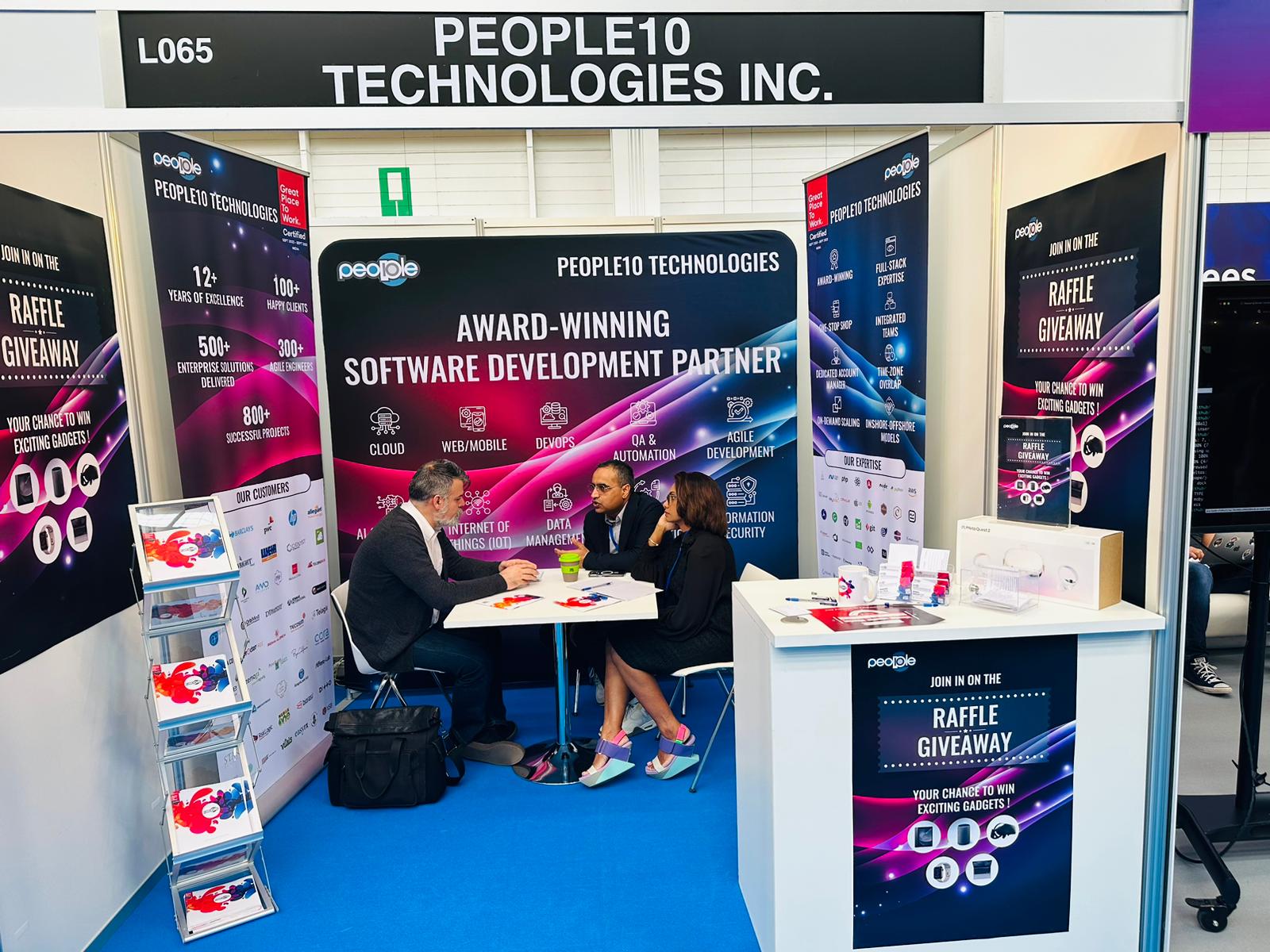
The photograph from Frankfurt records that small-scale reality. There are brochures, chairs, a table, and a large display trying to explain a complicated service in a few glances. People10 also ran a raffle for a virtual-reality headset. Even a discussion about cloud infrastructure can benefit from giving a visitor another reason to stop walking.
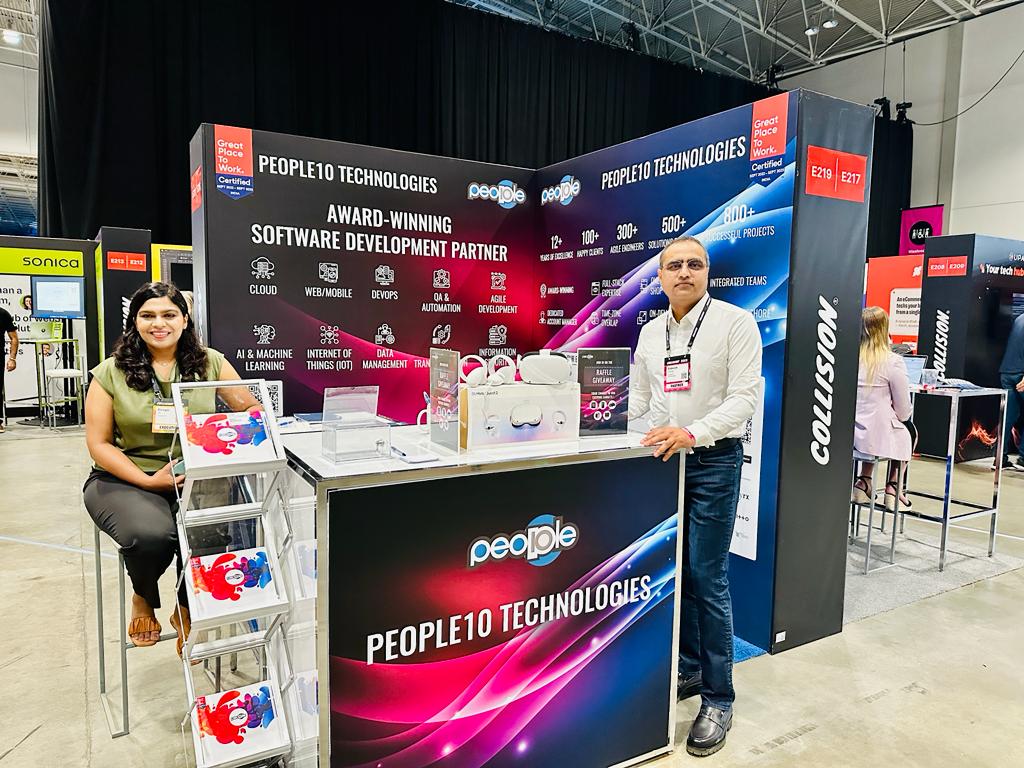
The following month, Dahiya and Shoukath represented People10 at Collision in Toronto alongside Deepti Vij, then director of software delivery. The event ran from June 26 to 29. The founders were taking the company into another market’s gathering of technology businesses, startups, and potential collaborators. The work of introducing People10 had continued well beyond its early years.
The lesson keeps changing
Back in Bengaluru on July 7, 2023, employees met Dahiya and Shoukath for a company gathering that combined discussions of values and future aspirations with activities and prizes. It is a modest episode, but a useful companion to the international photographs. A founder has an audience inside the company as well as outside it.
In September 2026, People10 announced its fifth consecutive Great Place to Work certification. The company’s account emphasizes employee feedback, learning opportunities, cross-skilling, and access to leadership. The recognition belongs to the workplace and its people. For Dahiya’s story, it provides a later point at which to revisit his early insistence that people deserve attention alongside systems and processes.
The technical vocabulary has continued to change. People10 now presents services in AI, data engineering, cloud, automation, and software development. Its centers of excellence and P10Labs give experimentation a place within the organization. A company founded around agile engineering has to keep deciding how new capabilities fit the work its customers need.
Dahiya’s career crosses two kinds of responsibility: running technology within a bank and helping build a company that supplies it to others. The second has required selling, explaining, traveling, and working with a co-founder whose own experience shapes the business. The recurring question is practical: how do capable people turn what they know into work that someone else can use? In 2011, there were no customers waiting to answer. People10 had to go and ask.