A flight to New York gets a founder into the country. It does considerably less to get a product into a buyer’s budget. QUAY Acceleration works in that gap: the awkward stretch between deciding to expand and knowing whom to call, what to say and whether the American market wants what is being sold.
The company combines US market-entry support with a second business that is easy to miss from the word “accelerator.” It designs and runs programs for governments, corporations, universities and other institutions. Founders receive guidance and introductions; institutional clients get an organized way to support entrepreneurship. The cohort is both a classroom and a service someone has commissioned.
That arrangement gives QUAY a wider brief than preparing a batch of startups to pitch investors. Its work reaches international B2B technology companies, retail brands and small businesses in a Maryland county. The common ingredient is organized access: put a founder in contact with people whose knowledge can change the next business decision.
Before the pitch, there was a different stage
Co-founder Frances Simowitz’s first ambition was music. In an autobiographical essay published by QUAY, she describes studying voice performance, becoming disillusioned with the professional environment and working jobs that included retail and nannying. An eight-week Startup Institute bootcamp helped her change direction. She subsequently joined Sittercity, a platform she had previously used to find nanny work.
“I never planned to be an entrepreneur. I planned to sing.”
Frances Simowitz · QUAY co-founder
Her account makes the change of mind unusually concrete. The original career stopped looking like the life she wanted; a short, practical training program opened a different door. Her later work helping startups expand gave that experience a commercial application. QUAY’s name follows the same thinking: a quay is somewhere a ship can dock before its next journey.


QUAY itself combines two predecessor businesses. WEVE specialized in helping international startups enter America; cela concentrated on accelerator programs supporting growth within the US. Simowitz and fellow co-founder John Lynn now appear as managing partners. The merger brought those complementary specialties under one name. WEVE’s lineage includes NUMA New York, whose New York office opened in 2017.
The accelerator is also the product
QUAY sells the design and operation of programs shaped around a partner’s objectives. A government might want local companies to expand abroad. Another might want stronger businesses at home. A corporate partner can bring a sector focus. QUAY’s offer spans customized bootcamps, full accelerators and immersion programs for corporate leaders.
The company also advertises licenses for its processes and program materials. That is a revealing addition: an institution can purchase the means to run a program itself. QUAY’s expertise sits in curriculum, founder selection, mentor coordination and the operational work of assembling a useful cohort. Those activities are less photogenic than Demo Day, but they are much of what a partner is buying.
A service model built around a defined assignment.
This places the business between professional training, market-entry consulting and publicly backed enterprise support. A founder can instead seek a government soft-landing scheme, a university incubator or a specialist consultant. The sensible comparison is the assignment: introductions, sales preparation, investment readiness or help running the business. The word “accelerator” alone tells an applicant surprisingly little.
Eight weeks, with a reason to make each introduction
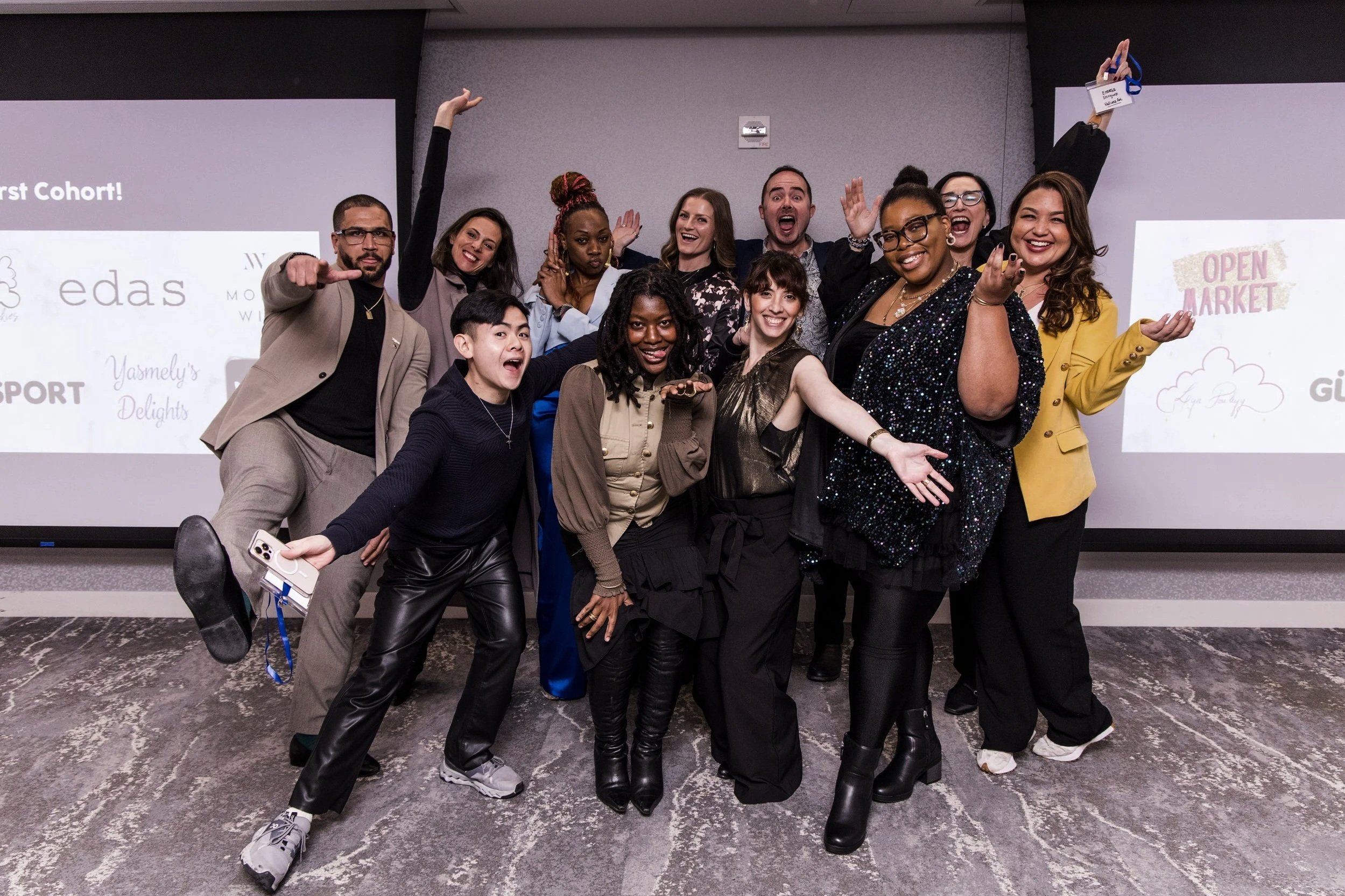
QUAY’s current flagship is an eight-week, equity-free program for international B2B startups preparing to grow in the US. Its Fall 2026 recruitment emphasizes companies with existing traction. The advertised offer includes a tailored expansion plan, individual mentorship, introductions and a New York experience ending in Demo Day.
Across its program description, QUAY specifies a lead mentor plus access to 10 to 15 specialists. Founders work on their market-entry roadmap and go-to-market strategy. This is useful specificity: the lead mentor provides continuity, while specialists can address particular problems. A founder needs someone who remembers last week’s plan as well as someone who knows this week’s difficult subject.
The predecessor programs show how variable the format can be. WEVE’s collaboration with the Canadian Technology Accelerator and The Wave Momentum supported seven Canadian retail-tech startups over five weeks. Its published account lists 15 hours of curriculum and more than 50 individual meetings. The practical unit of work was a targeted conversation, repeated often enough to generate feedback and potential opportunities.
What the price tag does - and doesn’t - say
A historical WEVE offer provides a rare clear price. For its fall 2023 program with Unfold.vc, the published options were $25,000, or $15,000 plus 1-3 percent in warrants. The program lasted ten weeks and advertised more than 100 hours of dedicated support. Unfold offered to cover acceleration expenses for up to two selected startups.
Ten-week predecessor program. These are historical terms, not a current QUAY quote.
Those figures help explain the economics without pretending every cohort has the same deal. The current QUAY flagship is marketed as equity-free. That describes ownership terms; it does not, on its own, establish a zero participation fee. A founder comparing programs should separate cash fees, ownership rights, travel costs and time away from normal operations.
The same distinction matters when reading QUAY’s performance numbers. Its homepage reports more than 600 alumni and $1.18 billion raised by alumni startups, alongside a network of more than 750 mentors. Alumni fundraising belongs to the participating companies. It is neither QUAY’s corporate funding nor its revenue, and it cannot tell an individual applicant what their own outcome will be.
Twenty businesses in Maryland change the picture
Charles County’s BGAP 360 program makes QUAY’s domestic role tangible. The county identifies an X Quay Accelerator track supporting 20 small businesses. Its work includes training, mentorship and collaboration around operational growth, product innovation and market expansion. The county names the operator as WEVE Acceleration Inc., doing business as Cela.
This is a different customer problem from helping a foreign software company find American investors. Here the institutional objective is strengthening businesses already in the community. The broader BGAP 360 initiative has three tracks; QUAY’s is one of them. Keeping those boundaries straight matters when assigning credit for a countywide program.
Westchester’s Element 46 offers another version of the approach. Its curriculum includes customer discovery, marketing, financial projections and investor pitching, with a dedicated mentor and access to professional service providers. Its FAQ says the program takes no equity and makes no direct cash investment. It also explicitly declines to guarantee an investment amount.
Even the name has local homework behind it. Westchester has 45 municipalities; the county becomes the 46th entity. Element 46 is palladium, used as a catalyst. The chemistry pun is doing civic duty. More substantively, the program gives local founders a structured route into a business community that can otherwise depend heavily on whom they already know.
Retail shelves, then a Saudi itinerary
QUAY’s partnership with SHOPLINE moves the model into retail. Announced in August 2025, the three-month accelerator was designed for brands selling across online stores, physical shops and social channels. The launch announcement described a planned intake of 40 founders, with at least half operating both digital and brick-and-mortar storefronts.
The pairing has a straightforward commercial logic. QUAY contributes founder programming; SHOPLINE brings commerce infrastructure, including point-of-sale, ecommerce and customer-management tools. Current program materials advertise grants of up to $50,000. That ceiling is an offer subject to selection and program terms, not a payment every applicant can pencil into a budget.
Geography is widening too. With Logistiya and Innovest, QUAY advertises a seven-week accelerator for startups entering Saudi Arabia in logistics, logistics technology, financial technology and property technology. Five weeks are online and two are in-market. The program focuses on market strategy, investor readiness and access to relevant organizations. New York remains central to QUAY’s identity, but it is no longer the only destination in the brochure.
The part a founder can copy
The transferable idea is to give every introduction a job. Before meeting an investor, know which financing question needs an answer. Before meeting a prospective customer, know which assumption about demand needs testing. Afterward, record what changed. This is an editorial reading of QUAY’s emphasis on roadmaps and tailored mentorship: a busy calendar is useful only when it improves decisions.
It also explains the limits of the offer. A founder who has no time to test advice will get less from a mentor. A company without a working proposition may be early for a traction-focused market-entry cohort. An institutional buyer that cannot define its desired outcomes will struggle to judge delivery. Program fit deserves the same attention as the application.
Simowitz’s July 2025 interview with 23mile discusses management buyouts, financial challenges on becoming CEO and adjustments after a merger. It supplies a useful counterweight to the polished cohort photograph. Running the organization that advises founders brings its own operational problems. The real question for QUAY, and for its customers, is what happens after the meeting: a revised offer, a better prospect list, a clearer decision about where to grow.