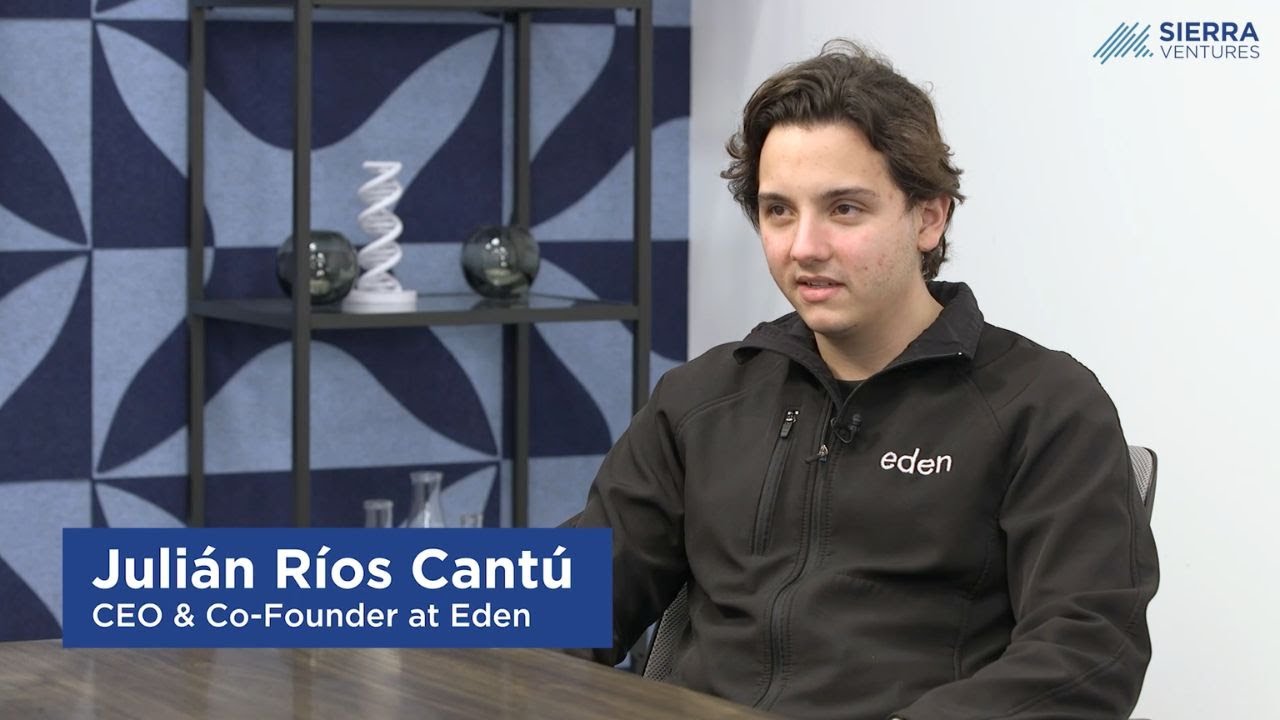
A teenage promise, made in a hospital corridor
Julián Ríos Cantú was eight years old the first time his mother was diagnosed with breast cancer. He was thirteen the second time. By then, the cancer had grown undetected - the initial lumps dismissed as benign. When the second mammogram told the real story, she lost both breasts.
What follows, for most teenagers, is grief. What followed for Julián was research. Lots of it. He spent the next several years reading everything he could about breast cancer detection, thermal imaging, biosensors, and early diagnosis. At 16, he pulled together two co-founders - Raymundo González and Antonio Torres - and started building.
The first product was EVA: a biosensor bra insert with 200 thermal sensors designed to detect the subtle temperature gradients that correlate with tumor growth. Wear it for 60 minutes a week. The AI does the rest. It was an improbable idea from an improbable place - a teenager in Mexico City, building medical devices in his spare time, funded by determination and a full merit scholarship to Tecnológico de Monterrey that he was quietly beginning to ignore.
"Breast cancer is the second-leading cause of death in women worldwide - and I had watched it up close. That's not an abstraction you can walk away from."- Julián Ríos Cantú, on his founding motivation
In May 2017, at the Global Student Entrepreneur Awards global finals in Frankfurt, Germany, Julián Ríos Cantú walked onto a stage and beat representatives from 56 countries. He was 18. He was the first Mexican to win the award. He was the youngest person to ever win it. The $20,000 prize was useful. The message - that young founders from Latin America could compete at the highest global level - was worth considerably more.
That same year, Mexico's government awarded EVA the Presidential Medal for Technology and Innovation. In 2018, Y Combinator accepted him into its Summer batch. The Thiel Foundation named him a Thiel Fellow. Kairos named his company one of the world's 50 most innovative. It was, by any measure, a remarkable 12-month window. He was 19.
Mexico has approximately 4,500 radiologists serving a population of 120 million. The United States, by comparison, has one radiologist per 2,000 people. In Mexico's underserved communities, patients wait more than a month to receive diagnostic results. Eden's platform delivers them in under 48 hours.
COVID shut down the booths. He digitized the entire workflow instead.
By 2019 and into 2020, Eden - then still called Eva - was operating physical diagnostic booths in Mexican clinics, using thermal imaging to screen for early breast cancer. Then the pandemic arrived, clinics closed, and the booth model became impossible overnight.
Julián did not pivot reluctantly. He pivoted completely. If the problem was that radiologists couldn't see patients, the answer was to digitize the entire radiology workflow so they didn't have to. The team built a cloud-native RIS/PACS system - a platform that lets any clinic, anywhere in Latin America, manage imaging workflows without expensive local infrastructure. No servers in a basement. No proprietary hardware contracts. Just the cloud.
By 2022, Eden had fully reoriented around this model. A radiology operating system: one platform for image storage, workflow management, AI-assisted diagnosis, patient communication, scheduling, and reporting. The pivot proved the company. What EVA had started as a hardware play became a software platform story, with significantly larger total addressable market and much stickier unit economics.
Today Eden describes its offering in three integrated layers: Eden PACS (cloud-based imaging), Eden Management (operational workflow), and Eden Intelligence (AI-powered productivity). In 2024, the company launched Eden AI Report - a platform where radiologists dictate their interpretations aloud while viewing medical images, and the system automatically generates complete clinical reports tailored to each specialist's workflow. Voice-first radiology reporting, in real time.
"We are building the radiology operating system of reference for Latin America, where deep gaps in access to timely, high-quality diagnostics persist."- Julián Ríos Cantú, on Eden's Series A announcement, October 2025
From 1 clinic to 2,200+ institutions in 18 countries
Eden now processes over 13 million diagnostic studies annually. Its dataset exceeds 1 billion medical images sourced specifically from developing-region populations - making it one of the largest such datasets on the continent and a meaningful competitive moat as the company trains AI models specific to these demographics.
The company has treated more than 4 million patients total. It operates across 18 countries in Latin America, with the United States now firmly in sight. The $22 million Series A closed in October 2025, led by Sierra Ventures and Liquid 2 Ventures, with a notable strategic co-investor: Daniel Servitje, the CEO of Grupo Bimbo, the world's largest baked goods manufacturer. Servitje understands mass distribution at Latin American scale. That's the point.
Earlier investors include Khosla Ventures, Kaszek Ventures, Hummingbird, and Y Combinator, along with celebrity angels - Leonardo DiCaprio, Ashton Kutcher, and Tony Robbins. The mix reflects the dual narrative Eden has always carried: a serious clinical infrastructure company that also happens to tell a story compelling enough to attract Hollywood.
"At Eden, we believe that healthcare technology has the potential to make diseases like cancer non-lethal."- Julián Ríos Cantú
Conviction over consensus, always
In conversations and interviews, Julián pushes back against the standard founder playbook. He's skeptical of generic resilience narratives, dismissive of performative networking, and direct about what he thinks founders get wrong: following other people's expectations instead of their own conviction.
He has spoken at TED Conferences, Singularity University, and La Ciudad de las Ideas. He won Silver and Bronze Cannes Lions in 2021 - in Health and Outdoor categories, an unusual distinction for a B2B SaaS founder. He named Forbes Mexico's 30 Under 30 list in 2025. He runs a YouTube channel and has maintained a public presence on Twitter and Instagram since his teenage days.
What runs through all of it is an insistence that significant transformation comes from smaller, deeply convicted companies - not from incumbents protecting market share. He has applied that belief to one of the most capital-intensive, relationship-heavy markets in Latin America, and so far, it's working.
The stated ambition: 40-50% of Mexico's population receiving their radiology diagnosis through Eden within a decade, then beyond that. Not a footnote in a larger story. The whole story, rebuilt from the cloud up.
"People in underserved communities often wait one month or more to get results. We get this done within 48 hours."- Julián Ríos Cantú