A nurse finishes a visit. The care is delivered; the note still needs writing. For the employer, that unfinished record can hold up billing. For the nurse, it is one more task waiting at the end of a working day. Jolly builds its business around this awkward little interval between work performed and work recorded. It offers the person who closes the gap something more spendable than gratitude.
- Employers set measurable goals; employees earn points when they meet them.
- Team Select reported a 30% improvement in timely nursing documentation.
- A planned Rye acquisition connects those rewards to AI-assisted shopping.
The nurse, the note, the bottleneck
In Jolly’s March 2025 funding announcement, Team Select Home Care chief executive Fred Johnson reported that on-time documentation among nursing staff improved by 30% after four months using the platform. He connected that change to quicker billing and better cash flow. This is a customer’s reported result, rather than a controlled experiment. Still, the choice of metric tells you rather a lot.
“a 30% improvement in on-time documentation”
Fred Johnson · Team Select Home Care
The problem was sufficiently specific to measure. The benefit reached beyond the task itself. And the worker doing the paperwork could receive a reward for an action whose financial importance might otherwise remain invisible. A care note is an unlikely place to look for an employee-engagement story. It is an excellent place to look for an operational one.
The target comes before the applause
Founded in 2022 by Dean Zimberg, Jolly gives frontline employers a way to attach points to useful actions. The founding vocabulary was familiar: airline miles, credit-card cashback, loyalty. Zimberg had worked in data science and investing; in a public post, he described Tesla’s approach to aligning a large workforce as a formative influence. Jolly brings that interest in alignment to the shift, the referral and the completed requirement.
The employer picks an outcome and budget. Jolly connects to operational systems, puts personalized targets on workers’ phones and dispatches points when targets are met. Its integrations directory lists 255 connections, including payroll, workforce-management, healthcare and commerce systems. The company says its Data Agent can map those records and propose campaigns. The less glamorous dependency is also the essential one: a trustworthy record of what happened.
This puts Jolly beside employee-recognition vendors such as Bonusly, Achievers and Awardco, while giving it a distinct sales argument. Its emphasis is the rule agreed before the work begins. Recognition can celebrate generosity or teamwork; a performance campaign needs a result it can verify. Jolly’s own comparisons champion that distinction. Buyers should judge the actual campaign and contract, rather than assume every competing product works identically.
The current product spans six campaign types. Scheduling rewards coverage of open shifts. Recruiting attaches rewards to referral and hiring milestones. Retention uses attendance, consistency and tenure targets. Compliance concerns requirements such as training and documentation. Productivity campaigns can pair output with quality; sales campaigns target add-ons and upgrades. The common design is a visible opportunity with a defined payoff.
The arithmetic behind the confetti
The reward has a conversion rate. Jolly’s help center says 200 points equal one dollar toward Shop purchases. Employees choose what to redeem, and administrators cannot see their shopping history or shipping address. Claimed points do not expire. Unclaimed spot rewards, however, must be claimed by the last day of the month, called Jolly Day. Even workplace generosity has a calendar.
Redemption value, according to Jolly’s help center. This is not an employer price quote.
Jolly calls its economic measure Return on Point Spend, or ROPS: the incremental profit generated per point spent on incentives. The useful word is incremental. A filled shift is valuable, but rewarding a shift that would have filled anyway produces a different calculation. A sensible buyer starts with a baseline, prices the bottleneck and checks whether the reward changes the outcome enough to cover its cost.
That cost has several parts. Jolly markets points that dispatch only when targets are hit. Its enterprise agreement also provides for platform fees, possible implementation fees and purchases of points, with amounts set in an order form. Performance-triggered rewards describe when employees earn; they do not, by themselves, describe the customer’s entire bill. The software is sold to employers, who fund the incentive program.
A rewards company wants a checkout engine
In March 2025, Jolly announced a $16.5 million Series A led by former Tesla finance chief Zach Kirkhorn, who joined its board. The stated purpose was product expansion and new verticals. By September 2026, the company reported nearly 200,000 frontline workers served across more than 100 employers and a dozen industries. “Served” is the company’s wording; the figure should not be read as a monthly-active-user count.
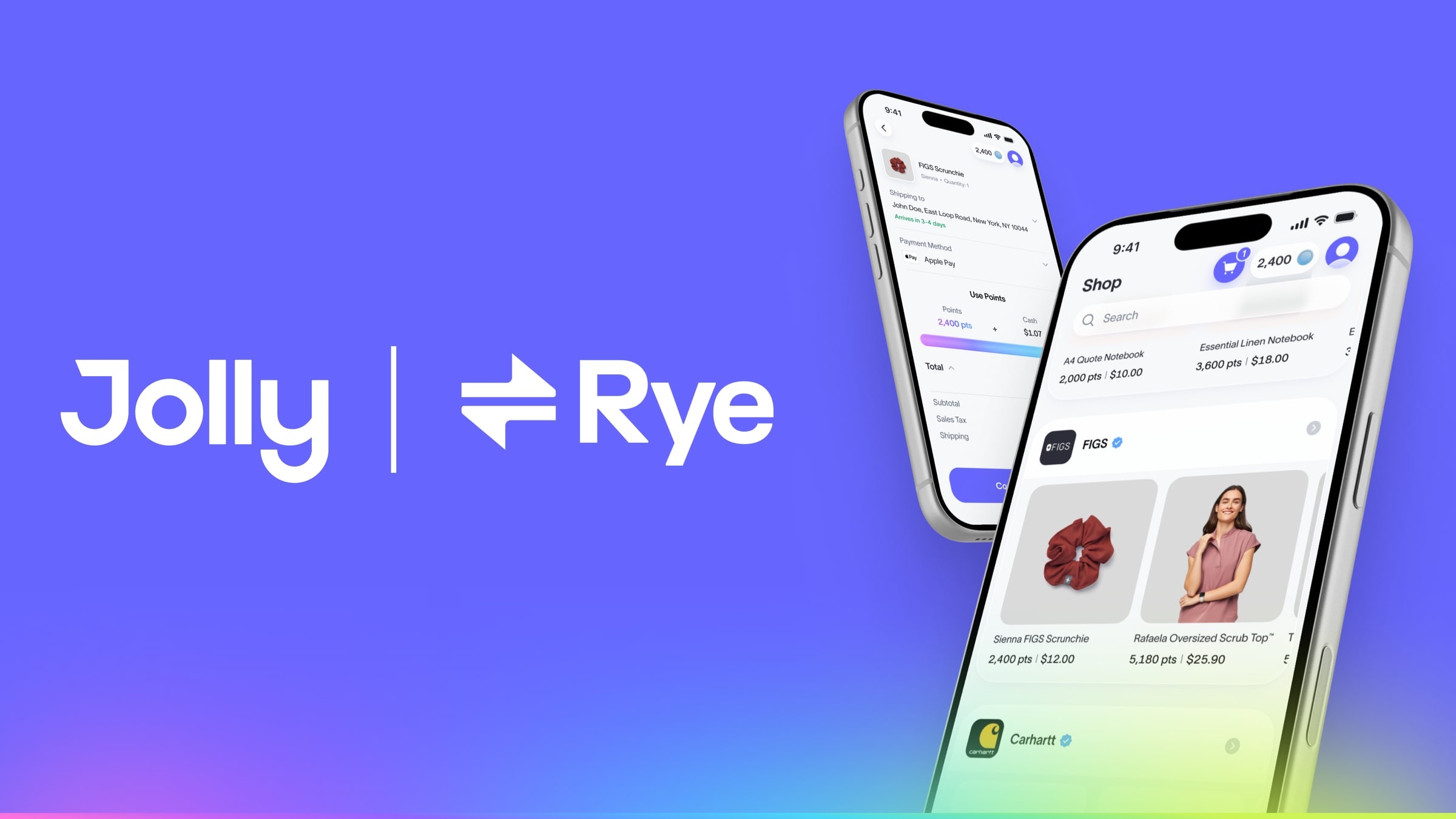
On September 14, 2026, Jolly announced it would acquire Rye, the a16z-backed commerce company whose founding team includes Arjun Bhargava and Twitch co-founder Justin Kan. Rye builds infrastructure for AI agents to shop and check out online. The announced combination links two moments: earning an incentive from a verified action, then using it to obtain a product. The release describes the intended capability; it does not establish that every new checkout feature is already available.
Choose the thing worth paying for
Jolly publishes values of velocity, integrity, growth and quality. The more revealing promise to customers is shared financial benefit. The employer gets an outcome; the employee gets something tangible. Its market is the operational workforce, especially people whose working day happens away from a desk and whose achievements may escape a manager’s immediate attention.
The lesson a reader can copy is modest: choose one expensive problem, make the desired action clear, and attach a reward to evidence of completion. Then ask whether the result improved. My inference is that this works best when workers can influence the target and the data captures useful work. If the measure rewards speed while overlooking quality, the points may purchase the wrong behavior. The intelligence begins with choosing what deserves the prize.