Medibank had the software. It had SuccessFactors, established processes and a rich history of employee data. What it struggled to produce was an answer. Reporting was manual, disconnected and difficult to understand. In One Model’s customer account, Joshua Reader, Medibank’s Head of People Services, describes the peculiar frustration of owning the machinery while being unable to read its gauges.
- One Model brings scattered HR and business records into a shared, governed data foundation.
- Teams use it for workforce reporting, hiring analysis, forecasts and predictive models.
- Its newer products connect that foundation to enterprise AI and examine whether AI usage improves work.
This is an excellent problem on which to build a company. It is ordinary enough to escape attention and expensive enough to demand it. If every meeting begins by reconciling spreadsheets, the organization is paying its analysts to negotiate reality. One Model sells those organizations a way to start further along.
The report was the problem
At Medibank, the first failure was the reporting experience. The underlying HR system was doing its job. People still struggled to find understandable information and someone who could help them interpret it. Reader’s account describes a search for self-sufficiency, accompanied by support. A number without an explanation was an inadequate prize.
The resulting One Model implementation brought together recruitment, onboarding, salaries, surveys, exits, leave and payroll. Finance joined too, adding full-time-equivalent and budgeting information. That detail matters: once finance participates in the same reporting environment, HR’s questions can meet the budget rather than stop at the departmental door.
“We had to live through a bit of pain”
Joshua Reader, Medibank, on learning what the team needed from its reporting tools
The change in buying criteria is the useful part. Medibank wanted users to answer questions themselves and understand the result. Readers can copy that requirement before looking at vendors. Ask who will use the report, who will explain it and what decision follows.
Three people tired of saying no
Chris Butler, David Wilson and Matthew Wilton founded One Model in 2014. They had worked in the Infohrm, SuccessFactors and SAP workforce analytics world. Butler’s retrospective describes customers requesting connections and custom metrics that the existing stack could not deliver. Cloud systems were expanding the possibilities faster than reporting infrastructure could accommodate them.
The founders chose to build an extensible data model. Their platform went live in 2015 with an emphasis on extraction. One AI followed in 2018; Storyboards were relaunched in 2020. The sequence reveals their priorities: get the records, make them usable, then broaden what people can ask.
A common language for the workforce
The core offering, People Data Cloud, handles extraction, cleansing, modeling, analytics and reporting. One Model connects systems such as Workday and SuccessFactors with other workforce and business data. Data Mesh supplies the foundation for organizations that want governed data available beyond one reporting application.
Robinhood’s customer account illustrates the stakes. Workforce information was distributed across two planning systems and manual spreadsheets. Stakeholders were confused about where to find information. Bringing it into one data source improved trust. The problem had been social as well as technical: colleagues needed to believe they were discussing the same thing.
Storyboards provide the visible layer: customizable dashboards, recruitment funnels, organizational charts and Sankey diagrams showing workforce movement. A hiring team can inspect its recruitment stages; a workforce planning team can examine headcount and forecasted attrition. Role-based access determines who can see and interact with those views.
The freedom to move data elsewhere is another concrete part of the offer. One Model’s warehouse materials describe destinations including AWS S3, Google Cloud, Azure and SFTP. An organization can therefore keep using other analytical tools while buying help with the workforce data underneath. For an enterprise with an existing BI investment, that is a useful distinction. The purchase is partly about maintaining a reusable asset: a set of records, relationships and definitions that survives a change in the screen used to display it. The dashboard gets the applause; the model gets reused.
The forecast comes after the plumbing
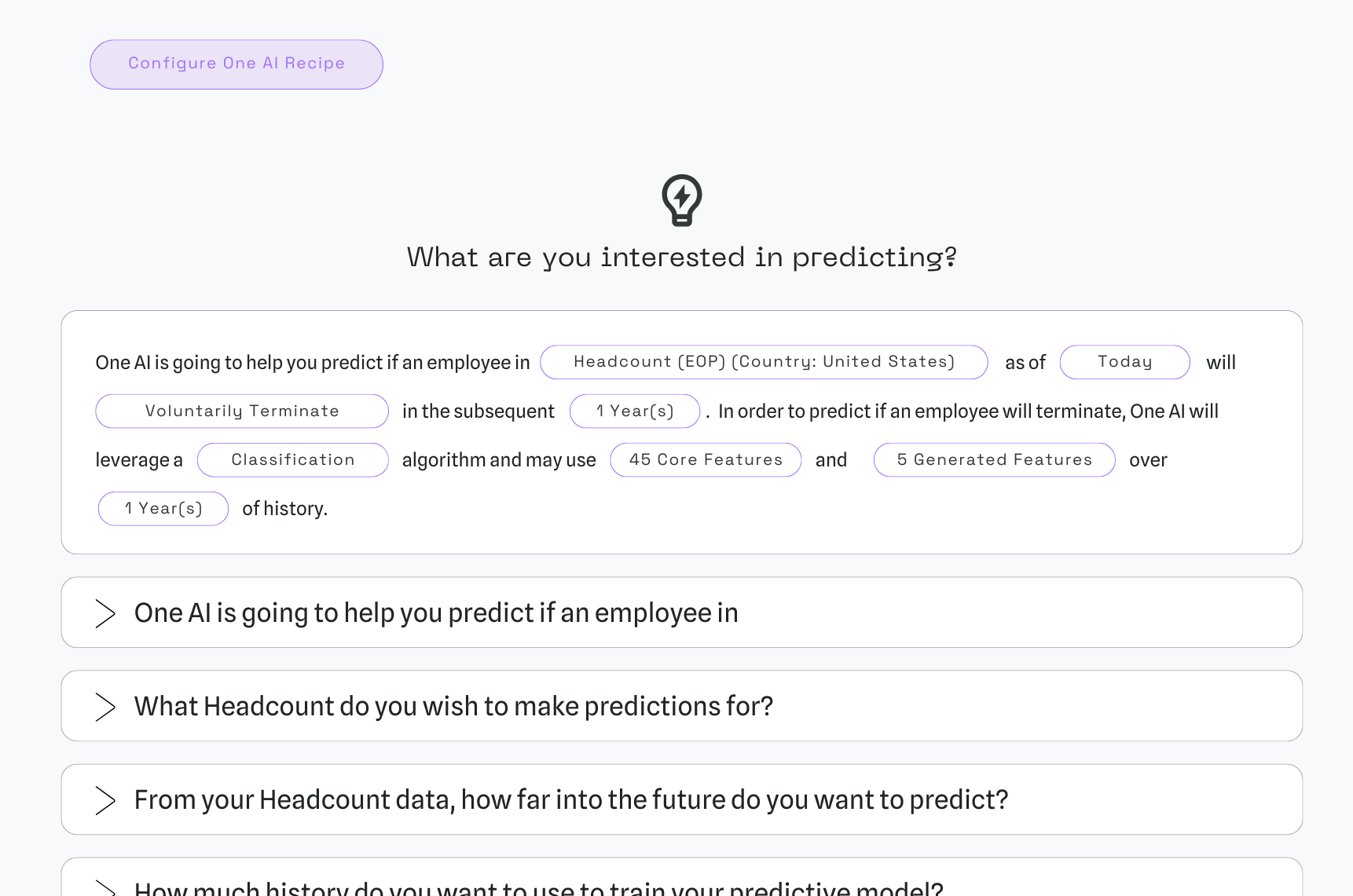
One AI adds predictive analytics. Its Recipes guide analysts through questions that configure a model, while data scientists can choose algorithms and settings. One Model says these predictive models train on the customer’s own organizational data. That makes the quality and suitability of that history part of the purchase decision.
The newer One AI Data Intelligence proposes tables, dimensions, metrics and relationships, with a subject expert reviewing generated code and logic before deployment. Enterprise AI takes another route: its Model Context Protocol connection lets compatible external assistants query approved One Model data.
The distinction is consequential. One Model’s documentation separates governed data retrieval from the external assistant’s interpretation. Permissions restrict what comes back; they do not settle every inference an assistant might make. Buyers still need agreed definitions, suitable data and people capable of questioning an attractive answer.
A business built on the unglamorous work
One Model sells quoted SaaS editions: Essentials for pre-built Insight Packs, Data Mesh for data unification and Enterprise for end-to-end analytics with AI. It announced a $41 million Riverwood-led growth investment in August 2023. Its 2026 business update says more than 95% of revenue came from long-term subscriptions and that it became cash-flow positive in the second half of 2025.
Its market is enterprise people analytics, where Visier is a direct alternative and internal warehouse-and-BI projects are another buying choice. One Model’s case rests on flexible modeling, data access and governance. Deloitte’s 2023 consulting alliance and Workday’s 2024 Innovation Partner designation place it alongside services firms and transactional HR systems.
What did all those prompts accomplish?
By October 2026, One Model was describing AI Impact, a product connecting cross-platform AI usage with workforce context. Logins and prompt counts show activity. Understanding the work requires more context. AI Impact offers optional prompt-level intelligence and role-based controls over who can see the detail.
The practical lesson travels beyond the software. Choose one workforce question. Agree on the population and definitions. Find the records that answer it. Decide who may see them and who can act. A small team with straightforward reporting may need little extra infrastructure. A sprawling enterprise arguing over its spreadsheets has a more compelling reason to call One Model. Either way, agreeing on the denominator is a surprisingly good place to begin.