SendGrid had employee feedback. It had workplace awards, too. What it needed was a way to turn the first into something more useful than the second. Its organizational development specialist, Ealga Ni Aodha, described the old surveys as good for the company’s image but less helpful for improving life inside it. Culture Amp sold the email company a different proposition: find the issues connected to engagement, compare the results with other employers, and give managers somewhere to begin.
That is the business in miniature. Culture Amp sells subscription software for employee engagement, performance reviews, feedback and development. The buyer is usually an HR or people leader. The people expected to change their behavior are often managers, who must turn uncomfortable answers into decisions about communication, recognition, career prospects and the everyday mechanics of work.
It occupies a peculiar corner of enterprise software: a product bought by management to hear what employees think of management. The questionnaire is the easy part. The commercial opportunity sits in the awkward pause afterward, when somebody has to decide what happens next.
02A film executive walks into HR
Co-founder Didier Elzinga came to the problem through an unusual door. Before Culture Amp, he ran Rising Sun Pictures, a visual-effects business working in the film industry. That background gave him experience leading creative, technical people whose output depended on their ability to work together. His next company would make the conditions surrounding that work its subject.
Culture Amp’s Australian entity dates to 2009. Elzinga founded the business with Doug English, Rod Hamilton and Jon Williams. Based in Melbourne, it grew into an international software company by treating workplace culture as something leaders could investigate systematically. In a 2019 statement of its mission, Elzinga connected two trends: greater reliance on data and a growing understanding that culture influences business success.
The argument was commercially pointed. Serving customers well depends on employees, so employee experience deserves the same serious attention given to other business inputs. Culture Amp built around engagement, performance and development, then wrapped the software in education and community. Its Culture First network extends that argument beyond the people who sign purchase orders.
03The office suggestion box gets a second job
The current offer centers on Engage and Perform. Engage covers listening: baseline engagement surveys, shorter pulses, onboarding and offboarding feedback, inclusion surveys and comparisons with external benchmarks. Perform covers the management routine: reviews and calibration, goals, one-to-one conversations, continuous feedback and development plans. Recognition appears as “Shoutouts,” a suitably enthusiastic name for saying a colleague did something well.
A useful way to understand the split is to follow one problem. Employees say they cannot see a future at the company. Engage can help identify where that concern is concentrated. Managers can then use development plans and regular conversations to clarify opportunities. A later survey can test whether employees noticed a difference. The software supports that sequence; the career opportunities still have to exist.
Customers range from startups to large employers. Culture Amp’s case-study collection lists brands including Canva, Etsy and McDonald’s, and advertises more than 6,500 customer companies. That breadth matters because a distributed employer needs more than a cheerful average. It needs to understand how experiences vary across teams and stages of employment.
The field is busy. Lattice also connects engagement, feedback and performance management; Workday Peakon Employee Voice competes in employee listening. Culture Amp’s case rests on the combination of organizational psychology, accumulated workplace data, benchmark context and manager workflows. Buyers should test that combination against their own reporting needs. An AI label alone does little to separate these products.
04What changed at Ticketmaster and Yelp
Ticketmaster’s experience shows why the reporting layer matters. In Culture Amp’s published customer account, the ticketing business moved from one engagement survey a year to three. People leader Paula de Haen used external benchmarks to give scores context and brought the first results to a quarterly business review with senior leadership. Employee feedback had acquired a business meeting.
When leadership communication looked weak, Ticketmaster used survey results to test the concern, then introduced initiatives including open forums with executives. The account reports an improvement in communication scores. The useful lesson is the sequence: name a concern, investigate it, change a practice, and return to the evidence. More frequent surveys were only one part of the work.
Yelp offers another version. After an increase in new-hire sales attrition during summer 2016, it used exit feedback and follow-up conversations with departed representatives to investigate. Changes to recruiting and onboarding followed in late 2016 and early 2017. Its customer story says trainee retention returned to historic levels. These are company-published accounts, not controlled experiments, but both describe actual management interventions rather than treating a dashboard as the result.
SendGrid supplied a quieter insight: people participate when they think someone will read the answers. Its 2016 survey drew 96% participation and more than 1,200 comments after executives encouraged feedback and made a practice of reading it. The invitation carried a promise of attention. That is a management habit another employer can copy without buying anything.
05An AI coach enters the conversation
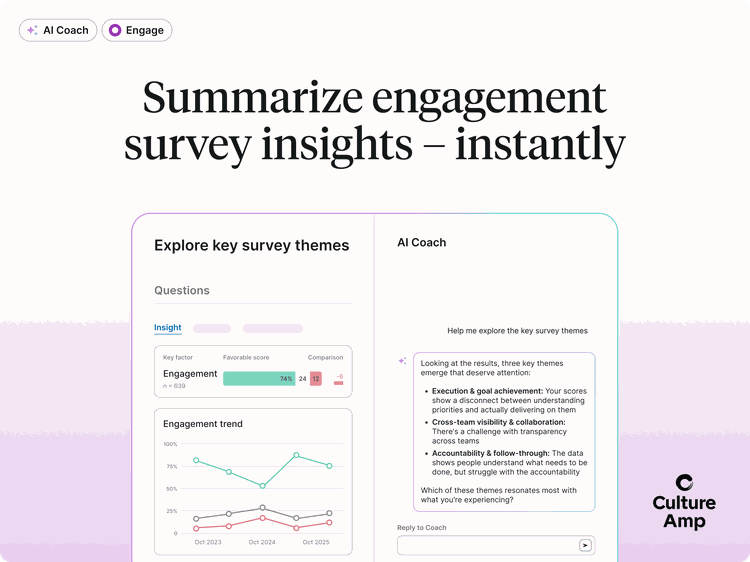
Culture Amp’s newer bet is that software can help with the next sentence as well as the next chart. In October 2025, it announced an expansion of AI Coach across its platform, with Engage availability and a staged rollout for Perform. The company said the expansion came at no additional charge. Its current pricing page includes AI Coach in every plan.
The announced uses are concrete: help managers interpret survey results, choose actions, prepare performance reviews and rehearse conversations. Culture Amp says the guidance draws on its people-science knowledge base and insights from more than 1.6 billion workplace data points. That figure describes the company’s research context; it should not be read as a count of individual employees or proof that any recommendation will be correct.
The move followed the 2024 announcement that Culture Amp was acquiring Belgrade-based Orgnostic. Its attraction was the unglamorous work underneath analytics: collecting, cleaning and connecting information scattered across HR systems. Combining those records with employee feedback could make questions about retention and organizational change easier to investigate. It also widened Culture Amp’s ambitions beyond the survey cycle.
06An annual contract, plus the cost of attention
Culture Amp charges annually, with the quote depending on employee count, selected products and service tier. People Science Consulting is available as an add-on. For a buyer, the useful budgeting question is therefore what the whole program requires: software, implementation, internal administration and the managers’ time to respond. The subscription is only one line in that calculation.
Workday integration provides a practical example. Culture Amp documents a one-way connection that imports employee data through Workday’s reporting service. It estimates one to two weeks for setup and validation, depending on the data model and availability of technical colleagues. HR cannot simply click “connect” and assume every department name and reporting relationship will sort itself out.
Retention Insights has similarly concrete prerequisites. The company recommends accurate start and end dates, a recent baseline engagement survey and an intent-to-stay question. If those inputs are weak, the analysis has less to work with. A small team may also have limited room to examine subgroups without making respondents identifiable. Choosing the right reporting boundaries is part of the job.
The practical buying test is straightforward: ask the vendor to walk through a real management question, using the organizational structure you actually have. Decide who will interpret the findings and who has authority to act. A sophisticated listening program will disappoint if employees expect punishment for honesty, or if every proposed change dies in a budget meeting. Those are conditions software cannot negotiate away.
07“Culture first” meets the payroll
Building the company required venture capital. In July 2021, Culture Amp announced a US$100 million Series F led by TDM Growth Partners and Sequoia Capital China, with Salesforce Ventures joining existing investors. The round valued the business above US$1.5 billion. That is a dated financing valuation, not a current price tag.
The harder test arrived in April 2023. Elzinga told employees he had tried other measures but could no longer avoid layoffs, affecting roughly 9% of the team. His explanation was that customers’ market conditions were not improving soon enough. The company offered a minimum ten-week separation package and allowed departing employees time to say goodbye with communication access intact.
“We can no longer maintain that position,” he wrote. The reversal exposes the limits of any promise built around workplace culture: values have to operate inside financial constraints. Culture Amp’s public account described how it would manage the departure, even as it acknowledged that its earlier position had become untenable.
The pressure continued. In July 2026, Startup Daily reported another reduction of about 70 roles, or 9%, following cuts in November 2025. Rawlinson told the publication the changes would align investment with revised priorities. For a business selling better workplaces, repeated layoffs create a pointed credibility test. Customers can reasonably examine its conduct alongside its product claims.
“We can no longer maintain that position.”
Didier Elzinga / April 2023
Explaining the reversal on layoffs
08A new CEO, and a very old test
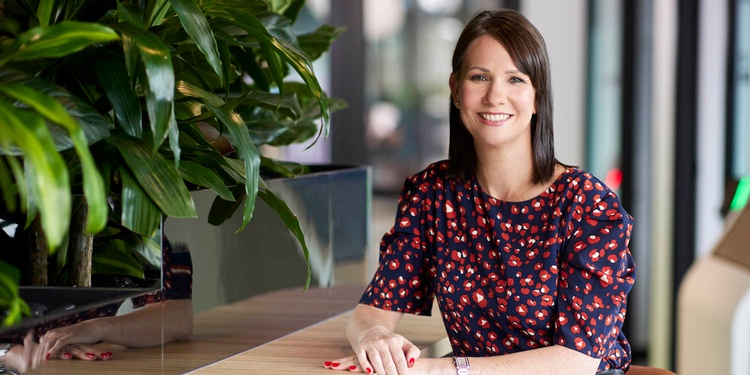
Caroline Rawlinson became CEO in January 2026, after joining as chief financial and operating officer roughly a year earlier. Elzinga moved to executive chairman, retaining a role in long-term strategy and the AI product vision. In announcing the transition, the company reported double-digit revenue growth and cash-flow positivity. Those claims describe operating progress; they do not make subsequent restructuring disappear.
Its public commitments have also continued. B Lab lists Culture Amp as certified since October 2017 and records an impact score of 102.1. The company announced recertification in May 2026. Internally, its stated values emphasize vulnerability, feedback, ownership of decisions and helping others succeed. Employees are known as “Campers,” giving an enterprise software business a faint summer-camp soundtrack.
Culture Amp’s proposition is strongest when it helps an organization complete a modest, repeatable cycle: ask a useful question, understand the answer, assign responsibility and report back. AI may shorten preparation. Benchmarks may sharpen judgment. Neither makes a manager keep a promise. The test comes when the next survey arrives and an employee can point to something that actually changed.