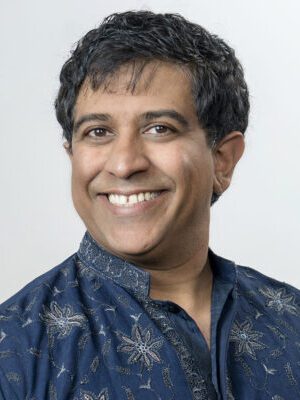
The designer who kept asking who the product was actually for.
Profile / Person
Jaspal Sandhu
A designer who runs on optimism, teaches art in a public health school, and now leads a lab betting on young people.
A designer who runs on optimism, teaches art in a public health school, and now leads a lab betting on young people.
On January 1, 2026, Jaspal Sandhu took the top job at Hopelab, a social innovation lab and impact investor that works on the well-being of people aged 10 to 25. He calls the place four things at once: a researcher, an investor, a convener, and a builder.
Most executives pick a lane. Sandhu spent three years as Hopelab's Executive Vice President arguing the organization should keep all four, and then got the chance to prove it from the corner office. He succeeded Margaret Laws, who had led the lab for a decade. In her endorsement, Laws pointed to his knack for turning design and health equity into something that actually lands.
The résumé is unusual for the job. Sandhu is a designer and a professor before he is an administrator, and Hopelab is backed by The Omidyar Group, which gives it more room than a typical nonprofit to behave like a lab. That combination suits him. He describes the organization's edge as perspective, the ability to spot opportunities that specialists in any single discipline tend to miss.
In 2003, Sandhu was a second-year graduate student in engineering at UC Berkeley, on track for the kind of career that engineering degrees promise. Then he went to India and visited the Aravind Eye Care System in Madurai, a hospital famous for performing cataract surgeries at extraordinary volume while designing its own surgical products. He came home with a different question than the one he left with: not what can we build, but who is it for.
Back at Berkeley he joined a group of graduate students working with Aravind on global health. They gave the idea a name that would follow him for two decades - human-centered design, the plain conviction that a product should start with the person using it. He finished his engineering PhD in 2008. He never really left the field he had wandered into.
He had arrived at design the long way. His bachelor's and master's degrees, both in engineering, came from MIT. Crossing from hard engineering into design is a rare move, and it gave him a habit of holding two ideas at once: the machine and the human who has to live with it.
MIT - Bachelor's & Master's, Engineering. The technical foundation.
UC Berkeley - PhD, 2008. Where a trip to India rewired the whole thing into design.
Human-centered design: start with the person, not the product. Sandhu has spent a career turning that sentence into surgical devices, apps, and public policy.
You have to have a dose of optimism. If we don't believe we can make it better, we shouldn't be in this line of work.
In 2009 Sandhu co-founded Gobee Group, one of the world's first social impact design companies. The name is the job description: a go-between, matching engineers who could build things with public health organizations that knew what needed building. Over roughly a decade, the work reached 25 countries.
Gobee launched two medical devices for newborns and infants. When Ebola broke out in 2015, the firm digitized response data across Guinea, Liberia, and Sierra Leone so officials could track how the disease moved. With the Blue Shield of California Foundation, Gobee helped create the Reimagine Lab, described as the first innovation lab dedicated to domestic violence prevention.
The through-line was never a single sector. It was a method - go find the people closest to the problem, design with them, and build only what they will actually use. A device for a newborn in sub-Saharan Africa and a data system for an outbreak response do not look alike on paper. They rhyme in practice, because both start by watching how real people move before a single line of code or plastic gets committed.
Gobee ran for more than a decade before Sandhu closed it in 2022. Companies that shut down are usually filed under failure. This one reads more like a graduation. The firm had spent years arguing that human-centered design belonged inside global health, and by the end that argument had largely been won. When Sandhu walked away, he did not walk toward a bigger version of the same thing. He walked toward a narrower, harder question: what do young people actually need, and who gets to decide.
Two medical devices designed for infants, shipped to the field.
Digitized outbreak data across three West African countries to track disease spread.
A first-of-its-kind innovation lab for domestic violence prevention, with Blue Shield of California Foundation.
Sandhu has designed and taught public health innovation courses at UC Berkeley since 2010. In 2011 he co-launched "Designing Innovative Public Health Solutions" with professors Nap Hosang and Kristine Madsen - the first human-centered design course offered by any school of public health. He also co-teaches a class called the Art of Public Health, because he thinks the two belong in the same room.
From 2016 to 2021 he was faculty lead for the Fung Fellowship, a Berkeley program blending digital health, design, and health equity. He is a Professor of Practice at the Wallace Center for Maternal, Child and Adolescent Health, where he mentors doctoral students working on reproductive health equity and care for Black birthing people.
Ask him where the pressure to keep improving comes from, and he does not point up the org chart. He points at his students.
The students are pushing me to better places.
Hopelab invests, researches, convenes, and builds. Under Sandhu it has put money into more than 20 early-stage companies working on young people's well-being.
Technology-enabled eating disorder treatment with virtual care teams, now operating in all 50 states with insurance coverage.
Teletherapy and psychiatry for Medicaid-eligible youth, using supervised resident-therapists to widen a thin workforce.
A gender-affirming journey app built by transgender founders - Sandhu's belief that lived experience makes stronger products, in one download.
A rough read of the initiatives Sandhu is associated with at Hopelab.
Sandhu says he is most excited about working with and for Black, Brown, and Queer young people - building toward joy, purpose, and connection. The funders who backed the youth power fund include The Archewell Foundation, Pivotal Ventures, and Pinterest.
A graduate trip to Aravind Eye Care in Madurai reroutes his career toward human-centered design.
Earns his PhD from the UC Berkeley College of Engineering.
Co-founds Gobee Group, one of the first social impact design firms.
Co-launches the first human-centered design course at any school of public health.
Gobee digitizes Ebola response data across Guinea, Liberia, and Sierra Leone.
Serves as faculty lead for the Fung Fellowship at UC Berkeley.
Closes Gobee Group and joins Hopelab as Executive Vice President.
Becomes President and CEO of Hopelab, effective January 1.
I'm most excited about working with and for Black, Brown, and Queer young people to build a future where they have joy, purpose, and connection.
Most leaders in philanthropy will tell you their hardest problem is managing risk. Sandhu says the opposite. His toughest professional challenge, by his own account, is resisting the pull to play it too safe - knowing when to take a calculated risk for bigger impact instead of defaulting to caution. It is an unusual thing for a nonprofit CEO to worry about out loud.
That tension shows up in how he talks about optimism. He treats hope not as a mood but as a job requirement. If you do not believe the situation can improve, he argues, you have no business trying to improve it. The design training is still there underneath: don't accept the problem as given, redraw it.
The redraw, at Hopelab, is about who holds the pen. Sandhu talks about shifting power toward young people and folding them into every part of the work, not as a focus group to be consulted at the end but as collaborators from the start. It is the same instinct that sent him to Madurai two decades ago, scaled up. The Responsible Technology Youth Power Fund, one of his first projects at the lab, put real money behind that idea, backing organizations run by the young people the technology is supposedly built to serve.