The first useful thing to know about Jason McClelland is that he did not begin with a campaign brief. He began with code. Before the chief marketing officer titles, before cloud platforms became a category and then a cliché, he worked as a developer at NetObjects. The experience gave him a native feel for the audience that many software companies spend lavishly trying to imitate: people who want the product to work, the documentation to be clear, and the adjectives to remain under adult supervision.
That early technical footing became the quiet through-line of a career spent translating complicated products into commercial stories. McClelland has moved through Adobe, Heroku and Salesforce, Domino Data Lab, Algolia, Shutterstock, DataStax, and now Sonatype. The logos look like a brisk tour of enterprise software's recent history. The work underneath them is more consistent. A technology changes how people build or buy. A company needs language for the change. Marketing has to turn that language into an operating system shared by product, sales, and the executive team.
McClelland has said that his aim is to make go-to-market work more efficiently through digital transformation. In his telling, digital is not decorative. It lets a company focus, get closer to customers, improve retention and expansion, and lower the friction in selling. He speaks like an operator because he has owned more than the communications layer. At Heroku, his remit included marketing, inside sales, data analytics and engineering, and business operations. The point was never merely to make the product famous. It was to make the whole customer journey legible.
Adobe taught him that a cloud is really a business model
McClelland spent much of his early career at Adobe, first in web and product roles and later in commerce and sales leadership. He was there for two changes that are now easy to compress into tidy corporate history. Adobe assembled Marketing Cloud as an end-to-end platform for marketers. Then the company moved Creative Suite from packaged software releases toward Creative Cloud subscriptions. McClelland worked on both transformations, including an ecommerce-as-a-service vision and the systems used to scale a services business beyond $1 billion.
From a distance, a subscription transition looks like a pricing decision with a pleasing arrow pointed upward. Inside the company, it touches product design, commerce, sales incentives, customer expectations, finance, and the tense question of what happens between a free trial and a durable account. McClelland's later career suggests that he kept the lesson: a market transition only becomes real when the organization can operate it.
Heroku made the free user part of the sales architecture
At Heroku, the developer platform acquired by Salesforce, McClelland helped build a large product-led and ecommerce-to-enterprise motion. Heroku's commercial puzzle was unusually instructive. Developers could begin on their own, often without a procurement meeting or a salesperson. Successful use generated evidence. Evidence could become an enterprise conversation. His team was credited with producing more than 70 percent of a $400 million annual recurring revenue business, while he held direct responsibility for $300 million.
This is where the popular version of product-led growth becomes inadequate. A free tier may open the door, but the business still needs onboarding, useful product signals, sensible expansion paths, an inside-sales motion, and enough organizational patience to let users demonstrate intent. McClelland has argued that go-to-market is often misunderstood when it stops at freemium. His Heroku brief crossed the departmental seams where promising strategies tend to become meetings.
One translator, seven changing markets
Cloud
Dev platform
MLOps
Search
Creative
AI data
Security
Salesforce also supplied a lesson in spectacle. McClelland recalled Marc Benioff's instinct to turn almost any circumstance into marketing, including being bumped from Oracle's OpenWorld and holding a nearby keynote instead. What stayed with McClelland was less the showmanship than the framing. Make customers the heroes. Tell how people like them succeed. The software vendor can survive a scene in which it is not the protagonist.
A category begins with one job, not every feature
After Heroku, McClelland became the repeat CMO called when a technical company needed a sharper enterprise story. At Domino Data Lab, he rebuilt marketing, repositioned the machine-learning operations platform, and developed its enterprise and account-based motion. At Algolia, he arrived as the search API company was expanding its language toward dynamic digital experiences. At Shutterstock, he joined the executive committee and set out to explain the company's broader creative workflow and enterprise ambition. Each role asked a version of the same question: what specific promise can this business credibly own?
His category formula is wonderfully unfashionable because it involves subtraction. Customers have jobs to do. A company must choose the job it can perform better than anyone else, put a memorable wrapper around it, and build the machinery to support the claim. The hard part is not dreaming up the category name. It is maintaining alignment with product, the chief executive, and the revenue leader while evidence accumulates. Category work requires the confidence to keep a position stable without confusing confidence for certainty.
That directness also appears in how colleagues describe him. A DataStax teammate praised his empathy, calmness, accountability, and speed, particularly his ability to keep an organization from overthinking itself into immobility. Another colleague who worked with him for years at Adobe remembered a strategic leader willing to be scrappy and roll up his sleeves. Those observations fit the path. McClelland has repeatedly occupied roles where a neat brand plan meets messy operational reality.
Then the database company caught the AI wave
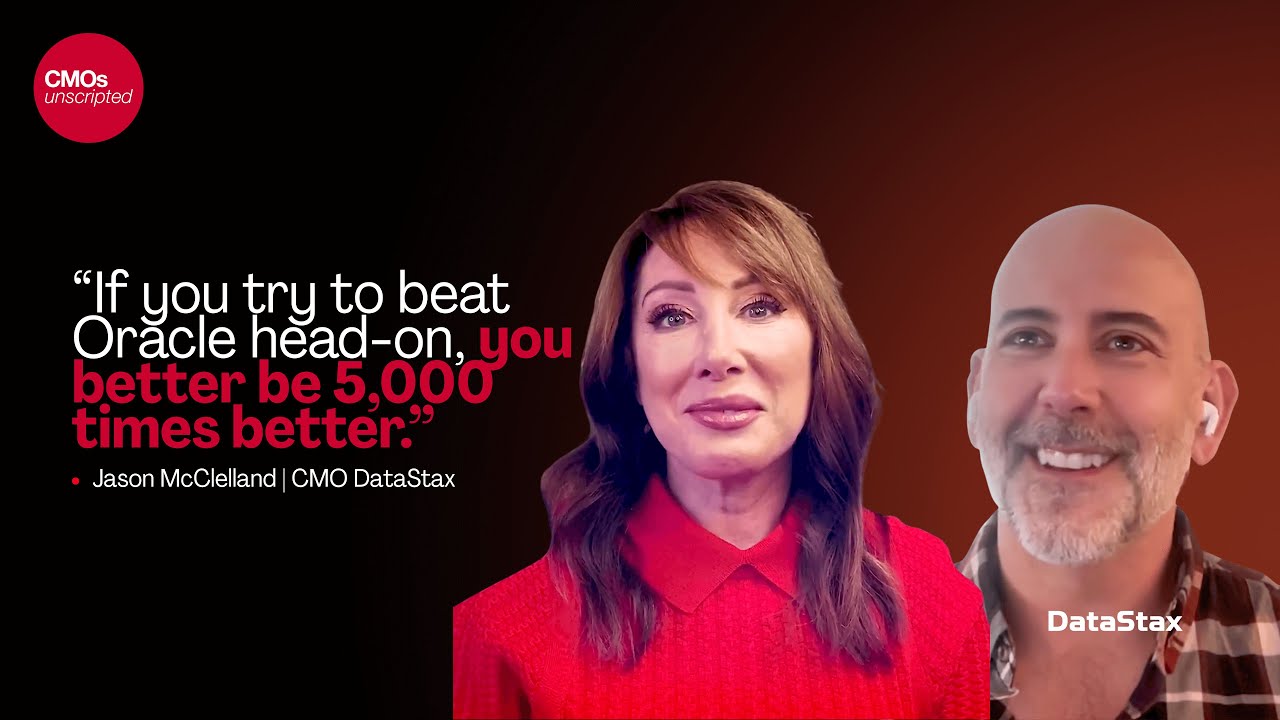
McClelland joined DataStax in 2023 with a characteristically unvarnished announcement. LinkedIn had, he joked, “sorta let the cat out of the bag” before he could write something thoughtful. Then came the enthusiasm: after more than 25 years of interesting work, he was “super friggin pumped” to join a team positioning real-time data infrastructure for generative AI.
The timing mattered. DataStax had roots in Apache Cassandra and distributed data, but the generative AI market needed a new explanation of why real-time, unstructured, and vector data mattered. McClelland's public commentary focused on taking AI from amusing demonstrations into production work. The company developed its story around an AI-ready data stack, Astra DB, and Langflow. In February 2025, IBM announced its plan to acquire DataStax. The deal closed that July.
He described the combination in terms of multimodal search, knowledge graphs, retrieval-augmented generation, enterprise scale, and a continued commitment to open source. It was technical language, but it served a simple narrative: useful AI needs trustworthy access to the right data. A marketer with a developer's background could move between both levels without treating either audience as a tourist.
At Sonatype, the risk arrives before the code
In June 2026, Sonatype named McClelland its chief marketing officer alongside new revenue and people leaders. Chief executive Bhagwat Swaroop placed the company at the intersection of AI, open source, and cybersecurity. That intersection gives McClelland a fresh translation problem. Modern software is increasingly assembled from public packages, third-party components, copilots, and machine-generated code. A risky dependency can enter the supply chain before a developer commits a line that a conventional scanner can inspect.
McClelland framed the opportunity around real-time insight and control: know which components are safe to use and deploy, then help teams ship AI and agentic software with trust. Sonatype operates both a widely used repository and a major open-source component registry. The raw scale is arresting, but scale alone is not a category story. His task is to make governance at software assembly feel like a concrete job rather than another security abstraction.
This is a fitting next chapter. McClelland started by making software. He then helped Adobe sell software as an ongoing service, helped Heroku turn individual developer adoption into enterprise relationships, helped DataStax connect data infrastructure to production AI, and now must explain how organizations can assemble software without surrendering judgment. The tools have grown more autonomous. The marketing discipline remains almost stubbornly human: understand the job, earn the story, and resist the urge to promise the whole universe.
There is wit in the fact that a career full of clouds, platforms, categories, and artificial intelligence keeps circling back to plain speech. McClelland's best public lines are short. Customers want one job done. Nobody searches for everything. Make the customer the hero. Behind each sentence sits an organization chart's worth of hard work. Clarity is not the absence of complexity. It is what the operator produces after meeting complexity in person.