Buildkite began with an employer saying no. In 2013, Australian engineer Keith Pitt was told to stop using a cloud continuous-integration service because the code could not be trusted to somebody else's build machines. The available self-hosted tools solved the policy problem and created a usability problem. They felt like infrastructure from another era. Pitt's answer was not to choose a side. It was to cut the system down the middle.
Buildkite would run the control plane - the web interface, job coordination, logs, permissions, and pipeline state. An open-source agent would poll for work and execute it wherever the customer allowed: a server rack, an AWS account, a Kubernetes cluster, a Mac under a desk, or specialized hardware nobody had thought to put on a public CI menu. The source code and secrets could remain inside the customer's boundary. The pleasant interface did not have to.
That sounds like a tidy diagram. In practice, it is a deal with two invoices. Buildkite charges for the software layer; the customer pays for and may operate the compute layer. For a ten-person startup running ordinary tests, the arrangement can resemble buying a restaurant and still bringing your own stove. For a platform team serving thousands of engineers, it is often the point. The team can tune machines, caches, networks, images, locality, and concurrency around its actual workload instead of negotiating with a fixed runner catalog.
The first thing that failed was the obvious choice
The original failure was not a broken unit test. It was a broken menu. Fully hosted CI was convenient but unacceptable under Pitt's workplace security rules. Self-hosted CI respected the boundary but made developers carry old operational furniture. Buildkite's first product, initially called Buildbox, joined those mutually annoying facts into one commercial thesis.
Pitt built the first version around time in an airport terminal. Lachlan Donald and Tim Lucas became part of the founding team, adding company-building, engineering, and design muscle. The business stayed lean and largely bootstrapped. By the time it took its first institutional round in 2020, Buildkite was profitable, employed 26 people, and said it served more than 1,000 customers. That A$28 million Series A, led by OpenView with General Catalyst, reportedly valued the company above A$200 million.

“It’s ok to break production, but not people.”One of Buildkite's published culture principles
Who buys control?
Buildkite's strongest customers are not shopping for their first green checkmark. They are engineering organizations whose CI has become a distributed system of its own. A monorepo may require thousands of jobs. Mobile teams need scarce macOS capacity and code signing. Machine-learning teams want GPUs or access to data that cannot wander onto a generic runner. Regulated companies need workloads to remain inside controlled networks. All of them care about the gap between a developer pushing code and learning whether it works.
The public customer list includes OpenAI, Anthropic, Airbnb, Block, Canva, Elastic, Intercom, PagerDuty, Pinterest, Reddit, Shopify, Slack, Uber, and Wayfair. Buildkite says its platform supports more than 60,000 users. The logos are persuasive, but the more useful evidence is the before-and-after shape of the work.
Elastic moved a Kibana pipeline from three hours to 55 minutes and reported cutting cloud infrastructure spending by nearly three quarters. Intercom reduced tests from 25 minutes to three while supporting about 150 deployments a day. Reddit's 2025 mobile rebuild dropped typical Android and iOS build times by roughly 30 percent, reached improvements of up to 50 percent, and pulled queue time from minutes toward five seconds. Caching brought code checkout from several minutes to around half a minute.
Those are vendor-published case studies, so treat them as outcomes under cooperative conditions, not coupons redeemable by anyone. The transferable move is to measure queue time, checkout time, test imbalance, cancellation waste, and feedback latency separately. “CI is slow” is a complaint. “Developers wait four minutes before a job even starts” is a systems problem with an owner.
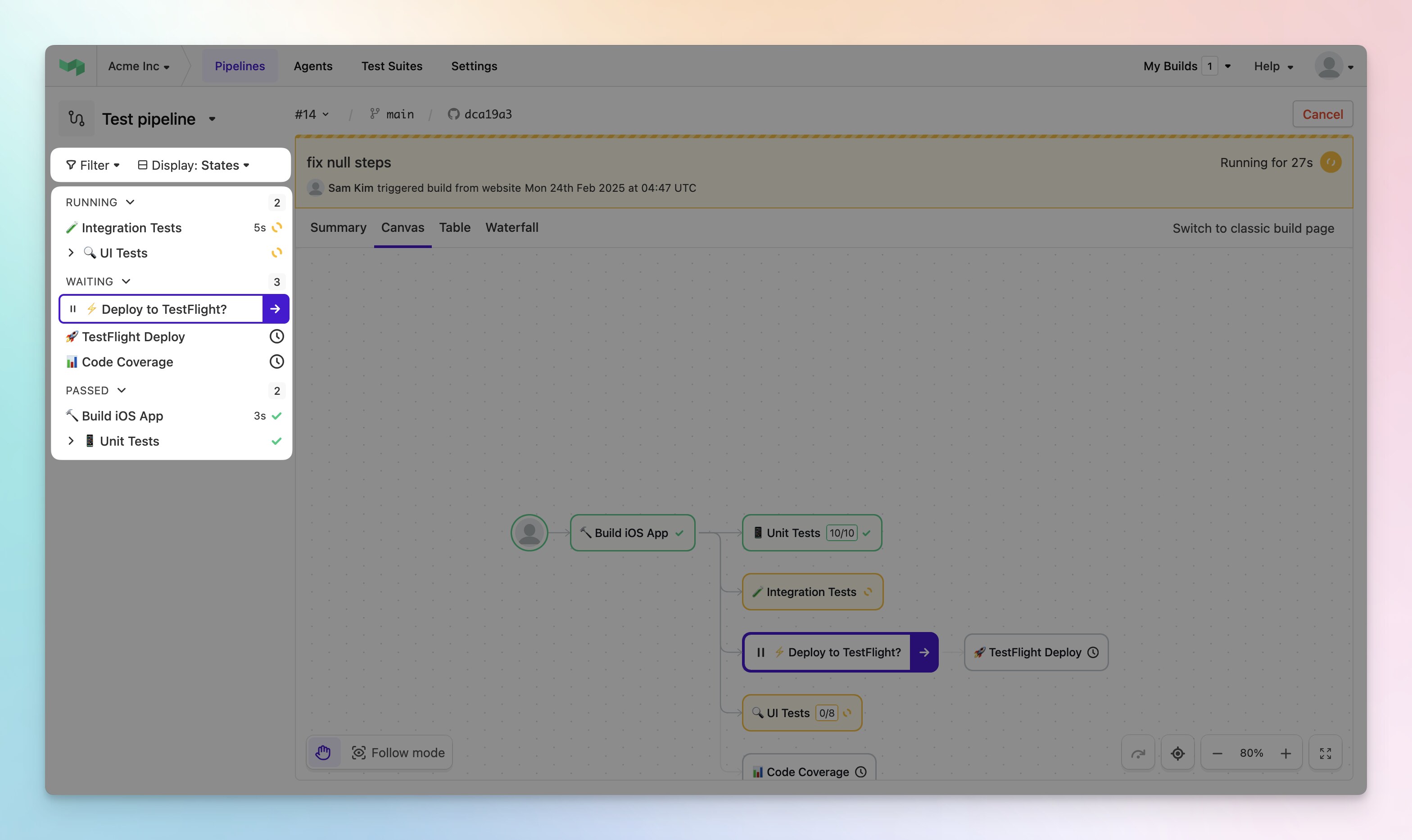
One product learns to become many
The founders did not always assume Buildkite should become a shelf of developer products. Pitt has written that the shifting CI market and the arrival of the pandemic produced a period of doubt in 2020. Early in 2021, he and Lucas stepped back, talked with friends and customers, and reconsidered the endgame. Customers were already bending Buildkite into workflows other systems could not express. The company decided the same appetite for control existed beyond the build itself.
Test Analytics arrived in 2021, later folded into Test Engine. It identifies flaky tests, tracks reliability and duration, splits suites across nodes, and can ingest results even when another CI provider runs the pipeline. That detail matters: the second product did not require a customer to swallow the first. By the 2022 Series B announcement, Buildkite said it was ingesting more than a billion tests each week.
The US$21 million Series B, co-led by AirTree and OneVentures, funded that platform turn. In 2023 Buildkite bought Packagecloud in a multi-million-dollar all-stock deal, adding package registries and artifact management. In 2024 it introduced hosted agents, relaxing the bring-your-own-compute assumption for teams that wanted the Buildkite interface without maintaining runners. Mobile Delivery Cloud assembled managed Mac infrastructure, testing, signing, and app-store workflows. Migration services and compatibility tools now target teams arriving from Jenkins, GitHub Actions, CircleCI, Bitbucket, and GitLab.
Today the business model mixes subscription tiers with metered resources. Personal, Pro, and Enterprise plans cover different capacities and controls. On the current published schedule, managed Linux agents begin at $0.004 per vCPU minute and Apple Silicon Mac agents at $0.02 per vCPU minute, with the effective bill scaling by machine size. Pro includes allowances for users, agents, test executions, packages, storage, and managed minutes; large organizations negotiate enterprise terms. The architecture may be unusual, but the economic engine is recognizable enterprise SaaS with usage attached.
The difference is freedom - and freedom needs an operator
GitHub Actions and GitLab make CI an appealing extension of the place developers already store code. CircleCI sells a mature managed experience. Jenkins offers enormous flexibility and an equally enormous opportunity to become somebody's permanent hobby. CloudBees, Azure DevOps, Harness, TeamCity, and Depot approach the territory from different angles. Buildkite's distinction is not that competitors cannot run self-hosted agents. It is that customer-controlled execution, dynamic pipeline generation, and unusual scale sit at the center of the product story rather than at its edge.
It works when
You have a platform team, spiky concurrency, strict network rules, a giant monorepo, specialized hardware, or enough CI spend to reward careful tuning.
It does not when
Your workflows are ordinary, your code host's bundled CI is good enough, nobody wants to own runners, or migration cost exceeds the time you could save.
Self-hosted agents keep code execution within a chosen perimeter, but they do not make security automatic. Customers still own images, credentials, patching, network policy, capacity, and the consequences of a permissive pipeline. Dynamic pipelines can shrink work by generating only the steps a change needs; they can also move configuration logic into code that becomes harder for newcomers to trace. Unlimited-looking concurrency is useful only when the underlying cloud quota and budget agree.
That is why Buildkite is easiest to recommend at the moment a company's software factory becomes specific. Before then, convention is a gift. After then, convention can become a tax.

Now the builders include machines
Buildkite's latest direction treats AI coding agents as another source of scale and another reader of CI. The company has released an open-source Model Context Protocol server that lets assistants inspect builds, logs, artifacts, and test health without inhaling an entire transcript. In 2026 it added purpose-built failure summaries, tools for finding slow and flaky tests, and “promise job failure,” which can mark a build as failing before a long-running job finishes while still allowing logs and artifacts to upload.
It also published agent-readable skills for designing pipelines and planning migrations, expanded a compatibility plugin that runs supported GitHub Actions workflows as native Buildkite jobs, and became a launch partner for Cursor's Origin code forge. The positioning is clear: if coding agents increase the number of changes entering the queue, the CI layer must absorb more work and explain failures in smaller, machine-readable packets.
This is a credible extension of Buildkite's old thesis, not proof that every team needs an AI-shaped CI rebuild. More generated code can mean more tests, but it can also mean more bad tests, duplicated work, and spectacularly efficient waste. The limiting system might be review, environments, or product judgment rather than compute. Buildkite benefits when orchestration becomes harder. Customers benefit only when faster feedback changes what they ship.
What to steal from the kite
- Find the rejected binary. Buildkite won by refusing “hosted or self-hosted” and designing a clean boundary between them.
- Measure the wait in pieces. Queue, checkout, build, test, retry, and deploy time demand different fixes.
- Let demanding users reveal the roadmap. Strange customer workflows pointed from pipelines toward tests, packages, and specialized compute.
- Keep the escape hatch visible. Dynamic steps, open-source agents, APIs, plugins, and customer-owned infrastructure make edge cases addressable.
- Know the no. If control has no economic or security value, choose the simpler tool and spend the saved attention elsewhere.
Buildkite's accomplishment is less romantic than replacing all of DevOps. It found a useful seam and kept it useful as customer systems became larger, stranger, and more regulated. The company now has to prove it can broaden the platform without blurring that seam. Package registries, hosted machines, mobile delivery, and agent tooling should feel like more control over one delivery system, not a catalog assembled because platforms are what venture-backed software companies eventually call themselves.
The copyable lesson is precise. A compromise becomes a strategy when both sides are genuinely valuable, the dividing line is legible, and customers can choose how much complexity to own. Buildkite put the coordinating intelligence in the cloud and left the physical work close to the customer. Thirteen years later, the kite is flying because the string is still attached.