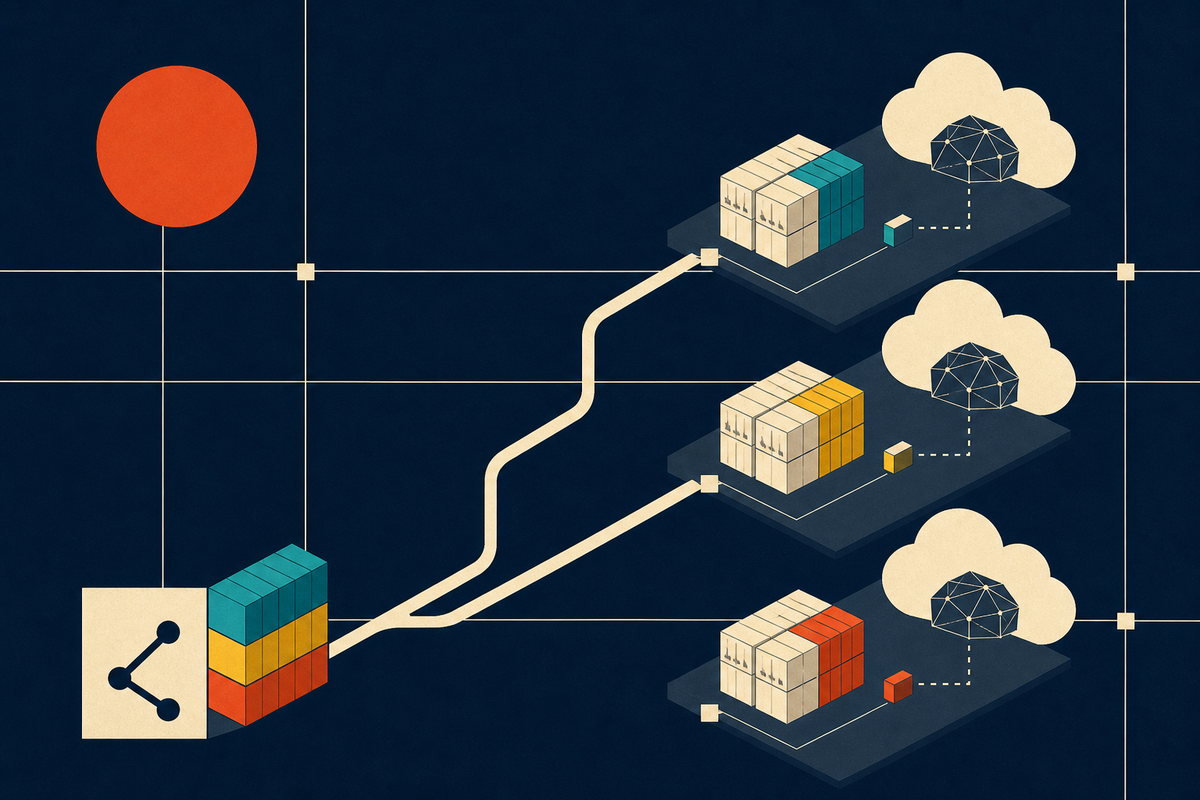
Friday deployment anxiety is a peculiar feature of the software economy. A change can look fine on a laptop, pass a test suite and behave in staging, then meet the crowded databases, queues and traffic of production and discover a new personality. Upsun built its identity around that moment. The company, known as Platform.sh until September 2025, gives a Git branch an isolated copy of the application stack - code, services, configuration and, when permitted, production data. The branch becomes a rehearsal room before opening night.
This sounds like a feature because developers experience it as one. It is also the organizing principle of a much larger business. Upsun manages builds, containers, databases, routes, certificates, backups, metrics, security patching and deployment across public clouds. The customer supplies an application and describes its needs in version-controlled configuration. Upsun supplies the operational machinery that turns those instructions into a running system.
The product is the missing afternoon
Cloud infrastructure is usually sold as abundance: more services, knobs, regions and architectural freedom. For a development team, abundance arrives with an assembly bill. Someone must connect the deployment pipeline to compute, databases, networking, secrets, logging, access control and incident response. Those connections keep changing. The hidden competitor to Upsun is therefore less a single vendor than a stack of tools plus the people required to keep them friendly.
Upsun's promise is time returned. Push a branch and the platform builds it, provisions its dependencies and creates a URL. Merge it and the same workflow promotes the change. Teams can use PHP, Python, Node.js, Java, .NET, Go, Ruby and other runtimes, with frameworks ranging from Symfony and Drupal to Django, WordPress, Magento and modern JavaScript stacks. The platform does not tell a retailer what storefront to build or a university which content system to choose. It standardizes how that software reaches the cloud.
“We give you your time back.”Upsun's compact version of the sales pitch
A company with three names
The lineage explains the product. Frédéric Plais, Damien Tournoud and Ori Pekelman began Commerce Guys in 2009, serving ecommerce and content-heavy Drupal projects. These were awkward workloads: large catalogs, active carts, complicated databases and websites that could not treat production as a casual laboratory. Their infrastructure work became Platform.sh, spun out in 2015 around fast cloning of production-grade environments.
The company broadened beyond its PHP and CMS roots. It expanded across major cloud providers, acquired application-profiling company Blackfire in 2021 and launched the more flexible Upsun product in 2023. Platform.sh then adopted Upsun as the unified brand in 2025. Existing plan-based customers moved under the name Upsun Fixed; the granular resource model became Upsun Flex. The rename tracked an expanding job, from hosting content and commerce to managing the application lifecycle for conventional and AI-assisted teams.
The customer list makes the breadth legible: Adobe and Pinterest, UNICEF and the YMCA, universities, banks, agencies, retailers and public-sector organizations. These groups share little at the surface. Underneath, each operates custom applications that need frequent changes, controlled access, predictable performance and somebody awake when a release goes sideways.
Portable, with an asterisk worth reading
Upsun runs applications in regions supplied by AWS, Microsoft Azure, Google Cloud, IBM Cloud and OVHcloud. The same declarative application configuration and delivery workflow can be used across them. That helps organizations place data in a suitable jurisdiction, buy through an existing cloud marketplace commitment or prepare a credible route away from one provider.
The useful distinction is between portability and simultaneity. Upsun does not claim that an ordinary project automatically fails over between every cloud. Moving a stateful application still requires planning and data migration. What the platform removes is the need to redesign its operating model for a new provider. The application definition, deployment pipeline and developer experience stay familiar. A crisis plan is easier when the team is not learning a second control plane during the crisis.
That places the company between several markets. Heroku, Render, Fly.io and similar PaaS vendors sell developer convenience. Vercel and Netlify excel at front-end workflows. Pantheon, Acquia and Amazee.io specialize in content systems. AWS, Azure and Google Cloud sell the raw universe. Self-managed Kubernetes offers control in exchange for operational appetite. Upsun's lane is a polyglot, enterprise-ready platform for teams that want custom software and cloud choice without making infrastructure assembly their main craft.
How the meter runs
Flex customers pay a project fee, user licenses and the resources they provision: CPU, memory, storage, backups and bandwidth. Resources can be sized per application or service and adjusted vertically or horizontally. Fixed customers choose predefined plans. Support levels, uptime commitments, advanced identity controls, compliance options and hands-on application services add to the bill; larger customers can negotiate committed spend.
This is provision-based pricing rather than a bill for every instant of measured CPU activity. That difference matters. Engineers can see what they allocated and finance teams can estimate the next invoice. Preview environments pause after inactivity, reducing active compute charges while preserving storage. The company also offers a 3 percent credit in six eligible greener regions - a small incentive that turns carbon intensity into a deployment variable instead of a paragraph in a sustainability report.
The unglamorous moat
Managed platforms are easiest to appreciate when something boring goes correctly. Certificates renew. A database backup exists. Security patches arrive. A noisy branch cannot knock over production. Metrics and logs are already attached when an engineer investigates. Upsun folds these duties into a shared platform layer, with SOC 2 Type 2, PCI Level 1 and ISO 27001 controls available for organizations that need evidence alongside assurances.
Blackfire strengthened that layer. Founded by Symfony creator Fabien Potencier, the profiler helps teams find expensive functions and trace slow requests. Platform.sh bought the company in 2021, putting performance analysis beside hosting rather than leaving customers to stitch together another account and agent. Potencier now serves as Upsun's chief product and technology officer.
The company itself operates as a remote organization across 43 countries, with follow-the-sun support baked into the brand story. “Up” evokes uptime and forward motion; “sun” refers to global coverage and the productive hours between sunrise and sunset. It is an unusually sunny name for a business that spends its days thinking about failure domains.
When robots join the deployment queue
Upsun's latest expansion follows a simple observation: AI tools can create more code without creating more organizational certainty. More pull requests still need architecture, review, test data, access controls, budgets and an audit trail. An agent that can open ten branches in an afternoon makes isolated, disposable environments more valuable, but it can also create ten new places to lose context.
The company has released an MCP server that lets compatible AI tools call platform functions through a controlled interface. In June 2026 it announced Upsun Dispatch in prerelease, framing the product as a coordination layer for human and agent work across the software-development lifecycle. The details will evolve. The direction is clear: Upsun wants the platform to carry the shared context that a coding assistant lacks - what an application needs, where it may run, which checks matter and who can approve the result.
Faster typing did not abolish deployment. It made the queue after typing easier to see.
Who should use it
Upsun makes the most sense when an application is custom enough to outgrow a turnkey SaaS product, important enough to need repeatable controls and varied enough that a framework-specific host feels narrow. An ecommerce team can test a million-item catalog without sharing staging. A university can standardize dozens of Drupal, WordPress and PHP sites. A regulated company can keep access and deployment records consistent across regions. An agency can give clients the same delivery playbook without building a fresh platform for each engagement.
The agency channel is important because many organizations do not employ the team that builds their public applications. Upsun maintains a tiered partner program for digital agencies, while technology relationships around Pimcore and Shopware put the platform beneath specialized commerce and content work. Cloud partnerships do a different job: AWS, Azure, Google Cloud, IBM and OVHcloud supply the regional infrastructure and marketplaces. Upsun sits between those providers and the implementation teams, turning a collection of commercial relationships into one operating experience for the customer.
A tiny static site may not need this much machinery. A company determined to own every Kubernetes primitive may prefer to build. Upsun wins when the alternative platform work is necessary but undifferentiating - the afternoon lost to a certificate, the release delayed by a shared test environment, the second cloud that becomes a six-month migration program.
The company's lasting insight predates its newest name: confidence can be designed into the path to production. Clone the whole stack, keep infrastructure beside code, make the steps repeatable and let specialists operate the substrate. The cloud remains complicated. Upsun's business is deciding how much of that complication a product team should ever have to meet.