The most revealing Pulumi customer story begins with an attempt to stop paying Pulumi. In 2023, managers at data-platform company Starburst looked at the bill for Pulumi Cloud and chose the familiar remedy: bring the state backend in-house. The team moved to Amazon S3. On paper, the replacement was cheaper. In practice, two engineers spent one or two days every week maintaining the substitute and the code around it. Dashboarding, deployment orchestration, security and infrastructure analytics had not vanished. They had merely become someone else's chores.
Starburst reversed the decision and returned to Pulumi Cloud. It is a neat little business-school case disguised as an engineering postmortem. The first thing to fail was not the infrastructure engine. Starburst kept using Pulumi's open-source code. What failed was the assumption that managed state was the whole product. Once the team priced the human wrapper around state, the commercial platform looked different.
“When we did it with Terraform, it took two weeks. Now we do it in about three hours.”Matt Stephenson, Starburst senior principal software engineer
01 / The original provocationWhy should the cloud require a second language?
Pulumi was founded in Seattle in 2017 by Joe Duffy and Eric Rudder, two Microsoft veterans with a taste for developer platforms and programming languages. Their provocation was easy to explain: application code lives in TypeScript, Python, Go, C# or Java, but infrastructure had been pushed into templates and configuration dialects. Why make engineers cross that border every time they need a database, Kubernetes cluster or identity policy?
The pair built an open-source deployment engine and software development kits that expose cloud resources as programmable objects. A team can use loops, functions, packages, types, tests, IDE completion and code review habits it already understands. Pulumi still records desired state and previews changes like other infrastructure-as-code systems; the novelty is that the program creating that desired state is real software. The company launched the open-source platform in 2018, followed by its hosted service, and declared a purpose that is less ornate than most mission statements: “to democratize the cloud for every engineer.”
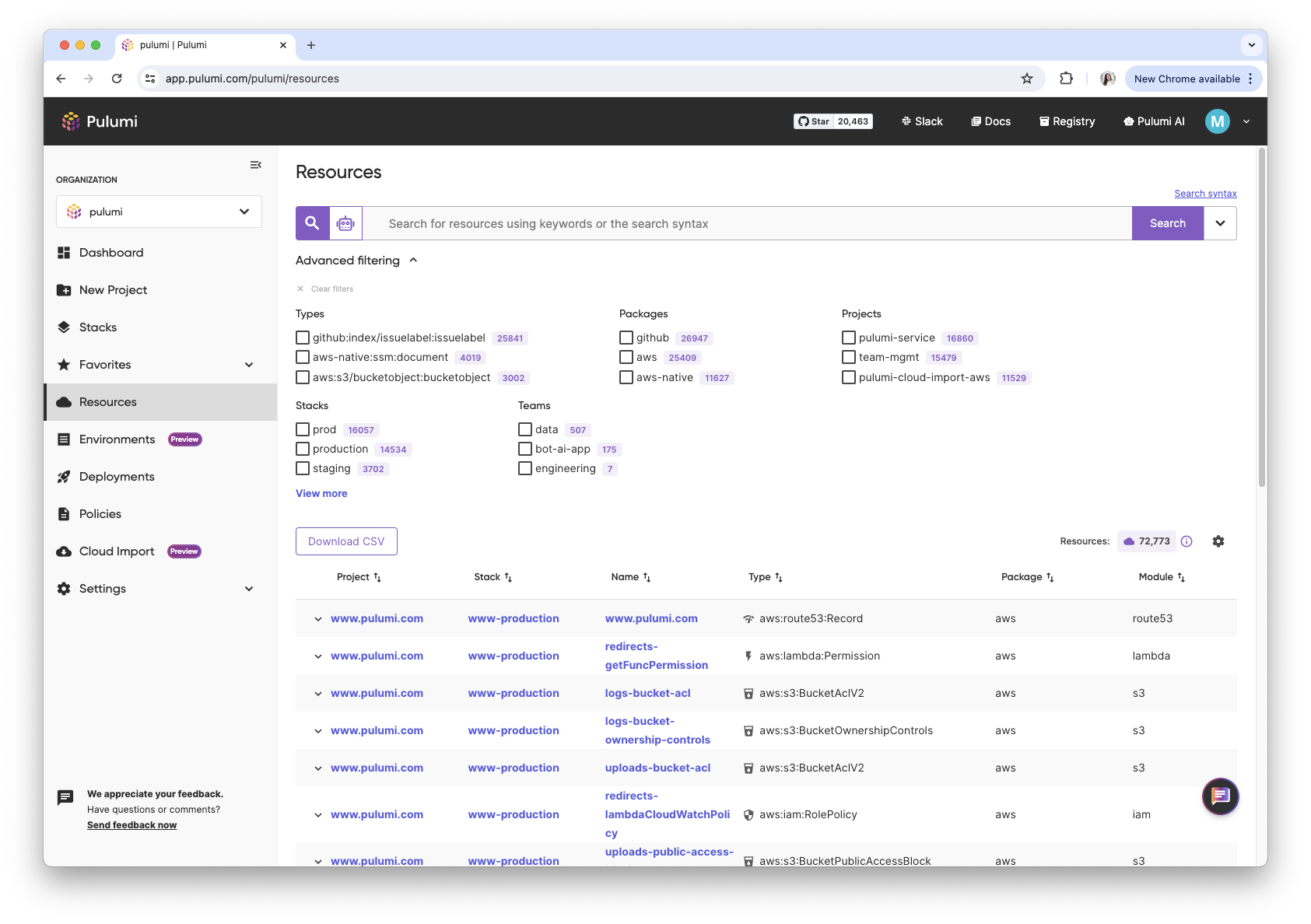
That language choice is Pulumi's wedge, but it is not the whole company. Pulumi IaC is the open-source engine and SDK. Pulumi Cloud manages state, history, access and collaboration. Deployments runs cloud changes as managed workflows. ESC handles environments, secrets and dynamic credentials. Insights searches and analyzes cloud resources. Policy as Code puts guardrails before deployment. IDP gives platform teams a way to publish approved, self-service building blocks. Neo, introduced in 2025, is an AI agent for code review, troubleshooting, policy remediation and routine infrastructure work.
02 / The numbers that matterWeeks disappear when the abstraction is right
Infrastructure tooling is unusually vulnerable to impressive demos and unmeasured migrations. Pulumi's better evidence comes from customers that published before-and-after numbers. Starburst's multi-region blue-green deployment fell from two weeks with Terraform to three hours with Pulumi, a reported 112-fold acceleration. The improvement came from automating orchestration that had previously depended on manually executed glue scripts, not from typing braces faster.
Learning Machine's results are just as instructive. Its new-customer provisioning went from as long as three weeks to one hour. Configuration shrank by 50 times, while a move toward ECS, Fargate and Lambda helped reduce AWS charges by 67 percent. Panther Labs ported more than 500 AWS resources as a benchmark before adopting Pulumi. It reported fresh deployments four times faster than CloudFormation, simple changes more than ten times faster and an infrastructure codebase cut by more than half.
These figures are customer case studies, not controlled lab experiments. They describe particular systems and teams. Yet the pattern is coherent: Pulumi pays off when a repeated cloud workflow can be expressed once as a component and reused. BMW manages more than 20,000 resources with Python-based infrastructure. Supabase has described 80,000 Pulumi resources across 16 regions. Wiz uses the Automation API and Go SDK across more than a million cloud resources, with hundreds of thousands of infrastructure updates a day. The product is most interesting after a stack stops being a stack and becomes a fleet.

03 / The business hiding behind free codeThe invoice is for the wrapper
Pulumi's business model is open-core SaaS. Individuals can use the hosted service free, with the open-source engine available under Apache 2.0. As of September 2026, the Team plan begins at $40 a month and Enterprise at $400. Each includes credits, then meters resources, managed secrets, discovered resources, workflow minutes and Neo tokens. Business Critical pricing is negotiated and adds controls such as self-hosting, compliance packs, audit export and higher-touch support.
The metering matters. Pulumi is not charging merely for accounts or a prettier console; it increasingly prices the activity moving through the platform. One Team credit equals one dollar, and the current list price includes usage rates for infrastructure resources, secrets, discovery, workflow time and AI tokens. Buyers must compare that bill with both competing platforms and the labor required to operate an internal one. Starburst's boomerang supplies Pulumi's favorite answer, but every company should run its own arithmetic.
The market is crowded. Terraform and its hosted sibling remain the obvious reference point, while OpenTofu offers an open-source fork. AWS CDK and CloudFormation suit AWS-centered shops; Azure Bicep occupies a similar cloud-native lane; Crossplane appeals to Kubernetes-native platform teams. Spacelift and env0 compete in orchestration and governance. Pulumi's distinction is the combination of a multi-cloud engine, general-purpose languages and an integrated management layer. It supports more than 200 providers and can mix cloud and SaaS resources in one program.
04 / A challenger learns compatibilityEven Pulumi no longer wants a language war
By 2026, Pulumi's competitive posture had become more pragmatic. It added first-class HCL, a Terraform and OpenTofu state backend, native Terraform module support and tools for discovering CloudFormation and Azure Resource Manager stacks. The company that once asked engineers to leave configuration languages behind now meets a Terraform estate where it lives. That is not a retreat from real code. It is an admission that enterprise infrastructure arrives with history.
The same pragmatism shapes Neo. AI can explain a preview, review infrastructure code, search resources and propose a fix, but cloud changes still pass through state, policy, identity and audit systems. Pulumi's advantage is not that a language model can produce TypeScript. Many models can. The advantage, if it holds, is that the agent operates inside a graph of actual infrastructure with a deployment engine and governance layer beneath it. In August 2026 the company extended that argument with a Context API for graph queries and Neo Security for tracing cloud attack paths.
The product began as a better way to write infrastructure. The company grew by owning what happens before, during and after the write.
05 / The useful copyRun a pilot that can lose
A team considering Pulumi should copy Panther Labs, not a launch video. Port a bounded but meaningful slice of infrastructure. Measure fresh deployment time, update time, teardown time, code volume and the number of manual steps. Build one component that combines the resources developers repeatedly request. Put it behind a pull request and a policy check. Then count the maintenance hours for state, access, secrets, audit, drift and CI. The point is to let the incumbent win if it is already good enough.
A four-move Pulumi trial
- Choose one repeated, painful deployment - not the whole estate.
- Port enough real resources to expose provider and state edge cases.
- Package the working pattern once, with tests and policy attached.
- Compare cycle time and weekly ownership cost, not line count alone.
The approach is less convincing for a tiny static environment, a team perfectly served by its cloud's native templates or an organization without developers ready to own shared libraries. General-purpose languages allow powerful abstractions, but a clever abstraction can conceal blast radius as effectively as it removes boilerplate. Teams without review discipline, testing habits or a platform owner may trade verbose configuration for elegant confusion. Migration also has a cost; mature Terraform modules, policies and operator knowledge do not become worthless because TypeScript feels familiar.
Pulumi reported more than 150,000 community users, 2,000 cloud customers and use at more than half the Fortune 50 when it raised a $41 million Series C in 2023. Its stated total then was $99 million in funding. The company had passed 100 employees and now appears to be roughly 130 people. The customer roster ranges from Atlassian and Snowflake to Mercedes-Benz R&D, Lemonade, Supabase and Wiz. These are signals of reach, not proof that every infrastructure team should switch.
The better proof remains smaller and more human: an S3 bucket that looked like a bargain until two engineers began tending it. Pulumi's founding thesis was that cloud infrastructure deserved the conveniences of software. Its commercial thesis is the mirror image. Once infrastructure becomes software, somebody must operate the surrounding system. A platform can send that work back to the vendor, or a company can keep it. The mistake is pretending the work costs nothing.