Before Genefa Murphy made a living persuading people to use technology, she spent three years studying why they do. Her doctoral research at Swansea University examined the adoption of online check-in and self-service kiosks in the airline industry. A kiosk is a humble machine, generally noticed only when it refuses to print a boarding pass. But it stages a remarkably pure encounter between a person and a new idea. The machine offers speed and control. The passenger brings habit, doubt, impatience, and a flight to catch.
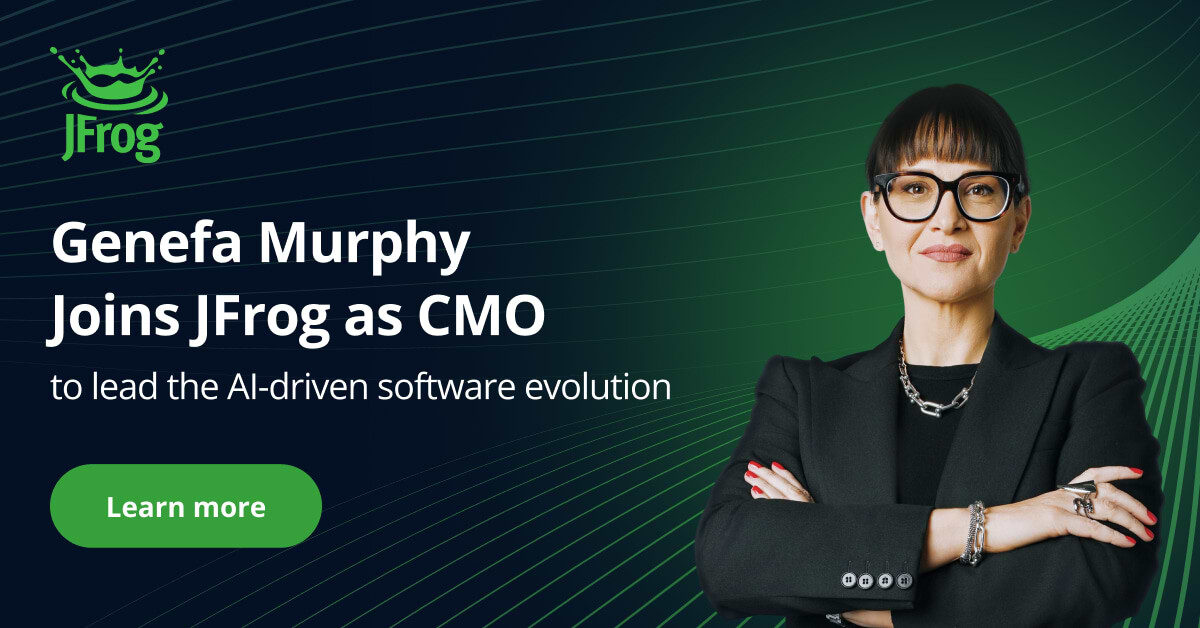
Murphy has been returning to that encounter, in grander and more lucrative forms, throughout her career. She has moved from researcher to consultant, from consultant to product manager, and from product manager to chief marketing officer. She has worked through the Hewlett-Packard family tree, the union of HPE Software and Micro Focus, the cloud contact-center boom at Five9, and the race to turn online courses into enterprise infrastructure at Udemy. In January 2026, she became CMO of JFrog, where the object awaiting adoption is no longer a kiosk. It is a system for managing the packages, models, evidence, and policies behind modern software.
The scale changed. The human hesitation did not.
The doctorate escaped the library
Murphy did not emerge from university with a secret plan to become a marketer. She has said the journey was unplanned. What she did have was a recurring appetite: once she understood a thing in theory, she wanted to touch it. Research led to consulting, where she worked with companies on SAP implementations and the automation of manual processes. Advising people on what to build then produced another itch. She wanted to help decide what the product itself should be.
At HP, product management became her apprenticeship in practical consequence. A feature is not an abstraction when customers have to use it. She worked across product strategy and user experience, took a stint with HP's chief technology office on cloud and mobility ideas, and advanced into go-to-market roles. Marketing entered the story almost as a dare to herself. She kept having interesting conversations with marketers and thought, in essence: let me see if I can do that.
“If you want to be a highly successful marketer, go do a job outside of marketing.”Genefa Murphy
It is advice with the pleasing inconvenience of being expensive. Leaving one's specialty means surrendering fluency, status, and the comfort of knowing the acronyms. Murphy argues that it also gives a marketer the view from product, sales, partners, or customer success. The reward is not variety for its own sake. It is the ability to understand what marketing's internal customers need before the campaign brief arrives.
Her own résumé bears out the argument. She did product marketing, partner marketing, brand, demand generation, communications, and enablement. When HPE's software business combined with Micro Focus in 2017, she went with it. Eventually she ran global marketing and enablement, then became senior vice president and CMO. Her team had to explain a sprawling enterprise-software portfolio while the organization itself was being remade. This was marketing as translation during corporate reconstruction.
A CMO with fingerprints on the product
Technical fluency is sometimes treated as a charming eccentricity in a marketing chief, like keeping a telescope in the office. For Murphy it is closer to operating equipment. Her doctorate drew from computer science, psychology, and sociology. Product management taught her how road maps get argued into existence. Consulting taught her that implementation is where beautiful diagrams acquire human enemies.
That mixture shapes how she talks about customers. At Micro Focus, she described marketing as both the maker of the company's narrative and the carrier of the customer's voice back into the organization. At Five9, which she joined as CMO in 2021, the product sat inside a familiar human drama: someone needs help, calls a company, and hopes the machinery will not make the day worse. Five9 sold cloud contact-center software, but Murphy framed the attraction in terms of people and technology producing a better experience together.
At Udemy, beginning in July 2023, adoption became learning itself. Murphy joined as the company's first executive in a newly created CMO role and later carried the title of chief marketing and content officer. She called herself a relentless lifelong learner. The phrase might have been prepared for a learning-platform press release, except that her career had already spent years proving it. Her enthusiasm was for making instructors, organizations, and learners visible through their stories. A marketplace full of courses is a catalog; the people changed by learning are the plot.
There is a consistent pattern here. Murphy tends to arrive where a product category is trying to become a human proposition. Enterprise software becomes a story about navigating digital change. Contact-center infrastructure becomes the quality of a conversation. Online education becomes the confidence to try a new livelihood. The abstraction needs a pulse before a buyer can care.
Cheerleader, expert, umbrella
Murphy's blunt leadership formulation would not survive a nervous corporate copy desk. A good leader, she says, must be a functional expert, a cheerleader, and a “shit umbrella.” The first knows enough to help without pretending omniscience. The second supplies belief and energy. The third stands between the team and the weather.
“My team's wins are their wins. Anything else, any failures, it's on my shoulders.”Genefa Murphy
The vulgarity does useful work. It rescues psychological safety from the soft cushions of management language and gives it a job description. A team can attempt difficult work when the leader will neither steal the applause nor outsource the blame. Murphy's version of accountability is not the theater of a boss solemnly accepting responsibility after everyone else has already suffered. It is preventive cover: people should know, before the risk, that someone has their back.
Her marketing framework is tidier. FIRE links focus, integrated goals, return on investment, and execution. Its purpose is to stop marketing from becoming fascinated with numbers that only marketing admires. Attention is not the same as commercial movement. Alignment with sales does not require identical perspectives, but it does require shared outcomes and a common account of what happened.
The frameworks share a temperament: energetic but unsentimental. Murphy likes work that gets done and results for which someone is accountable. She protects the early morning for strategy or messaging before meetings colonize the day. She also keeps room for play. Asked to choose a return-to-office soundtrack, she proposed a 1980s compilation that begins with the drum break of Phil Collins and ends with Tom Petty refusing to back down. Corporate culture has endured worse playlists.
The trust stack
JFrog brings Murphy back toward the machinery of building. The company manages software artifacts: the packages and components that move through development pipelines toward release. As AI coding agents make software creation faster and more abundant, that machinery becomes easier to overlook and more dangerous to ignore. An enterprise must know what entered a build, where it came from, which rules it passed, and what changed on the way out.
Murphy's language since joining has centered on trust, control, and discipline. These are sober supporting acts for AI, the flamboyant headliner. They are also adoption conditions. A developer may prize velocity. A security chief needs provenance and policy. A finance leader wants evidence that the new expense produces a return. Marketing has to make one platform legible to all three without sanding it into meaninglessness.
This is where the old kiosk returns. People rarely reject technology because its inventors failed to call it transformative. They reject it because the benefit is obscure, the risk feels personal, or the new ritual is harder than the old one. Murphy's career has placed her on both sides of that exchange: deciding what gets built and deciding how it should be understood.
She has also used her platform beyond the product. At Micro Focus she sponsored the INSPIRE corporate-responsibility program, backed the SHINE women's network, and convened women-in-technology roundtables in Bengaluru and Mumbai. Her argument was concrete: visible role models matter, networks matter, and flexible technology can widen participation. At JFrog she remains a limited partner and go-to-market adviser in the Stage 2 Capital community, extending the operator's view into younger software companies.
A straight-line career is easy to explain and often dull to inhabit. Murphy's line bends whenever understanding gives way to curiosity: learn the theory, advise the customer, build the product, shape the market, then start again in a category with a fresh set of acronyms. She once said she was still learning how to be comfortable with being disliked. That may be the final promotion in leadership, the point at which clarity matters more than universal approval.
For now, her task is to explain why the age of instant code requires a slower virtue. Speed gets software into the world. Trust decides whether anyone sensible lets it stay.