The elevator at Twilio's old Folsom Street office took 11 minutes to rise three floors. Brian Mullen remembers this because beginnings advertise themselves in peculiar details: borrowed Formica desks, one shared conference room, one salesperson, and enough empty space inside a converted candy factory to make ambition echo. He joined in 2011, when the company numbered roughly 30 people. It was an API business whose clean surface rested on a messier physical world of carriers, regulations, routes, countries, and contracts. Mullen's job was to make that hidden world cohere.
The career that followed is usually summarized with titles - head of business development, general manager, CMO, venture partner, CMO again. The titles are accurate and somewhat beside the point. The more revealing thread is his appetite for the work before a playbook exists. He likes the foundation: the partnerships, routes to market, customer signals, and operating connections that let a technical product travel.
Now he runs global marketing and strategic partnerships at Coralogix, spanning brand, demand generation, product marketing, and alliances. Observability can sound forbiddingly abstract. In practice, it is how teams understand what their software is doing from its exhaust - logs, metrics, traces, and the telemetry newly generated by AI systems. Mullen has landed in another market where the visible interface depends upon invisible infrastructure. It is familiar water.
The infrastructure beneath the interface
Twilio's proposition to developers was almost mischievously simple: communications could be called through software. Behind that simplicity, someone still had to negotiate with the telecommunications industry. Mullen helped build what the company called its Super Network. An earlier InfluxData biography credited him with more than 150 global partnerships; his current Coralogix biography puts the figure above 200. He also helped establish Twilio's first teams in Europe, Asia, and Latin America.
This was business development in its architectural sense. Mullen has drawn a distinction between expanding a proven channel and inventing the program itself. The latter attracts him. It is a cycle of proposing, testing, learning, and deciding whether to persist or change direction. Partnership decks may promise inevitability. The actual work is closer to carpentry, with measurement, adjustment, and a worrying number of things that must meet at the right angle.
“It is this creative, figure-it-out-and-go motion that has always captured my interest.”Brian Mullen, on foundational business development
By Twilio's 2016 public offering, the little company with the sluggish elevator had more than one million developers and $300 million in annual revenue. Employees marked the day in shirts printed with “Day One,” the internal phrase that insisted the company was still beginning. Corporate slogans normally expire by lunchtime. This one stayed with Mullen because it named his preferred state: experienced enough to build, unsettled enough to learn.
Around the time he turned 40, he began asking what he believed, what he liked doing, and where he should go next. His answer was to leave a company he enjoyed. In 2017, after a conversation with InfluxData chief executive Evan Kaplan at The Grove on Mission, he joined an open-source database company in San Francisco. The choice was less a rejection of scale than a return to unfinished terrain.
A marketer fluent in trust
InfluxData gave Mullen several vantage points on the same company. He led business development and partnerships, became vice president and general manager of cloud, then served as chief marketing officer. Over more than seven years, he helped take a developer product into a broader commercial story while the InfluxDB community grew past one million developers.
He did not pretend to be one of those developers. In a public essay, he described his Python skills as rudimentary. The admission carries more weight than false fluency. His useful conviction was that developer empathy has to live in a company's DNA. Technical buyers notice when marketing language and product reality occupy different planets. They respond to documentation, community, useful education, and a product that respects their time.
As CMO, he spoke about meeting developers where they were: in their chosen languages, tools, and clouds. InfluxData launched free technical education and took workshops on the road. It also produced scores of presentation videos with engineers and product specialists, choosing a collaborative whiteboard manner over the lacquered solemnity of a corporate broadcast. The subject was database infrastructure; the medium tried to behave like the audience.
A career across the hidden layers
In 2024, Mullen hung up what he called his InfluxDB hoodie and joined Nexus Venture Partners. It was a new position with an old mechanism. He led business development, expanded a network of senior executives, connected portfolio companies with prospective customers and partners, and advised founders on go-to-market decisions. His description was generous in a way that also revealed his temperament: his time was their time, including lessons from both the good calls and the poor ones.
Venture capital placed him one step away from operations, able to see many companies wrestling with similar problems. Yet his next move returned him to an operating seat. At Coralogix, he again owns both marketing and partnerships. The pairing can look broad on an organization chart. In his career, it is practically hereditary.
Read the conditions, then move
Mullen's life on the water predates his technology career. He grew up sailing Lasers in the St. Francis Yacht Club junior program in the early 1990s. From 1995 to 1999 he raced for Cal and captained the university's sailing team. After college, he and his brother Kevin campaigned a J/24 named Blue J, followed by the J/105 Cuchulainn.
Then came a long interruption. Between 2010 and 2017, while his children were young, he largely disappeared from the racing scene. His own account of the return is cheerfully unsentimental: one day he reappeared with two children in elementary school and free time again. In 2017 he bought J/70 sail number 607 and named it Orange You Glad. The new class supplied what his work also seems to require - expertise accompanied by fresh incompetence, enough familiarity to begin and enough uncertainty to stay awake.
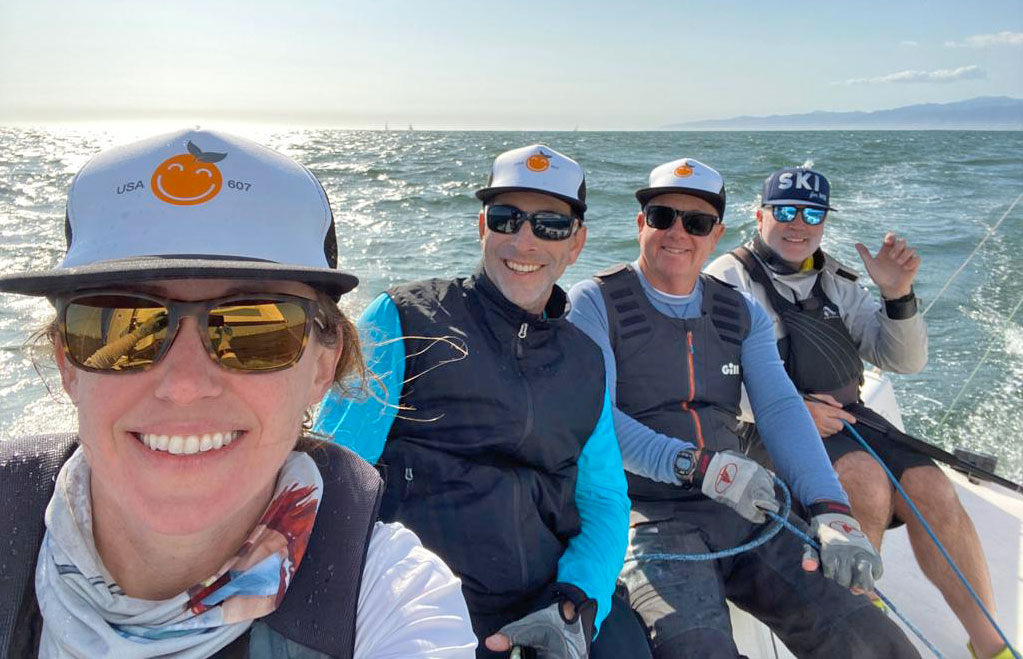
His boats leave a small trail through the public record. A 2005 profile described Brian and Kevin leading a young J/105 crew in San Francisco Bay. In 2017, Orange You Glad placed third in an Express 27 national series. That same year, his instructions for the 67.5-mile Delta Ditch Run included a comic provision: open a beer whenever the boat passes beneath a bridge. Even competition, properly arranged, has room for punctuation.
Sailing analogies are an occupational hazard in business writing, and most deserve to be thrown overboard. This one earns its passage. A skipper cannot negotiate with the wind. The work is to observe conditions, coordinate the crew, and adjust without confusing movement for progress. Mullen's professional language is built from similar verbs. Watch what customers do. Build around their behavior. Preserve the team's capacity to learn.
The title changes. The recurring job is to build the connective tissue that makes the product useful in the world.The pattern across four technology eras
The next flood of data
Coralogix arrives at a convenient bend in that course. AI agents are beginning to write code, operate systems, investigate incidents, and produce their own swelling volume of telemetry. Mullen's current market argument is that agents and engineers need the same complete foundation: full-fidelity data, stored in open formats, available without sampling away the inconvenient parts.
He framed Coralogix's $200 million Series F in June 2026 as the meeting of product reality and market timing. The company says more than 5,000 customers now run petabytes of production data on its platform. For Mullen, the narrative joins two concerns he has carried from earlier roles. The infrastructure must work at scale, and the customer must retain enough agency to trust it.
The same practical instinct appears inside his own marketing operation. When global growth complicated the routing of accounts and leads, his team considered building an agent. Instead, it hired specialists and expanded the relationship over time. Mullen's explanation was plain: experts focused solely on the problem were the better choice. The CMO of an AI observability company did not need every problem to become an internal AI showcase. Good operators are allowed to choose the boring answer.
Mullen's public style tends to preserve a little mischief. He cheers a funding round with “Let's goooo,” compares a colleague's Rome video to an Aaron Sorkin walk-and-talk, and names a racing boat with a dad joke. The levity helps because his subject matter rarely does. Telecom interconnects, time-series databases, and observability architectures can make a bright room feel fluorescent. His contribution is often to locate the human action inside the system: connect, learn, build, begin.
Two decades into his career, Day One is no longer innocence. It is a choice made with a memory of everything that goes wrong after Day Two. Mullen has seen a startup through an IPO, helped an open-source database grow up, advised venture-backed founders, stepped away from racing, and learned a new boat upon returning. At Coralogix, he is back at another starting line. The elevator may be faster now. The interesting work is still on the third floor.