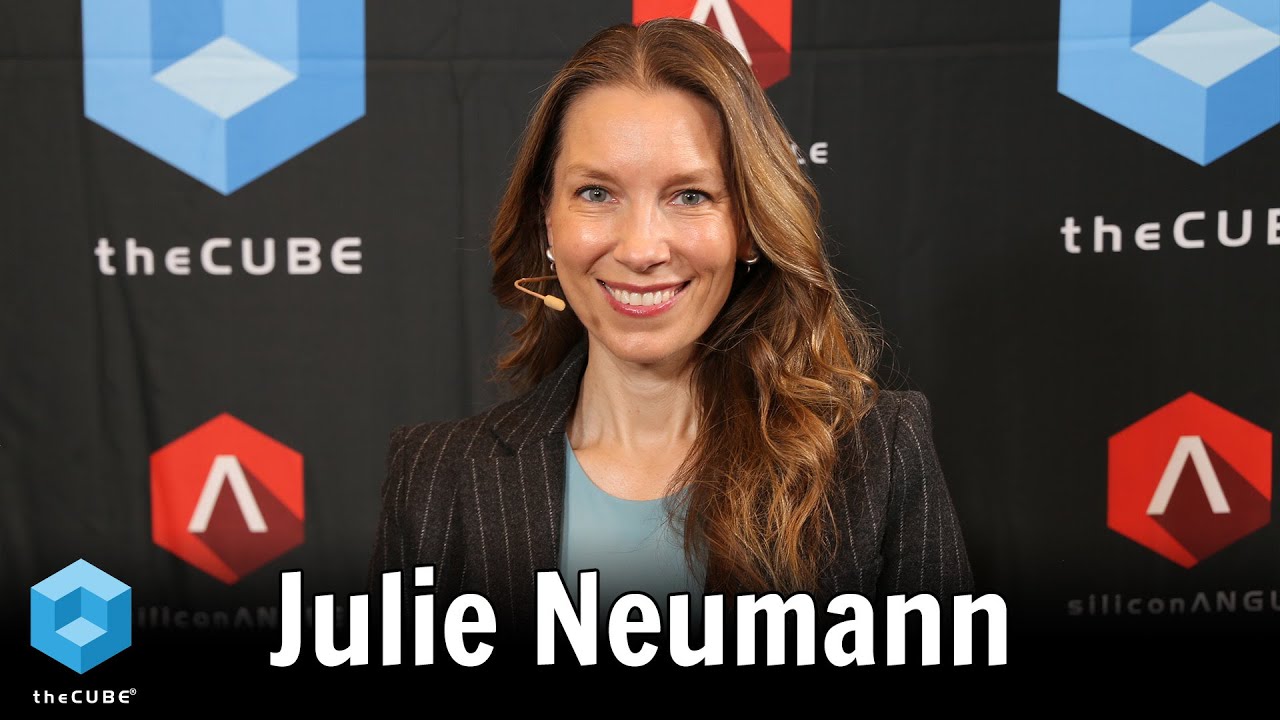
Julie Neumann arrived at observability by way of the sentence. Long before her work involved traces, telemetry and the unruly behavior of AI agents, it involved poems, reported stories and photographs. She edited poetry at Vanderbilt. She earned a graduate degree in journalism in Austin. She worked in a newsroom. Later, at Yahoo, her title was gloriously plain: Storyteller. The nouns changed as her career moved deeper into technology, but the underlying assignment held steady. Look closely. Find the consequential detail. Make it clear enough that another person can act.
Today Neumann is chief marketing officer at Honeycomb, the developer-focused observability company. The domain can sound forbiddingly mechanical: distributed systems emitting high-cardinality data so engineers can investigate what their software is doing in production. Her job is to help that complexity travel between the people who build the product, the engineers who use it and the executives who need to understand why it matters. It is translation with a revenue target.
Neumann has described herself, on an older personal website that preserves the exuberance of early blogging, as a “word nerd, fitness addict, music maven, girl geek.” It reads like a pocket inventory of attention. The site moves cheerfully among marketing work, live-music photography, dogs and Austin life. It also offers an early clue to her professional range: she could care about the frame and the spreadsheet, the concert and the conversion.
“Writing code was never the hard part. How you get code to do what you want it to in production, that is the hard part.”Julie Neumann, AWS re:Invent 2025
The editor enters the machine room
Neumann’s education joined creative writing and economics at Vanderbilt, followed by journalism at the University of Texas at Austin and study in international trade and finance at the London School of Economics. It is an unusually tidy intellectual triangle for a marketing leader: language, incentives and evidence. On campus she worked on the newspaper and literary magazine. She also competed with Vanderbilt’s equestrian team and served as a student coach, a detail that suggests she was never confined to the seminar table.
Her early work kept one foot in publishing. She was an associate editor at the Vanderbilt Register, an editorial consultant, a features editorial assistant at the Austin American-Statesman and a web editor at Offers.com. Then technology companies began giving her larger canvases. At Yahoo, she shaped corporate narratives. At MapMyFitness, she helped turn a vast behavioral dataset into a story about a community. At BigCommerce, she built content marketing for entrepreneurs learning to sell online.
The MapMyFitness project is a miniature of her method. To mark 20 million registered users, Neumann led two data specialists and a designer through a two-week sprint across 15 terabytes of workout data. The aim was not to present the size of the database as a trophy. It was to discover the lively facts hiding inside it, then compose an infographic that let the community recognize itself. Data became memorable only after someone decided which details deserved the frame.
Even one of her stranger credits fits this pattern. Neumann helped with a History Channel segment featuring Lacy dogs, collaborating on the script, finding animals and handlers, preparing an expert and securing locations. She also became, in her telling, the de facto animal trainer. Marketing careers are often written as smooth ladders. Real careers contain dogs who have missed their mark.
A career in finding the useful signal
After BigCommerce, Neumann’s work moved steadily into B2B software. She led marketing at Clearhead and TrustRadius, then brand and corporate marketing at Snow Software. She went on to Testlio, a software testing company, and Sinch, where she led marketing across developer, email and communications businesses. In 2024 she served as interim CMO at Maxio. Each stop added another layer of technical and organizational complexity, the sort that punishes a marketer who has not done the reading.
The translation stack
There were visible wins along the way. CheckingFinder received Finovate Best in Show recognition and a Webby. Yahoo’s Bus Stop Derby made a Clio shortlist. Reimagining Yahoo! Search received a PRSA Silver Anvil. Awards do not explain a career, but these share a recognizable pattern: make a complicated or ordinary system tangible enough that people want to engage with it.
Colleagues have described Neumann as a direct communicator, an empathetic manager and a leader who can alternate between strategy and the workbench. That combination matters in developer marketing. Engineers are practiced detectors of inflated language. Executives still need a clean argument. A useful CMO has to respect both audiences without pretending they speak identically.
The portable playbook
Start with curiosity. Find the evidence. Choose the human consequence. Cut the language until the technical truth and the memorable sentence can occupy the same room.
Why observability needs a storyteller
Neumann joined Honeycomb at the beginning of 2025. Her announcement centered on three things: people, product and opportunity. She was particularly drawn to the company’s role in creating the modern observability category and to the chance to carry its founders’ vision to more engineering teams. Soon after, Honeycomb announced its acquisition of Grit alongside Neumann’s appointment and that of chief revenue officer Matt Nelson. The pairing made the remit clear: technical ambition had to become wider enterprise adoption.
Observability begins with a deceptively simple desire. When a software system does something surprising, its operators should be able to interrogate rich production data without having predicted every possible question in advance. Traditional monitoring watches for known failures. Observability supports exploration, including the awkward unknowns that arrive at 2 a.m. wearing no name badge.
AI makes that promise more urgent. Agents can now write code, invoke tools and make chains of decisions across systems. They add speed and capability, but also behavior that is harder to reconstruct. At AWS re:Invent in 2025, Neumann compared the current shift to the move to cloud at “10X speed.” Her argument was not that speed is undesirable. It was that velocity increases the need for feedback. If code reaches production faster, teams need equally fast ways to learn what it did there.
“How can you trust the speed that AI is giving you? And that’s where observability comes in.”Julie Neumann
This is where her editorial past becomes more than a charming origin story. Reporting and observability share a moral preference for evidence. Both are suspicious of the first tidy explanation. Both become valuable when the world refuses to match the outline. The marketer’s task is to explain this kinship without turning a technical practice into a slogan too smooth to be useful.
The human point of view
Neumann’s latest chapter also unfolds against a marketing problem of its own. Generative tools can produce an astonishing volume of competent copy. She has warned about the “massive distribution of AI slop,” the polished material that fills a feed while saying very little. Her answer appears to be grounded in experiences and points of view that cannot be manufactured by adjusting a prompt. Honeycomb’s O11yCon and smaller observability events put practitioners in rooms where customers, engineers and executives can test ideas against one another.
In 2026 she curated O11yCon’s Culture & Leadership track, while Honeycomb introduced products for observing agent workflows and conducting investigations with AI assistance. She promoted Agent Timeline, Canvas Agent and reusable Canvas Skills as ways to make the decisions of complex systems more legible. The product story and the event story met in the same place: people learning how to operate when neither the software nor the organization can be understood from a static dashboard.
There is a temptation to treat Neumann’s route from poet to CMO as a transformation. It is more interesting as continuity. The poet cares about the exact word. The journalist cares about what happened. The photographer cares about where to point the lens. The operator cares about whether the work changed an outcome. At Honeycomb, those instincts converge around systems that generate nearly limitless evidence and still require judgment to make sense of it.
Her public life retains small reminders that a person exists outside the funnel. There are photographs of music, dogs and open sky. There is the equestrian team. There is an official Honeycomb biography that mentions an Austin home shared with her husband and a “very spoiled dog.” These details do not need to become a leadership framework. Their charm lies in resisting one.
The through line is attention. Neumann has spent a career deciding what to notice and helping other people notice it too. In the AI era, that may be the scarce resource. Code is abundant. Content is abundant. Telemetry is spectacularly abundant. The useful act is still the old editorial one: look into the noise, keep asking questions and return with a fact that changes what someone does next.
Continue exploring