In November 2025, Jaleh Rezaei chose to give up a business that had already cleared a hurdle most startups never reach. Mutiny had eight figures in annual recurring revenue. It had customers, investors and a product people paid to use. She and her co-founder, Nikhil Mathew, decided to reset it anyway.
By the following June, she was describing Mutiny as a company only six or seven months old. The calendar said 2018, the year it was founded. Her operating reality said something else: a smaller team, a new foundation, the need to find out quickly whether the new product deserved a place in customers’ working lives.
The decision makes more sense when you follow the recurring irritation in her career. Rezaei keeps encountering people who know what should happen next, yet cannot make it happen without waiting for someone else. Eventually, she starts examining the machinery that makes them wait.
An engineer discovers a different sort of problem
She was born in Tehran to engineer parents and grew up interested in how things worked. Mechanical engineering at the University of California, Berkeley, seemed a plausible route to NASA. Business entered the picture through a friend’s case studies. Here were problems about competition, products and organizations, with people complicating the equations.
In 2005, she entered Stanford’s management science and engineering program. VMware followed in 2007; later came an MBA at Stanford. The sequence matters because her marketing career grew out of technical training. She had learned to take a system apart before she was asked to persuade anyone to buy one.
At VMware, she worked with enterprise sellers on large deals. Each account warranted research: earnings announcements, press releases, conversations about what the customer needed. The resulting presentations and business cases could speak directly to that organization’s priorities. It was laborious work, with a clear purpose. Somebody had to understand the buyer.
Years later, she would return to that experience when discussing AI. The attractive possibility was preserving that attention while reducing the labor required to deliver it. Technology could bring information scattered across people and documents into the work itself. The point was still the customer at the other end.
The customer who landed on somebody else’s website
Gusto introduced a different set of economics. Rezaei joined in 2013, when it was still a seed-stage company. Its early customers included startup founders. As the business reached restaurants, accountants and lawyers, the website’s original assumptions became awkward. An advertisement could address one audience while the destination page appeared to belong to another.
Her team worked on conversion, signup and onboarding. They would find a blockage, propose a change, have it built and measure the result. The difficulty was capacity. A spreadsheet could contain 200 ideas while only a few would make it into a quarter’s engineering work. Being able to see the problem did not supply the ability to fix it.
Rezaei led marketing and business development during that expansion. Mathew saw the same dependency from the engineering side. The arrangement made important work compete with other important work. Together, they began asking whether the recurring pieces could become a product that other businesses would not have to construct for themselves.
That is a fairly unromantic origin for a startup called Mutiny. No barricades were required. An adequately populated backlog would do.
First, do the work by hand
In May 2018, Rezaei and Mathew spent four hours over dinner at Original Joe’s in San Francisco discussing the company they might build. Family and community entered the conversation alongside rebellion. The agreement was about the place they wanted to create as well as the software.
They joined Y Combinator’s summer batch. Early Mutiny let marketers change website experiences without writing code. For recommendations, Rezaei initially supplied the labor herself: analysis, judgment and copy. Her description of the offer was pleasingly direct.
“So for free, I’ll be your AI.”
Jaleh Rezaei, recalling Mutiny’s early recommendation service
The manual work served a practical purpose. In early customer research, the team attended growth meetings and watched people use the product. That exposed what customers actually did with the information in front of them. By 2022, Mutiny was using GPT-3 for personalized copy and had acquired the AI marketing company Intellipse.
There was room for peculiarities along the way. Raccoons approaching the team’s food during a 2019 camping trip on Angel Island supplied the inspiration for Mutiny’s mascot. An animal with an entrepreneurial attitude toward unattended provisions was a defensible choice.
- 2018Personalize the website
- 2022Recommend and write with AI
- 2026Create work for individual deals
A calendar full of motion
Rezaei’s account of speed includes an admission that will sound familiar to anyone who has maintained a busy marketing calendar. At Gusto, her team spent a year pursuing content about company culture before discovering that small-business customers wanted practical answers to immediate questions. Effort had been plentiful. Useful learning arrived late.
Her response was to insist on earlier contact with the market. A small live experiment could expose a weak assumption before months of preparation made it expensive to abandon. A team needed to know what it had learned recently and which result it was trying to produce.
“You can’t be fast if you don’t know what’s important.”
Jaleh Rezaei, on prioritization
In product discussions, she applied structure to uncertainty. Mutiny’s early team identified five hypotheses that needed to hold for its vision to work, then attached measurable tests. The method allowed iteration within a shared understanding of what the company was trying to prove. Even disorder benefits from having an address.
There is a quieter side to this management philosophy. She recommends monthly reflection because a growing startup changes people’s jobs before they have necessarily changed their habits. Taking time to discuss how someone is operating can build the trust needed for direct feedback. A manager asking for faster execution also has to help people adapt.
She carried a small memory from Gusto into her own company: Josh Reeves interrupting his work to wipe up water from the kitchen floor. Shared responsibility became visible in a few seconds. Rezaei later described communal dinners and a Slack chore bot at Mutiny. Apparently, even rebellion needs someone to do the washing-up.
The cost of keeping the old machine running
Mutiny’s initial approach had earned substantial backing. Its 2022 Series B raised $50 million at a reported $600 million valuation. Those figures describe an earlier financing moment. They help explain why starting again involved giving up something tangible.
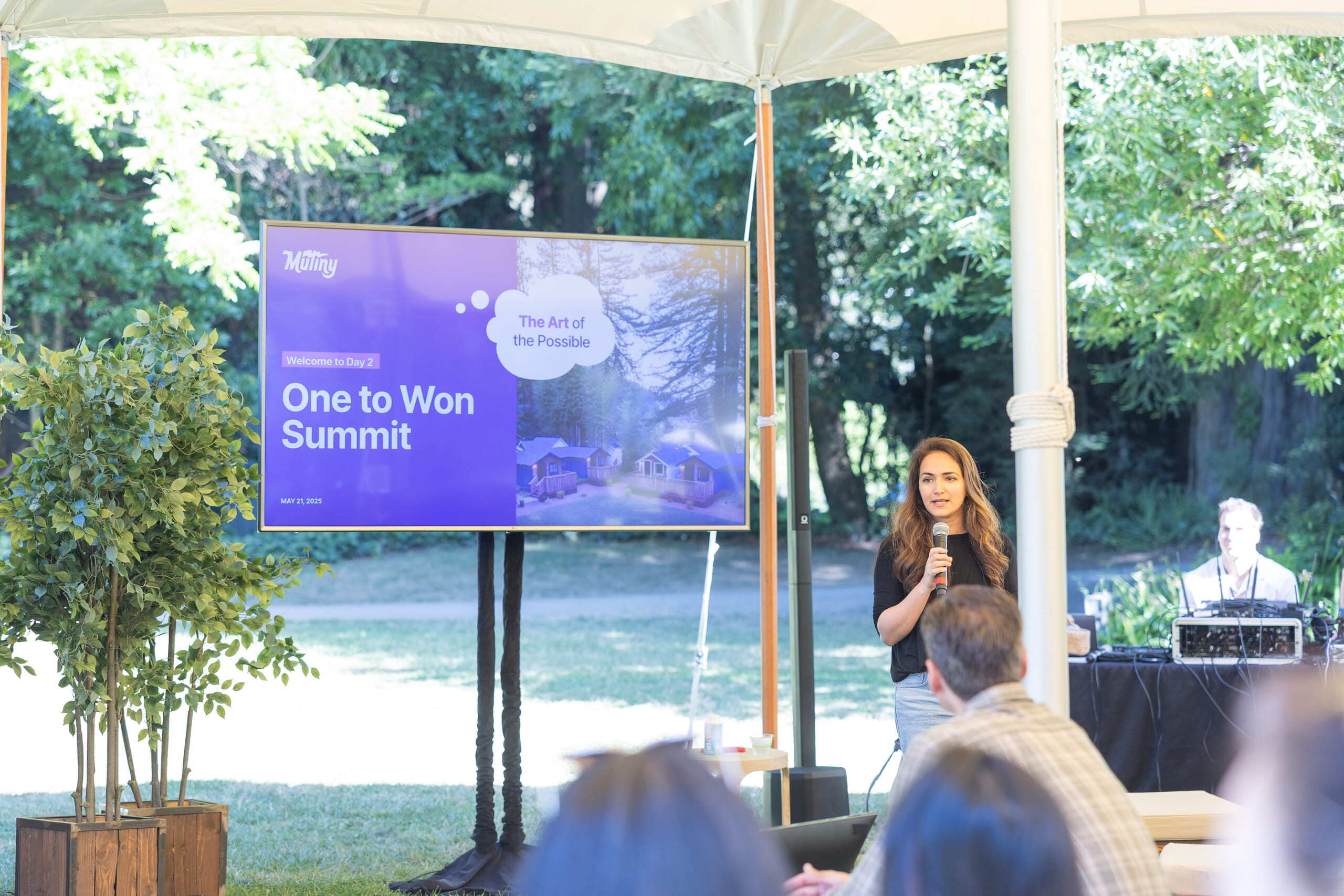
By May 2025, Rezaei was already showing marketing leaders a more individualized buying experience at a gathering at Dawn Ranch in California. But developing AI inside an established software company and rebuilding the company around it would prove to be different undertakings.
Her later account describes the problem with running both businesses at once. A mature software operation brings existing customers, processes and a familiar method of improving interfaces. An agent requires different judgments about the quality of its outcomes. Maintaining both can divide attention precisely when a new product needs concentrated decisions.
The reset came in November 2025. A private preview followed in February, and general availability in April 2026. In an August interview, the launch sequence placed the new product within months of the decision. The years spent building Mutiny had not disappeared. The founders were choosing where to apply them next.
The current product extends into customer-facing work: account research, presentations, deal rooms and other material that helps a seller move a conversation forward. Mutiny’s public launch describes connections to CRM systems, call recordings and other tools, so that the material can draw on the context of a deal.
For Rezaei, the ambition remains recognizable. Give the person closest to a buyer more ability to act. A useful presentation delivered while the conversation is alive has a different value from one arriving after the buyer has moved on.
Send the engineers to sales class
Her recent public updates offer a smaller illustration of the same instinct. She brought in sales educator Nate Nasralla to teach the company how enterprise deals progress. Engineers worked through exercises involving real customers and used Mutiny to build the material a seller would need. Building for sellers became a reason to experience their job.
She has also written about the discomfort of being a software buyer herself: repeated meetings, uncertainty about whom to trust, difficulty establishing what a product actually does well. The person selling a better buying experience still has to endure other people’s buying experiences. It is an effective arrangement for discouraging complacency.
Her story keeps returning to that proximity. Watch the customer work. Try the job. Discover where the handoff fails. The new tools change what can be attempted, but someone still has to notice the wrong assumption.
A business that works can make those assumptions harder to question. Revenue arrives with persuasive arguments for continuity. Rezaei has already accepted the inconvenience of beginning again. Now comes the less theatrical task she has practiced throughout her career: putting something in front of a customer and finding out whether it helps.