A robot can learn to walk. It can learn to jump. Getting it to walk up to something and then jump is another problem entirely. Sriram Somasundaram worked on that awkward interval as a young researcher: the moment when one useful skill must give way to another. Years later, his own career offers an unusually good reason to pay attention to the intervals.
There is the move from an undergraduate laboratory at the University of Southern California to graduate research at Stanford. There is the move from academic machine learning to the founding team of Hebbia. And there is the decision to start Latent with Rishabh Jain, a friend whose introduction required neither a networking event nor a carefully worded email. They met in first-grade homeroom.
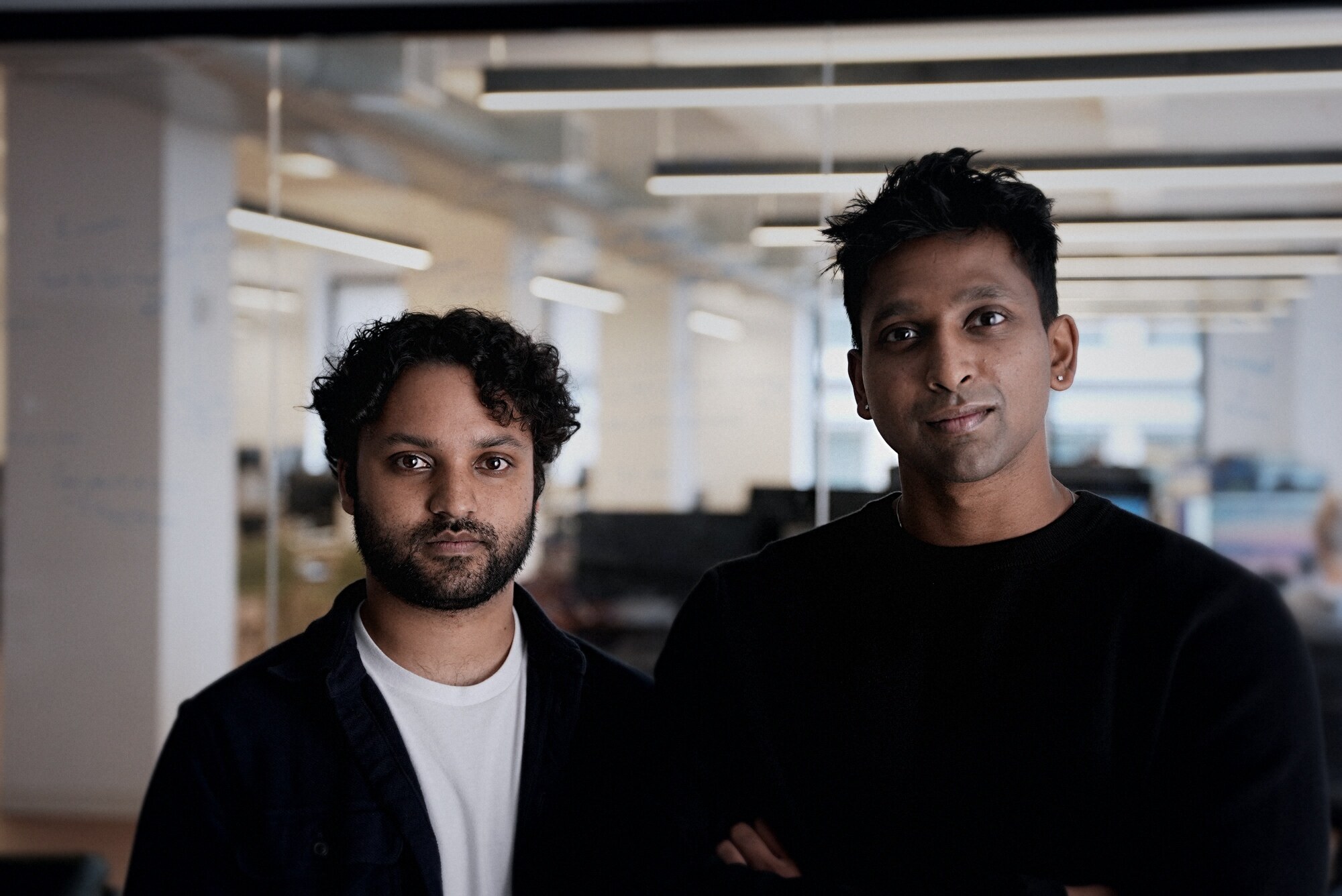
Somasundaram, who also goes by Sri, is now Latent’s co-founder and co-CEO, based in San Francisco. The familiar startup milestones are there: a 2022 founding, Y Combinator’s Winter 2023 batch, an $80 million Series A announced in March 2026. The more revealing details are smaller. They include a restaurant-rating hobby, simulated robots and a New York apartment with very little room for ceremony.
A friendship before the pitch deck
In Somasundaram’s account of Latent’s beginnings, Jain visited his 300-square-foot New York apartment after selling his previous business. The setting deserves its place in the story. Three hundred square feet is a modest amount of space in which to entertain another person, let alone the possibility of a company. The founders brought considerably more shared history than floor space.
He has described Jain as his best friend. Their relationship had already lasted through school and the separate experiences that followed. A prospective co-founder can explain a résumé over coffee. A friend from first grade has seen earlier versions of the person across the table, including versions that would never make it into the résumé.
“I started Latent with my best friend, Rish, who I met in 1st grade homeroom.”
Sri Somasundaram
That history does not answer every question a company will face. It does give this particular partnership a beginning well before incorporation. For a profile of Somasundaram, it is a useful corrective to the temptation to start the clock with a funding round. The business began in 2022. The relationship that helped make it possible was already old.
What the machine saw
At USC, Somasundaram worked in the Cognitive Learning for Vision and Robotics Lab with Joseph J. Lim. One research collaboration produced a paper at the 2018 International Conference on Machine Learning, co-authored with Shao-Hua Sun, Hyeonwoo Noh and Lim. Its subject was learning the underlying program behind a set of demonstration videos.
The everyday analogy is watching someone carry out a task and trying to understand the rule behind the movements. A single recording shows what happened on one occasion. Several recordings can expose the choices: when an action changes, what condition prompted the change, and which parts of the procedure repeat. The researchers sought an explicit program that could represent that logic.
The work used a demonstration encoder, a summarizer and a program decoder. Those names describe a sequence a reader can follow: represent the examples, combine the useful differences, then produce code. In experiments, the team used Karel and ViZDoom environments. The question underneath the machinery was approachable: could a system recover a procedure from watching it happen?
For Somasundaram, this was early work on making learned behavior structured enough to execute and inspect. There is an appealing practicality to that ambition. A system that observes something impressive still has work to do before it can turn the observation into a dependable sequence of actions.
The difficult bit between walking and jumping
The next publication tackled a neighboring difficulty. At ICLR in 2019, Somasundaram was a co-author with Youngwoon Lee, Shao-Hua Sun, Edward Hu and Lim on research into composing complex skills through transition policies. The title is technical. The demonstration is easier to picture: a simulated agent navigating an obstacle course by walking, jumping and crawling.
Knowing the individual motions leaves a coordination problem. The agent must arrive at a state from which its next skill can work. The researchers trained transition policies to connect the pieces, using proximity predictors to help supply the reward for approaching a suitable starting point. Their experiments covered locomotion and robotic-arm tasks.
It is the sort of problem that becomes obvious only after someone states it. Learning several skills does not automatically produce a useful sequence. The project’s examples included an arm tossing and hitting a ball toward a target, and an agent repeatedly walking forward and backward. Even in simulation, competence needed some choreography.
The career analogy is tempting, though it remains an analogy. Somasundaram’s later jobs were different undertakings, with different collaborators and measures of success. Still, those experiments give a concrete view of his early technical interests: how systems move from isolated capabilities to behavior that holds together over time.
A laboratory with a wider doorway
Stanford came next in his education. He studied for a computer science master’s from September 2019 to May 2021, following a USC computer science bachelor’s degree from August 2015 to December 2018. At Stanford Vision Lab, he worked in the People, AI, and Robots group, advised by Fei-Fei Li.
His research interests during those years were reinforcement learning, robotics and machine learning, with an emphasis on enabling machines to acquire complex skills in real-world settings. The wording fits the two conference projects, while extending the ambition beyond a particular simulated task.
At USC, he graduated summa cum laude with a 3.97 grade-point average. Alongside the robotics work, he collaborated on a voice-conversion course project with Andrew Szot, Md Nasir and Arshdeep Singh. The project explored ways to convert audio between male and female voices, including approaches using audio spectrograms. It was another setting in which the raw material was familiar to a human listener, while the computational problem demanded careful choices about how to represent it.
His working environments already included commercial engineering. Riot Games, Raytheon and Quid appear among his internships. These are quite different places to learn what software is for. The record does not require a grand theory connecting every stop. It does show a young engineer accumulating experience in more than one kind of organization before becoming a founder.
ICML paper on learning programs from videos
ICLR paper on transitions between learned skills
Co-founded Latent with Rishabh Jain
Latent joined Y Combinator’s winter batch
Lunch, with a scoring system
One of the more human entries in that engineering history comes from Quid in 2016. Asked for a fun fact, Somasundaram described a private restaurant-rating project with his brother, inspired by the Food Network. They assessed dishes on three dimensions: creativity, presentation and taste. Dinner, apparently, could accommodate a little peer review.
The same interview described his work connecting an organization-description pipeline to an outside provider. It involved removing technical debt and learning across the stack: servers, databases, cloud storage and an interface. This was the unglamorous, connective labor that makes an engineering team useful. He also spoke warmly about colleagues, mutual support and lunch with the other interns.
The restaurant rubric is a lovely detail because it can remain a restaurant rubric. It need not explain his companies or reveal a hidden philosophy. It shows two brothers finding a shared game in a meal, with enough categories to make the discussion interesting. A dish could look wonderful and still have to answer for how it tasted.
From a research result to someone’s working day
At Hebbia, Somasundaram joined the founding team and worked on putting language models into use for large financial institutions. It was a further change of setting: from experiments designed to study machine behavior to software used inside organizations. The buyer, the workflow and the consequences of a failed answer now belonged to an enterprise.
One way to read this move is as a change in the question being asked of the engineer. Academic work needs a well-defined problem and a persuasive experiment. An enterprise application must also fit into a working day. Installation, integration and the experience of using the result acquire their own importance. A useful model has a surrounding life.
By the time he and Jain founded Latent, Somasundaram had worked on both learning systems and the software around them. Y Combinator followed in Winter 2023. In March 2026, Latent announced its Series A, co-led by Spark Capital and Transformation Capital, with participation from Conviction, McKesson Ventures, General Catalyst and Y Combinator.
Series A financing. A company milestone, distinct from any estimate of a founder’s personal wealth.
Funding is an easy place to end a startup story because the number supplies a ready-made flourish. Somasundaram’s earlier work offers a more interesting stopping point. The useful action has to connect to the next useful action. A program must run. A learned motion must lead somewhere. A co-founder must be someone with whom the work can continue.
In his case, that person first appeared in homeroom. The technical education came later.