Before Benjamin Munoz-Cerro had a company to explain, he had a particle detector to build. At the Instituto de Humanidades in Concepción, Chile, he worked on the apparatus with physics teacher Ariel Araneda. It is an appealing place to begin a founder’s story: a student, a teacher, and a device intended to reveal something the eye cannot see. The eventual startup would come later. First came the effort to make an invisible process leave evidence.
Today, Munoz-Cerro is the co-founder and CEO of Velum Labs, which he started with Alen Rubilar-Muñoz. His route passes through Stanford, a Harvard summer laboratory, and research experience in Germany. Those names can make a young career read like a collection of institutional stamps. The detector offers a more useful organizing principle. Here was someone learning to ask a question by building the means to answer it.
A teacher, an apparatus, a departure
Munoz-Cerro graduated from school in 2020. He credits Araneda with sustained guidance and describes the school laboratory as an important part of his scientific education. Rocketry workshops and mathematics competitions also belonged to those years. He had begun preparing for an overseas university application while still in seventh grade; by eighth grade, studying in the United States was already a goal.
That is a long runway for a departure. The university application arrived after years of preparation, rather than appearing as a sudden decision at the end of school. There is something useful about that order. Ambition had practical work attached to it: competitions, projects, an application process. A distant destination gradually acquired a set of tasks close enough to do.
His later description of company leadership returns to the same laboratory habits: forming hypotheses, experimenting, and reporting results. He described it as carrying the scientific method into industry. The phrase makes a modest promise. An idea still has to survive a test, however impressive the person presenting it sounds.
“El método científico trasladado a la industria.”
Benjamin Muñoz-Cerro, reflecting on the school lab’s influence
Yttrium hexaboride before the pitch deck
Stanford became the next setting. His studies included physics and mathematics; the university’s physics department has a student profile bearing his name. In 2023, he joined Harvard’s summer research program, where the work had the pleasing specificity that the phrase “technical background” tends to erase. His project concerned the growth and characterization of yttrium hexaboride thin films.
The compound is written YB6. Even the name makes a startup pitch sound conversational. Munoz-Cerro’s listed mentors were Jenny Hoffman, Anjolaoluwa Bamtefa, and Jason Hoffman. On August 3, Harvard’s REU symposium scheduled his presentation on the characterization of those films for 10:30 in the morning. A career contains moments like this: a material, a question, a slot on a program, and findings to explain.
Growth and characterization of yttrium hexaboride thin films.
Harvard summer research, 2023.
His name also appears among Stanford summer interns in the Max Planck Institute for the Physics of Complex Systems’ scientific report covering 2021 to 2024. Put alongside the Harvard project, that entry gives the early career some texture. Before running a company, he had already worked in environments organized around research questions, with other people responsible for challenging the answers.
The friend arrived before the business
Alen Rubilar-Muñoz entered the story in 2020, through EducationUSA, a program helping students apply to universities in the United States. The two were completing school in Chile. Munoz-Cerro would go to Stanford; Rubilar-Muñoz would study at Minerva. Their connection began around an application process, years before Velum was founded.
That history matters because a co-founder relationship asks people to share far more than an idea. There are decisions, revisions, and the question of whether to keep going together when the work changes. Munoz-Cerro calls Alen his best friend. The company sits inside a relationship that already had time behind it.
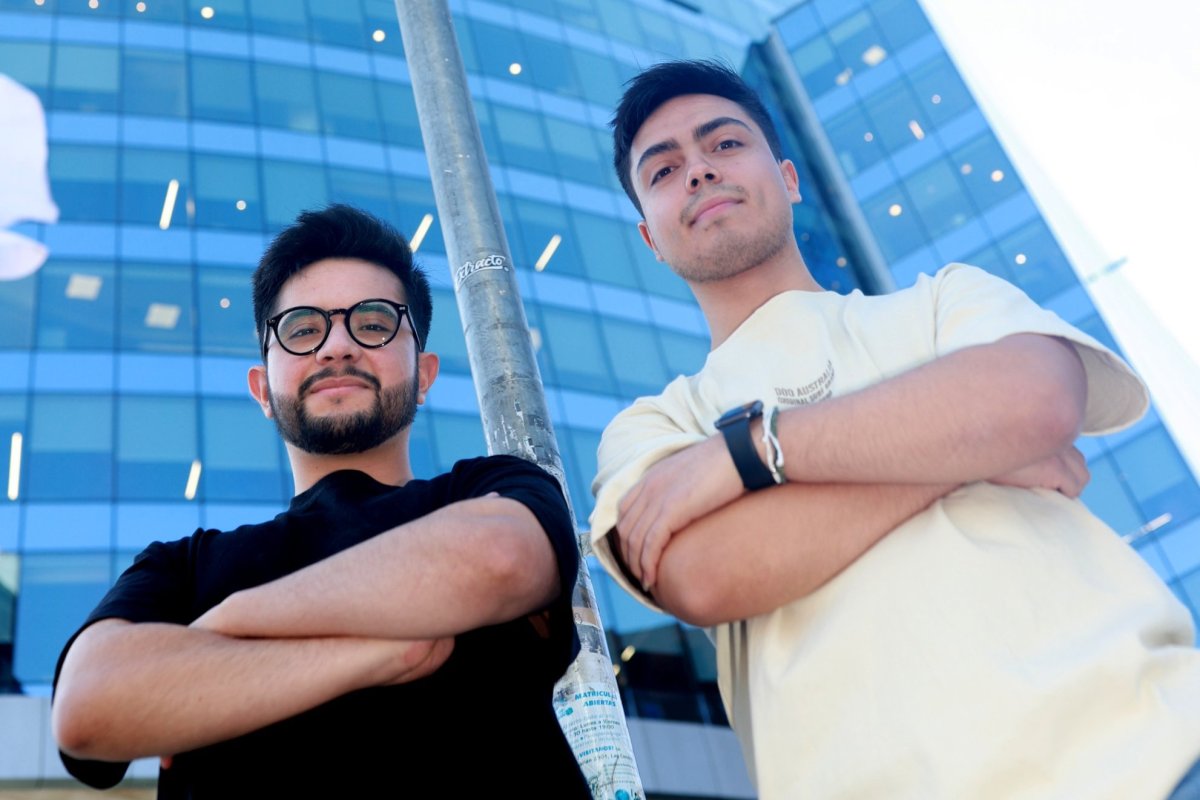
They founded Velum in 2025. A Stanford residence provided the setting for working on the startup together. Later came acceptance into Y Combinator. Its current company directory places Velum in Winter 2026 and names Aaron Epstein as its primary partner. The accelerator supplies a recognizable milestone; the longer friendship explains who was standing beside Munoz-Cerro when it arrived.
Meets Alen through EducationUSA
Harvard summer research
Co-founds Velum Labs
First, make the information private
Velum’s early public ambition concerned privacy in artificial intelligence. The founders wanted useful computation to take place while information remained encrypted. For a company holding confidential financial or legal material, the appeal is straightforward: using a model should not require casually exposing the material to everyone involved in processing it.
Fully homomorphic encryption was central to that early description. The technical ambition was to support operations on encrypted data, rather than making privacy depend entirely on the promises of whoever operated a system. Munoz-Cerro’s April 2026 alumni interview still described this direction, including the goal that only the user should be able to read the answer.
It is a revealing early problem for a physicist to choose. The proposal asks for a property that holds inside the mechanism. A policy can be written in reassuring language; an engineered constraint asks what the system actually permits. That distinction helps explain the intellectual appeal of the project, without treating an early ambition as a finished commercial result.
Then, make the numbers dependable
A later description of Velum centered on data quality. In that version, the company aimed to monitor and enforce standards across a business’s data systems before unreliable information reached its dashboards. The setting had changed from encrypted computation to the everyday machinery behind business reporting. The cost of an error could be a meeting in which two people brought incompatible numbers.
Munoz-Cerro described leaving his Stanford physics degree to pursue this work. “I dropped out of a physics degree at Stanford to work on data quality,” he wrote. It is an unusually direct statement of the trade: a course of study gave way to a company problem he wanted to pursue.
The temptation is to make that decision into a general rule for ambitious students. His story offers no such instruction. It records one person’s choice, with a research education already behind him and a co-founder beside him. The laboratory experience remains part of the biography even after the student stops following the degree’s timetable.
Now, choose the model for the task
As of October 15, 2026, Velum’s homepage presents RouteKit. It describes software that sits on a user’s machine, pools available compute, and directs coding tasks to an appropriate model. Evaluations run against the user’s own repository. The question has moved again: which model should do a particular piece of work, on the code that actually matters to its user?
The proposition is concrete enough to picture. A repository becomes the testing ground. Instead of choosing entirely by a general ranking, a team can look at performance on its own work. The company is presenting a way to connect model selection to local evidence. Whether a tool proves useful rests on what happens when people use it.
Privacy, data quality, and model routing belong to different chapters of Velum’s public story. Reading them in sequence preserves the movement of an early company. Munoz-Cerro’s background supplies continuity without requiring each chapter to have the same product. The recurring interest, as this career suggests, is in the machinery beneath a result: who can see it, whether it is dependable, and how to test it.
His work also has a public code trail. On GitHub, he uses the name benjamzc and describes his background as physics and mathematics at Stanford. A pinned repository belongs to OpenDacs’ DAC-ADC project, written in C++. It is a small, concrete addition to the biography: another technical object alongside the institutional names. There is a social trail, too. Fellow founder Alfonso Rojas Anfossi has written about appearing with him at a talk on their experiences building companies in the Bay Area and Chile. Munoz-Cerro’s career crosses those places through people as well as institutions.
Leave room for Borges
There is another introduction to Munoz-Cerro, written before the CEO title had taken over the biography. In his Harvard summer-program profile, he identified his hometown as Chiguayante, Chile, and listed things he enjoyed outside the lab: tennis, wildlife photography, playing the ukulele, and reading Borges’ short stories.
It is a welcome list. A person with a thin-film research project is allowed a small instrument and a short story. There is no need to turn every leisure interest into a theory of entrepreneurial advantage. Tennis can remain tennis. Borges can remain something to read when the experiment is over.
Those details also make the distance traveled easier to grasp. A student from Chiguayante becomes a researcher in Cambridge and a founder working with a friend he met while preparing to leave Chile. The institutions change. The person keeps a history outside their names.
The school detector remains a good place to leave him. It involved help from a teacher, a question about the physical world, and something built to make an answer visible. Years later, the company and its questions are still changing. The earlier lesson is sturdy enough to travel: give an idea an apparatus, and let the result have its say.