Before Benjamin Muñoz Cerro had a company, he had a box that made invisible things visible. In a school physics laboratory in Chiguayante, a city tucked beside Concepción in southern Chile, he researched and assembled a low-cost cloud chamber. The device reveals the trails left by charged particles, those ghostly scratches of matter passing through ordinary air. It was a serious instrument built by a teenager with the guidance of his teacher, Ariel Araneda. It was also, in retrospect, an unusually tidy prologue.
Muñoz Cerro has spent much of his young career looking for signals in places where the naked eye sees very little. First came particle tracks. Then the behavior of quantum materials. Later came damaged data pipelines and the uncertain performance of artificial-intelligence models. The apparatus changes. The instinct does not: build something that can expose what is really happening.
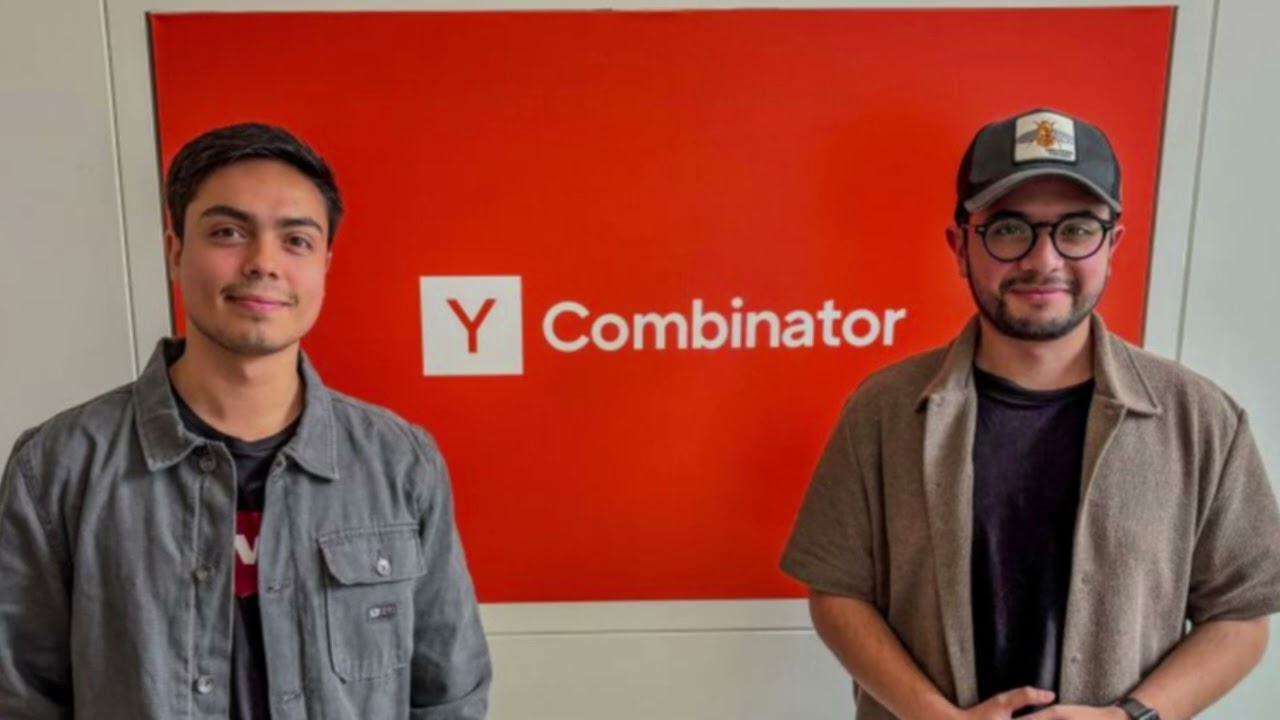
At 23, he is the co-founder and chief executive of Velum Labs, a two-person San Francisco company in Y Combinator's Winter 2026 batch. His co-founder, Alen Rubilar-Muñoz, is also an old collaborator. They were building together before either had a startup vocabulary for it. The company has already described itself in several ways in public, and that shifting record is more illuminating than a perfectly sanded origin myth. Muñoz Cerro is not staging certainty. He is running trials.
Anxiety, converted into apparatus
The future arrived early in Muñoz Cerro's thinking. He has said that he began preparing to apply to a university abroad in seventh grade. By eighth grade, the destination in his mind was the United States. He entered mathematics olympiads organized by the University of Concepción and kept returning to the science workshop at the Instituto de Humanidades Alfredo Silva Santiago. There, Araneda helped turn broad curiosity into the narrower, more productive discomfort of a question that can be tested.
His teachers noticed the velocity. They told him he seemed anxious about what came next. Muñoz Cerro's reply, years later, was candid: yes, he was anxious, but he learned to convert that anxiety into action. He searched for opportunities rather than waiting for them to introduce themselves. It is a revealing bit of self-knowledge. Ambition can be a fog machine, impressive and impossible to hold. He treated it more like voltage, something useful once wired to a task.
“Science is not only learned, it is lived.”Muñoz Cerro, reflecting on his school laboratory
The projects accumulated. In 2020, Muñoz Cerro, Rubilar-Muñoz, Martina Novajas and Gabriela Oyarzún formed The Boring Team, with Araneda as their guide. The name was dry; the prototype was not. Their digital totem combined ultraviolet imaging with image processing. It won Samsung and Fundación País Digital's Solve for Tomorrow competition in Chile. The victory mattered, but the cast would matter longer. One teammate would become Muñoz Cerro's co-founder.
A year later, a proposal for low-cost graphene detectors for electron and positron beams made the top 26 projects in CERN's international Beamline for Schools competition. By then Stanford was no longer a distant plan. Muñoz Cerro began undergraduate physics studies there in 2021, arriving with a Luksic Scholarship and a taste for experiments that could be built without a cathedral-sized budget.
Field notebook / six observable events
The education of a measurement addict
At Stanford, physics gave Muñoz Cerro bigger rooms in which to practice the same discipline. A 2023 summer program at Harvard's Center for Integrated Quantum Materials placed him in Jenny Hoffman's orbit, working with Anjolaoluwa Bamtefa and Jason Hoffman on the growth and characterization of yttrium hexaboride thin films. The material, shortened to YB6, belongs to the vocabulary of superconductivity. Muñoz Cerro presented the work at Harvard's research symposium that August.
He also spent time as an undergraduate researcher connected to the Max Planck Institute for the Physics of Complex Systems in Dresden. The institutional itinerary can sound grand when recited quickly: Stanford, Harvard, Max Planck. His own description of off-hours restores the human scale. He played tennis and ukulele, photographed wildlife and read Borges short stories. It is an attractive toolkit for an observer: racquet, camera, instrument, labyrinth.
Borges is a particularly apt companion for someone moving into artificial intelligence. The writer loved mirrors, branching paths and systems that generate more reality than they can comfortably contain. Modern AI offers plenty of all four. Muñoz Cerro approached it with a physicist's suspicion of claims that cannot be measured in the setting where they are supposed to work.
A company with visible revisions
In 2025, Muñoz Cerro announced that he and Rubilar-Muñoz had entered Y Combinator with Velum Labs. The first public thesis centered on privacy: zero-trust infrastructure using fully homomorphic encryption, a technique designed to let systems compute on encrypted information without first exposing it. In an April 2026 interview with his former school, he described the aim as keeping user data encrypted even while a model worked with it.
Another version of Velum soon focused on data quality. Muñoz Cerro wrote that he had left his physics degree at Stanford after hearing data teams describe a punishing routine: broken pipelines, stale dashboards, silent schema changes and, most unsettling, numbers that remained plausible while becoming wrong. The company pitched monitoring and enforcement as infrastructure, with the goal of catching bad data before it reached the dashboard.
The current Velum website offers a third formulation. RouteKit runs locally, pools available compute, sends each coding task to a suitable model and evaluates performance on the user's repository rather than on a public leaderboard. Privacy infrastructure, data quality, model routing: the nouns move around. The durable concern is whether a technical system deserves trust, and whether that trust can be demonstrated rather than advertised.
Velum's public experiment log
A pivot is often treated as a confession, which encourages founders to narrate every revision as the plan all along. Physics offers a kinder and more exacting frame. A hypothesis earns its keep only by surviving evidence. When it does not, changing it is the work. The awkward part is not changing direction. The awkward part is preserving a clean account of what changed and why.
Velum's brisk revisions create open questions about where the company will settle. They also display Muñoz Cerro's stated management philosophy in public. He has called startup leadership the scientific method transferred to industry: formulate, experiment, report. The phrase is modest enough to be useful. No mystique is required. There is just a claim, an instrument and the nerve to look at the reading.
The partnership inside the experiment
The other constant is Rubilar-Muñoz. Muñoz Cerro introduced their Y Combinator news by calling him his best friend and recalling that they had started building together in high school. The Solve for Tomorrow record gives that memory a date and a prototype. Their shared work began not with a pitch deck but with a team of four students trying to make an invisible phenomenon visible to ordinary people.
Muñoz Cerro's advice to younger students returns repeatedly to environment. Stay near laboratories, he has argued, because research teaches project work and creates networks. The person beside you may become a future partner. His biography supplies the footnote. Araneda offered sustained guidance. Harvard mentors widened the apparatus. Rubilar-Muñoz kept building alongside him. Even the most solitary-looking scientific image, the researcher peering at a result, has a crowd just beyond the frame.
In 2026, Muñoz Cerro also began speaking publicly about the bridge between Chile and the Bay Area. He joined a talk in Concepción about building in San Francisco and later shared an invitation to an August gathering for Chilean developers and founders. The theme is consistent with his old message to students: put yourself where the desired future becomes more probable, then help widen the path for the next person.
The company may keep changing its apparatus. Muñoz Cerro's wager is that the habit of honest measurement can remain fixed.A founder's constant
There is a temptation to make his story about escape: out of Chiguayante, out of the classroom, out of physics and into Silicon Valley. The more interesting movement is inward. Each stage tightened a way of thinking. At school, science became something lived. At Stanford and Harvard, measurement became exacting. At Velum, the same instinct became commercial: find the hidden failure, design the detector, see whether anyone needs it badly enough to pay attention.
The cloud chamber remains the right first image. A charged particle passes, indifferent to whether anyone notices. The chamber gives it a trail. Muñoz Cerro's work now concerns different invisible traffic - encrypted information, silent data errors, prompts moving among models, evaluations inside a codebase. Somewhere in that flow is a signal worth seeing. His task is still to build the box that lets the rest of us see it.