The modern front-end developer enjoys a peculiar privilege: being the only participant in the room who can see everything. The browser shows the page. DevTools shows the runtime. The IDE shows the code. The coding agent, eager and capable, sees only what it has been handed. So the developer becomes a bicycle courier for context, pedaling screenshots, selectors, console logs, and explanations between tools that sit inches apart on the same screen.
Quentin Romero Lauro has spent much of his early career studying these little negotiations between people and machines. His subjects have ranged from Pittsburgh makers learning the business side of their craft to engineers trying to understand why a retrieval-augmented generation pipeline produced the wrong answer. The settings changed. The question held: what does the person know that the interface has failed to carry forward?
Radius, the San Francisco company he co-founded with Michael Klikushin, is his most commercial answer so far. It is a browser for developers, designed so coding agents can see, navigate, and act on the workspace from the tabs themselves. The company went through Y Combinator's Fall 2025 batch and has already worn three names - Inspector, Sol, and now Radius. Underneath the costume changes sits a remarkably stable idea. The browser should understand that software is being made inside it.
The first interface was a spreadsheet
Long before San Francisco, Romero Lauro was a computer science student at the University of Pittsburgh with an appetite for building. He operated a Raspberry Pi ecommerce and tutorial site, made a web app that matched student tutors with classmates, taught mathematics and programming, and collected the kind of hackathon prizes that reward turning an idea into something clickable before the coffee cools. He also received Pitt's Nordenberg Leadership Scholarship.
The more consequential turn came through Carnegie Mellon University's Human-Computer Interaction Institute. As an NSF undergraduate research student, and later a research assistant, he worked with makers who were becoming entrepreneurs. Creative work had acquired inventory, pricing, customer records, and the spreadsheet - business software's beige waiting room. His project, “Simplify the Spreadsheet,” explored a mobile interface that could help makers manage product data without flattening the creative reasons they had started.
The work changed the scale at which he looked for product ideas. A tool was no longer merely a bundle of features. It sat inside friendships, anxieties, habits, and uneven levels of confidence. When Romero Lauro later interviewed 11 entrepreneurs and support workers about generative AI, he found adoption happening socially. Owners shared accounts with co-owners, learned side by side, asked trusted people to operate tools on their behalf, and decided together where AI did not belong.
“The design and the deployment of AI tools are not just about how the interface is structured and how the interface looks, but also the community and the context in which it is deployed in.”Quentin Romero Lauro
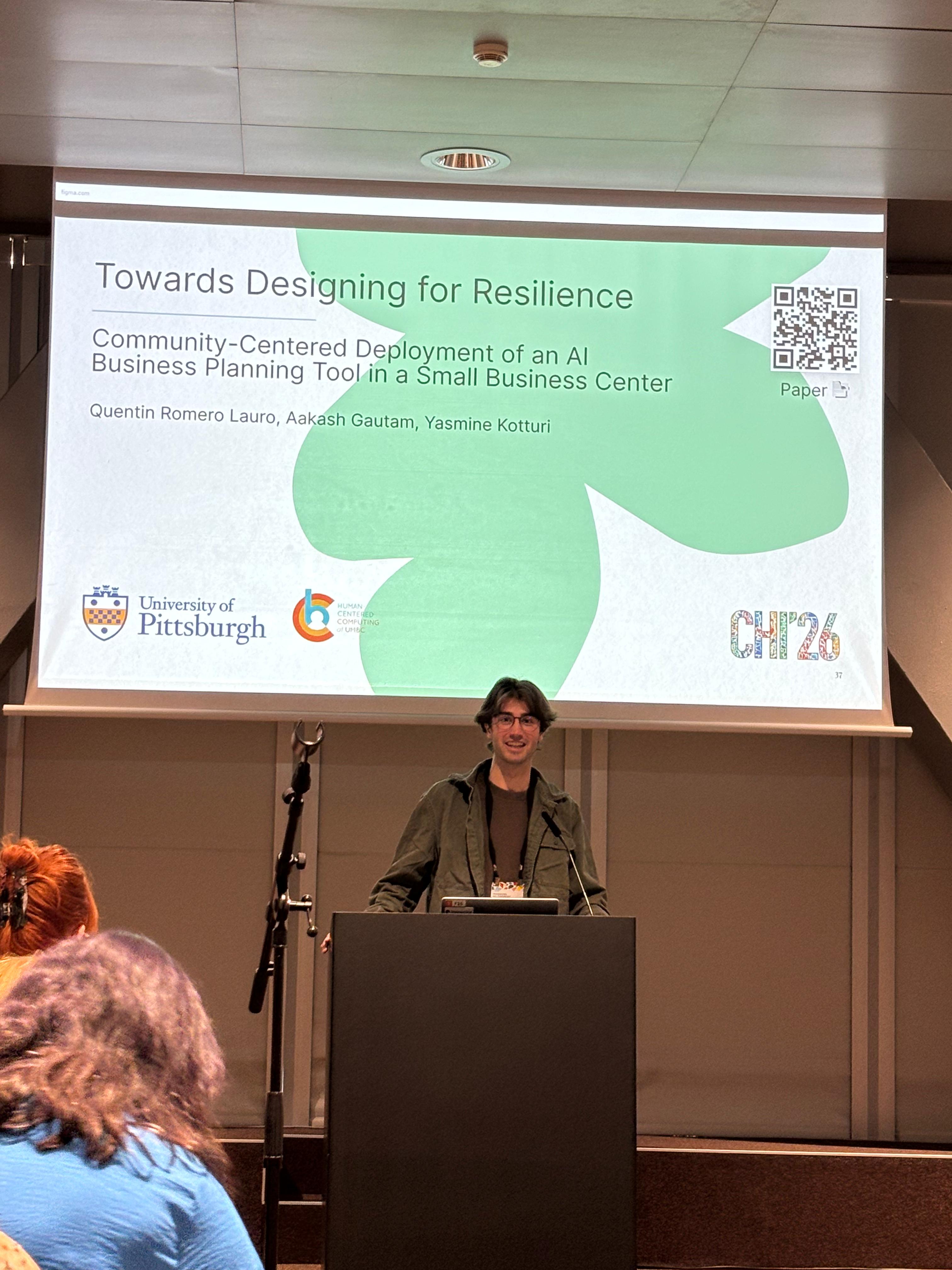
That observation became part of the thinking behind BizChat, an AI-assisted business-planning tool developed with collaborators across Carnegie Mellon, Pitt, and the University of Maryland, Baltimore County. BizChat was built for people with different levels of digital skill. It offered a guided path, short lessons in the moment, and language grounded in business activities. The aim was not to ask a novice to become a prompt engineer before breakfast.
Romero Lauro's own warning about AI adoption is admirably unfashionable: “Being critical towards your productive use of AI is extremely important. It's like, am I adopting this just for the hype, or am I actually getting something out of it?” BizChat's later community deployment treated easy output as a mixed blessing. Translating an idea into polished business language could help someone pursue capital, but instant polish might also skip the thinking that makes a plan useful. The research proposed “productive friction” - an interface that helps without relieving the user of judgment.
Research as rehearsal
At UC Berkeley's EPIC Data Lab, Romero Lauro moved from new AI users to highly technical ones. Retrieval-augmented generation, or RAG, gives language models access to outside material such as documents and databases. When a RAG system answers badly, however, the cause can hide anywhere along the chain: the documents may have been split poorly, the search may have fetched the wrong passage, the prompt may have framed the task badly, or the model may have ignored good evidence.
Fixing one variable often means rebuilding an index and waiting. Engineers compensate with a patchwork of scripts, notebooks, dashboards, and intuition. Romero Lauro and his collaborators studied 12 engineers who had built production RAG systems. They watched how those developers diagnosed mistakes, where they looked first, and how a discovery in one component forced a change in another.
and chunks
and ranking
and model
answer
The resulting tool, raggy, combines Python components with an interactive browser interface. Engineers can inspect intermediate results, change retrieval settings, edit prompts, rerun individual steps, and save useful test cases without repeatedly rebuilding everything. The related paper, “RAG Without the Lag,” received a Best Paper Award at CHI 2026. In a field currently fond of making the model larger, raggy made the work around the model more legible.
The project also sharpened a theme that would matter for Radius: developers do better when the interface exposes the state of a system instead of asking them to narrate it from memory. Romero Lauro has joked that the startup advice to “code and talk to users” is simply HCI's contextual inquiry with a new label. The joke lands because his research and founder life share the same method. Sit nearby. Watch the workaround. Resist the elegant explanation until the messy behavior has had its say.
Best friends, browser tabs, and the context tax
Romero Lauro met Klikushin through Carnegie Mellon HCII and later described him as his best friend when announcing their startup. Between them, the pair had worked on interfaces and products at Character.AI and Oracle. They started building web-based games together and found themselves spending days that stretched to 12 hours tweaking front ends.
Their loop was absurdly familiar. Sketch in Figma. Move to code. Open the browser. Notice what is wrong. Capture a screenshot for a coding agent. Explain which element mattered. Return to DevTools for the log. Carry that back too. Every tool was competent within its border; the developer paid tax at every crossing.
The product idea was hiding in the courier route: give the agent the runtime context the developer already has.
Inspector was their first public answer. It connected the browser and codebase so a developer could select an element visually and request a change. DOM-aware screenshots could snap to an element. A click could point the agent toward the corresponding code. Terminal and DevTools output could travel with the conversation. The pitch was less about a robot writing an entire application and more about ending the small acts of clerical theater required to help it understand one.
The idea widened into a browser where developers can orchestrate agents from their tabs. Inspector became Sol, and Sol became Radius. Product names are often treated as declarations of eternal identity, right up to the afternoon the domain changes. Here the sequence is more useful as evidence of a young company finding the right frame while keeping its center of gravity.
Inspector
Sol
Radius
A browser with a memory for work
Romero Lauro's path can look unusually varied when reduced to nouns: ecommerce, makers, small businesses, RAG pipelines, Character.AI, browsers. Read as a sequence of interfaces, it is coherent. Each project asks software to preserve the context people otherwise have to reconstruct. For a new entrepreneur, that context may be the meaning behind a financial-planning question. For an AI engineer, it may be the retrieved passage that poisoned an answer. For a front-end developer, it may be the button glowing incorrectly in the tab beside the code.
This is also where the academic work saves the startup story from a familiar trap. “AI browser” can sound like a category assembled from two fashionable nouns. The years before Radius show a more specific conviction: interfaces should let people inspect, steer, and question AI in the setting where the work actually happens. Romero Lauro's projects do not remove the human from the loop. They spend a surprising amount of effort making the loop visible.
Radius is still an early company, with two active founders listed by Y Combinator. Its final shape is unwritten. What is already clear is the wager. As agents become capable of taking action, the browser cannot remain a passive stack of rectangles. It needs to understand the page, the workspace, and the developer's intent without demanding another screenshot and a small essay about the button in the upper-right corner.
There is a modest pleasure in the symmetry. Romero Lauro began by simplifying a spreadsheet for people whose real work happened elsewhere. Now he is trying to simplify the browser for developers whose real work is happening inside it. The software changed. The observation did not. People are most articulate when they can point.