Before Matthew Wong tried to understand why customers churn, he tried to understand how fast a wave moves through the ground beneath Los Angeles. The first problem involved seismometers, ambient noise, and sedimentary layers. The second involves support tickets, sales calls, CRM notes, surveys, and product events. They sound like different careers. Wong has treated them as versions of the same puzzle: the visible event is only the surface, and the interesting structure is hidden below.
That instinct now sits inside Poth Labs, the two-person company Wong co-founded with Mojmir Horvath. Wong is CEO; Horvath is CTO. The company entered Y Combinator’s Summer 2026 batch with a tool designed to help companies understand why users behave as they do. Its promise is less magical than the usual AI pitch and more demanding: connect the evidence, show the trail, surface contradictions, and admit when the available record cannot support a confident answer.
Wong’s LinkedIn summary supplies the swagger in four words: “Building the Qualtrics killer.” His personal homepage supplies the counterweight: “Still figuring it out.” Together they make a more accurate portrait than either line alone. He is comfortable making a large claim. He is also preoccupied with how claims become knowledge.
“I’m interested in how and why we think what we think.”Matthew Wong, December 2025
The ground was talking first
Wong’s early résumé reads like someone testing several ways to make invisible systems legible. In 2023, while still at Mark Keppel High School in Alhambra, California, he joined Caltech’s Seismological Laboratory as an Earthquake Fellow. He ran field experiments, observed fault scarps, and used Python to examine seismic data created by sources other than earthquakes. The following research project, mentored by geophysicist Robert Clayton and conducted with Yuping Wang, focused on the Los Angeles Basin.
The basin is not merely a broad patch of land under a famous city. Its layers of sediment affect how shaking travels. Wong and Wang used Rayleigh waves gathered across two lines of seismic stations, estimated surface-wave arrival times, built dispersion curves, and translated those curves into an estimate of shear-wave velocity at depth. Their paper was published through CaltechDATA in 2024. Wong later placed third in Earth and Space Sciences at the Los Angeles County Science and Engineering Fair.
That summer, the map grew colder and the chemistry more exacting. Wong was one of 48 students selected from 1,245 applicants for Stony Brook University’s Simons Summer Research Program. Working in the Department of Geosciences, he investigated the Porcupine Fault System in Alaska, a structure tied to competing explanations for how the Arctic Ocean opened.
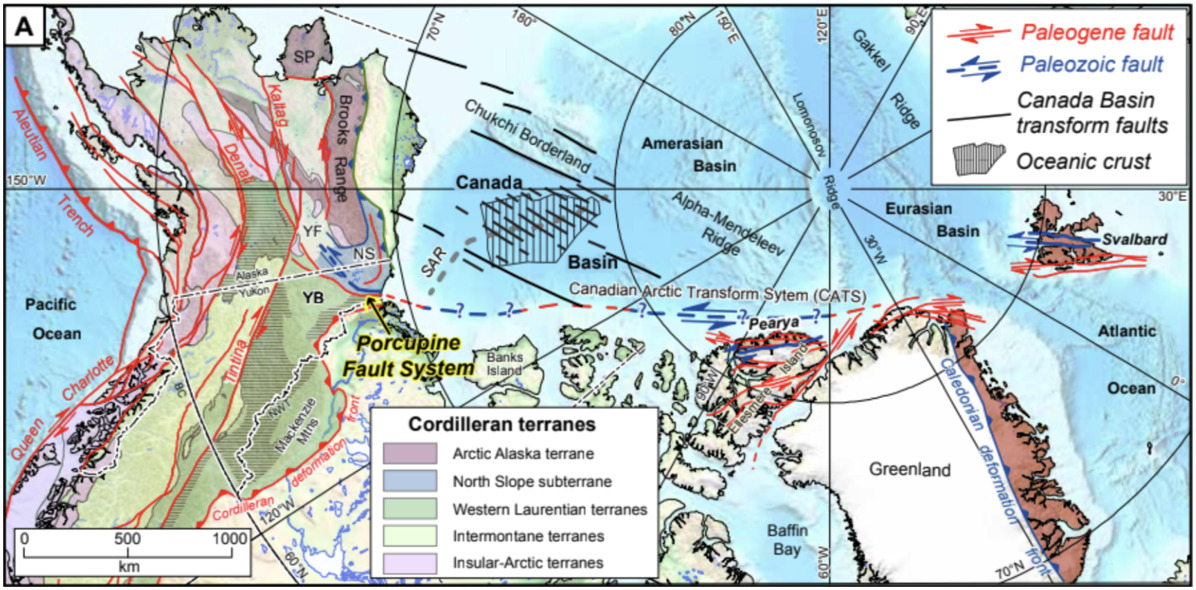
Dating a fault can require isotope dilution, rare equipment, and slow chemical separation. Wong asked whether a known isotope tracer, or “spike,” could make the work faster and less expensive on a standard quadrupole mass spectrometer. He first tested the method against a reference rock with an established age, then used it on Alaskan samples. His results placed major fault activity roughly 120 million years ago, in the Cretaceous period, and also suggested that some portions had been chemically reset less than 10 million years ago.
He presented the work at the American Geophysical Union’s 2024 Fall Meeting and received a travel grant award. The project was technically specific, but its shape would recur: take a costly process, identify the inferential bottleneck, and design a more accessible route from raw evidence to a defensible conclusion.
A deployment strategist with a seismologist’s reflex
In December 2024, Wong announced that he had been admitted to Stanford. He planned to study computer science and geophysics while exploring entrepreneurship. His current résumé lists an expected graduation in May 2030, reflecting the gap year he later described publicly.
Before that pause, Palantir gave him a different laboratory. Wong joined through the company’s Meritocracy Fellows Program in August 2025, describing his work as a forward-deployed engineer role that became deployment strategy in the U.S. commercial sector. Forward deployment puts an engineer close to the customer and close to the messy consequences of a system. It rewards the person who can move between code, business context, and the sentence a stakeholder has not quite managed to articulate.
His résumé records several compact examples. At a Fortune 500 telecommunications company, he shipped production data platforms for senior stakeholders. He rebuilt an Apache Spark job whose troubled pipeline ran for more than eight hours, cutting the runtime to 1.5 hours. He also built an embeddings pipeline to organize and analyze more than 100,000 unstructured employee roles. In another engagement, client discovery helped scope a data solution tied to a new logistics contract.
The numbers matter because they show Wong’s habit in working form. Find the structure beneath the slowdown. Make the structure usable. Then sit with the people affected by it long enough to learn whether the rebuilt system answers the real question.
The gap year becomes the work
On December 14, 2025, Wong published the first entry on his personal site. He had left Palantir, taken a gap year from Stanford, started Poth, and received backing from Y Combinator. There was a scheduling wrinkle worthy of a two-person company: Horvath was still a senior at Phillips Academy Andover, so they deferred their YC batch until Summer 2026.
Poth’s original product combined company data with adaptive interviews and surveys. It could form a hypothesis about churn, abandonment, activation, or adoption, then change its questions according to a user’s answers. Analytics showed the behavior. Poth would investigate the reason.
Building that interview system required the founders to understand the evidence a company already possessed. They created a customer knowledge graph that identified accounts, users, products, features, conversations, behaviors, and feedback, then connected those objects through their relationships. Early teams began using this underlying model as much as the survey function. The founders responded with a soft pivot: the living model became central.
The Poth loop, simplified
A company might ask why enterprise accounts tried a feature but failed to adopt it broadly. Poth could connect low product usage with permission complaints in support tickets, concerns voiced on calls, and renewal context in the CRM. The answer is meant to show supporting evidence, contradicting evidence, and whatever information is still missing.
This is where the company’s principles become more interesting than its category labels. “Evidence over vibes” sounds like a slogan until one considers how many product decisions are assembled from the loudest memory in a meeting. Poth treats an uncited answer as a hypothesis. It preserves uncertainty instead of polishing it into false resolution. The phrase “we don’t know yet” becomes useful because it tells a team what to investigate next.
“Your analytics tell you what your users did; Poth tells you why, starting from your own data.”Matthew Wong, June 2026
Ambition, with pottery on the side
Wong is still early in several stories at once: an undergraduate education, a company, and a public body of writing that currently begins with one short essay. The personal details he chooses to display are revealing without pretending to finish the portrait. His website has sections for projects, a bookshelf, and pottery. He says he is reading in logic and epistemology. His homepage keeps quotations from Agnes Callard, Steve Jobs, and Alan Kay close at hand.
The declared aspiration is broad: “My goal is to create as much impact as possible.” His path toward it has been unusually empirical. Rather than settle on one domain, he has moved through building and safety, seismology, geochemistry, enterprise software, and customer research. Each stop gives him a different instrument for asking how social change might actually be made.
Poth now faces the ordinary hard questions of enterprise software. Can a two-person team connect enough systems reliably? Will product and research teams trust a generated explanation? Can the software distinguish a real contradiction from mere mess? The founders have not hidden those tensions. Their product position depends on making them visible.
There is a practical lesson in Wong’s young career. A field can change while a method survives. Seismic stations, mass spectrometers, Spark pipelines, and customer knowledge graphs are wildly different instruments. All become useful when someone asks what the signal can honestly support, where the gaps remain, and which question should come next.
For now, Wong is building the company and postponing the neat ending. His own three-word homepage introduction remains apt: still figuring it out. In a culture that rewards instant certainty, that sounds less like hesitation than a serious operating system.