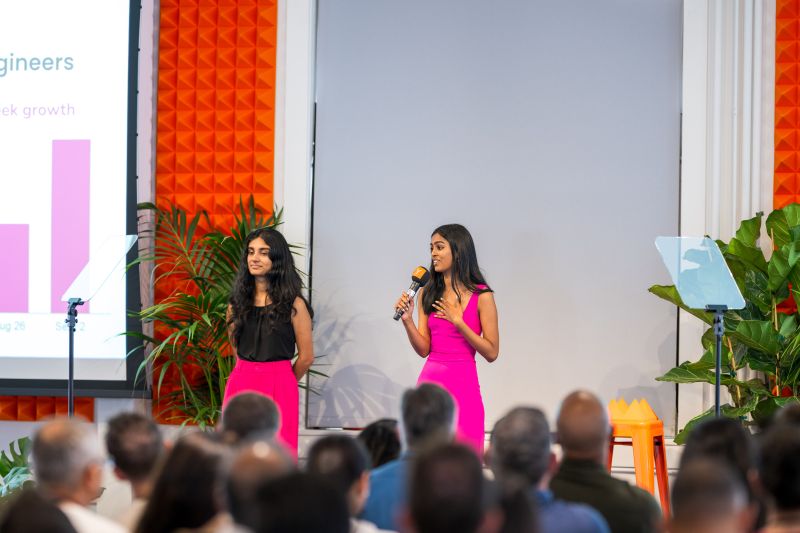
Halfway through Nixo’s Y Combinator Demo Day pitch, the teleprompter stopped. Priya Khandelwal saw the next sentence freeze at the edge of her vision. She and co-founder Priti Rangnekar were already hard to miss, standing in hot pink amid the usual founder palette of black and blue. If the pitch went wrong, the wardrobe would make the moment especially memorable.
Khandelwal made a tiny decision with public consequences: her face would reveal nothing. She finished the line, kept the energy in her voice and continued from the subject she had lived for two months. When she went backstage to report the malfunction, the control room had no idea it had happened.
The story is a neat miniature of the company she was pitching. Forward deployed engineers, or FDEs, live where prepared scripts encounter stubborn reality. They take an AI product into a customer’s particular systems, translate an ambitious promise into production code and keep a relationship intact while requirements wriggle. When the neat interface freezes, they carry on.
“If you can hold the room when the slides freeze, you can hold a market when things go sideways.”
01 / Before the companyThe researcher walks toward the customer
Khandelwal’s route into this work began at Stanford, where she studied computer science from undergraduate study through a master’s program. Her public record has the gratifying range of someone unwilling to become only one thing: AI research, course teaching, the Stanford Technology Ventures Fellowship, Pear Garage, leadership in Graduate Women in Computer Science and FashionX runway design. She served as a course assistant for John Ousterhout’s CS111 and received Stanford’s Centennial Teaching Assistant Award in 2025.
Her research credits include work on multimodal data fusion and federated learning, along with a Scale AI guide to improving long-context instruction following in open-source models. But the decisive education came with a customer attached. In 2023, before “FDE” became one of AI’s fashionable three-letter titles, she took a machine learning forward deployed engineering role at Kumo.AI.
She was not initially sure what the title meant. The role preserved the research-minded work she liked but moved it closer to the customer. There she saw a curious arrangement: technically formidable people solving recurring deployment problems with their own templates and private hacks. Support sat in Zendesk, tickets in Jira or Linear, issues in GitHub, notes in Notion. The engineer supplied the connective tissue, usually from memory.
The flaw was not a lack of effort. It was that every surrounding tool had been designed for somebody else. A CRM understood sales. An issue tracker understood engineering. A support queue understood support. The FDE’s job crossed all three and added delivery, persuasion and project judgment for good measure. The tools recorded pieces of the work while the person carried the whole.
02 / The founder pairA friendship becomes infrastructure
Khandelwal and Rangnekar met as Stanford freshmen and became close friends. Their backgrounds later formed a useful fit. Khandelwal had felt the friction of high-touch deployment from the field. Rangnekar had worked on platform engineering, including operational tooling used by engineers. One knew where the seams hurt; the other knew how infrastructure could make seams disappear.
They founded Nixo in 2025 and entered Y Combinator’s Summer batch. The company’s premise is intentionally narrow: create an operations platform for FDE teams. Nixo connects customer conversations, engineering tasks and project delivery so teams can scope problems faster, notice when work can be reused and understand how effort is spread across accounts.
Only months separated Khandelwal’s student life from running a San Francisco company. She has credited YC with compressing that change. Nixo’s customers were AI startups, so a community filled with AI founders also became a dense pocket of users. The result was a faster feedback loop and, by her account, growth beyond what the founders had expected.
03 / The commercial lessonA credit card is a research instrument
Nixo’s first paid customer arrived before the product was finished. Conventional advice suggested a free trial. Khandelwal and her team did the more clarifying thing: they charged $1,000 for a one-month pilot. Payment changed the texture of every meeting. Curiosity was no longer sufficient; the conversation had to be about return on investment.
The product had to survive inside an overextended FDE team’s actual workflow, not a courteous demo. Before the month ended, the customer asked to secure a full contract. Khandelwal’s lesson was plain: a paid pilot produces urgency, serious feedback and mutual commitment. The amount matters less than the line it draws between finding a product interesting and needing it to work.
“Charging $1K meant every meeting was about ROI.”
That story also reveals her operating style. Nixo does not appear to be built around the theatrical promise that AI will dissolve difficult work. It begins with the more sober observation that difficult work persists, then asks which parts can become visible, reusable and better managed.
04 / The people problemMini founders cannot be hired by acronym
Khandelwal calls FDEs “mini founders.” The phrase is not decorative. They own customer relationships, build through the sales cycle, manage implementations and decide what belongs now versus later. They need enough technical strength to ship and enough behavioral range to ask an uncomfortable question without making the room uncomfortable. A great engineer can still fail at the role if ambiguity or customers feel like interruptions.
This gave Nixo a second, adjacent problem. Teams asked how to improve their FDE operations, then immediately asked where to find good FDEs. Candidates asked which companies understood the role. Nixo started a Hiring Hub to match the two. In one example Khandelwal described, a company needed someone who understood technical integrations and had sold to senior executives in its industry. The useful candidate was not a generic engineer but a former founder with unusually relevant context.
Hiring and operations meet at leverage. Khandelwal warns that headcount cannot solve every delivery problem. Adding people to a poorly scoped system merely gives the system more calendars. The stronger hire can own a technical project, separate urgent work from merely loud work and increase the effectiveness of the people already there.
“Not everything can be solved by adding headcount.”
05 / The economic betCustom work, without custom chaos
The company’s larger ambition is economic. Traditional software-as-a-service earns attractive margins because one product can serve many customers. Enterprise AI often breaks that picture. An out-of-the-box product supplies part of the value, while a human must understand the customer’s systems, evaluate the model, build integrations and steer the deployment. Each contract threatens to become its own small consultancy.
Khandelwal argues that AI agents have accelerated coding and deployment, but deciding what will bring a particular customer to value remains human. Nixo is trying to make that human work more repeatable. Better records of customer communication reduce chasing. Clear allocation prevents one engineer from quietly drowning. Reusable code and deployment playbooks keep yesterday’s solution from being rediscovered tomorrow.
Her view of current AI is blunt: general systems remain unreliable and require extensive hand-holding. She expects the FDE model to persist while the underlying technology stays within its present limits. The bubble, in her formulation, is the belief that generalist AI can replace all this specialization before the technology is ready.
That conviction explains why she went all in on Nixo. It is also why the company’s target is SaaS-level margins rather than SaaS-like sameness. The aim is not to pretend custom deployments are identical. It is to find the repeatable structure inside their differences.
06 / Building a categoryThe conference is part of the product
Nixo’s work has expanded beyond software into the community forming around the role. The company has hosted FDE conferences and roundtable dinners in San Francisco, including events with Y Combinator, Rippling and ElevenLabs. Khandelwal turned notes from those rooms into an FDE Advent Calendar, an appropriately seasonal choice for someone who publicly describes herself as a full-on Christmas fanatic and puts up her tree immediately after Thanksgiving.
The whimsy serves a practical purpose. A young category needs shared language as much as tooling. Conferences reveal how teams define the role, where hiring breaks, which practices repeat and where the market is confused. Community becomes research with better snacks.
This is the most interesting part of Khandelwal’s story so far. She has moved through research, teaching, engineering and company building without abandoning the connective work between them. The same person who studied model behavior is now concerned with team design. The former course assistant explains a new job category. The founder wearing hot pink onstage is also the operator charging for an unfinished pilot.
Nixo is still a small company, six people by Y Combinator’s current listing, and its thesis will be tested in deployments rather than prose. Yet the problem has an undeniable shape. AI companies can generate more software than before. Customers still need someone to decide what should be built, make it fit and own the outcome. The more impressive the demo, the more conspicuous that last mile becomes.
Khandelwal has chosen to build there, in the untidy distance between a model that works and a customer who succeeds. It is not the part of AI that sparkles on command. It is the part that keeps speaking when the teleprompter stops.