The awkward moment in a print job often arrives after everybody has approved the beautiful design. Someone asks which paper it uses. Someone else asks how it folds. The printer has questions. The deadline, naturally, has stayed exactly where it was. Intaglio built its proposition around getting those conversations into the same room.
The Los Angeles company, founded in 1991, brought graphic services and project management together from the beginning of a job through completion. Founder Marina Poropat Joyce called its approach “Total Image Management”: keeping a client’s identity consistent wherever it appeared. It was a practical offer for businesses whose communications had to survive more than a presentation on a screen.
Its published service list stretches from identity systems and business documents to packaging, event materials, retail graphics and large-format printing. Mailing and warehousing extend the work beyond the printed sheet. The commercial logic is straightforward: a customer buying several connected pieces has fewer handoffs to coordinate when the provider understands the whole assignment.
A disc could open the door. An estimate kept it open.
Joyce entered printing by buying the shop she had used while working for a holding company. She knew branding and running businesses. Production was a steeper education. In a 2017 TypeThursday interview, she recalled learning to estimate first, then discovering how much she still had to learn about materials and processes.
Early on, she would agree to a customer’s request and return to a pressman who explained that the shop could not do it. She had to find a solution. The shop had been the inexpensive option among her former employer’s suppliers; raising its standards meant upgrading presses and retraining employees.
There was an opening, too. Joyce could accept computer discs at a time when, she recalled, relatively few Los Angeles printers could. Digital artwork brought customers through the door. Production knowledge made the promise deliverable. Her account supplies a useful distinction for any service business: making work easy to submit creates demand; knowing what it takes to complete it determines what happens next.

The accountant’s unwelcome advice
Demand brought its own problem. In a Girls Who Print Q&A, Joyce described borrowing to buy the business and later financing growth from sales. She remembered the difference between asking a holding company’s finance chief for money and having to find it herself. Eventually, her accountant advised slowing sales because cash flow had become a problem.
That recollection gives the company’s growth story some welcome friction. Orders are encouraging. Paying for growth is a separate task. For a founder trying to expand a production business, the important number cannot simply be the next invoice. Joyce’s experience makes a case for treating access to cash as an operating requirement, alongside the ability to win work.
“The difference between expectation and reality is stress.”
Marina Poropat Joyce · Girls Who Print
Her stated management philosophy is equally direct: be honest with customers, decline unsuitable work when necessary, and give employees timely, objective reviews. That is an exacting counterpart to a business built on saying it can handle the whole project. Coordinating more of the work also means being willing to discuss its limits.
A whole job has more than one price
Intaglio’s service mix places it among providers that combine design and production knowledge for business buyers. Its model is best understood as project work: customers need finished communications, with decisions and execution managed along the way. The service description makes coordination central to the offer.
The founder’s later writing explains the market around that offer. Commercial printers, brokers, specialist shops and gang-run providers solve different buying problems. Gang-run printing groups compatible work from several customers on a sheet. It can suit standard pieces; exacting color requirements make it a less comfortable choice. A specialist may be appropriate when a particular material or format drives the job.
Those alternatives matter because a coordinated service is most useful when there is something consequential to coordinate. A buyer with settled artwork and ordinary specifications may have a simpler purchasing decision. A project with connected pieces, unusual finishing or a demanding identity system benefits from earlier production discussion. That is a reading of the service model, rather than a claim that every job needs the same treatment.
Editorial schematic drawn from Joyce’s production and scheduling guidance.
Cost follows those choices. In her discussion of printing methods, Joyce gives the example of invitations combining process color and foil: an economical printing method may cease to be suitable if the finishing requires tighter alignment than that process can deliver. Quantity alone cannot settle the estimate. The pieces of the job have to work together.
Her large-format guidance, shared by Millcraft in 2021, adds another complication: equipment capabilities change. Some machines can cut shapes without a separate die and apply decorative effects. That can change the up-front cost of a short project. The sensible question is what a supplier can produce for this particular design.
The print shop becomes a book
Joyce’s later educational work carried this attention to production beyond individual client jobs. Her author biography describes writing Designing for Print to explain the subject in language graphic designers could use. It also reports Intaglio’s recognition among 50 fast-growing print companies, the Inner City 100, and Los Angeles’ leading women-owned businesses.
The book gave that experience another form. Its press kit identifies Inez D Inc. as publisher and lists January 2018 as the publication date for a 208-page softcover with a $95 retail price. Those are historical book specifications, not a current printing quote. The publication is the founder’s separate educational project.
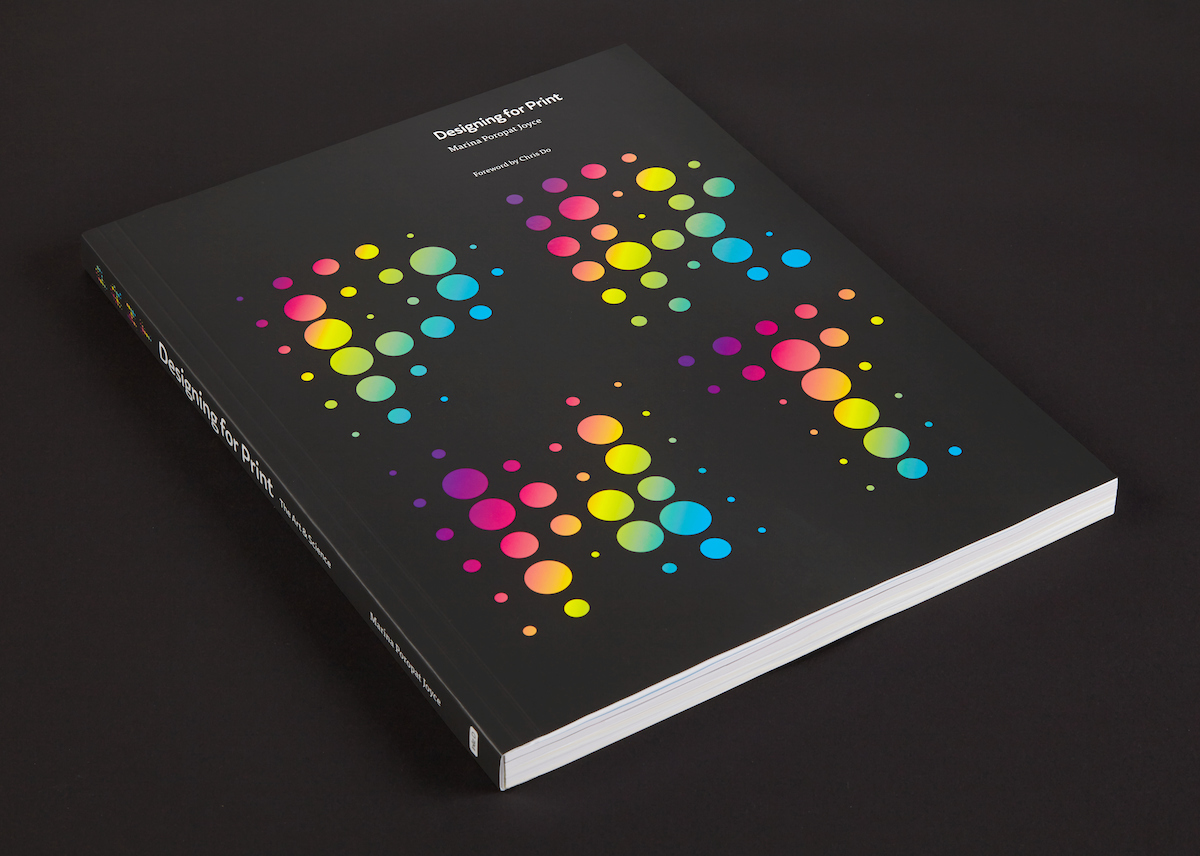
Paper, methods, proofing and finishing - the decisions behind the finished piece.
The book’s explanatory approach includes charts, checklists and decision trees. Its promotional material describes comparisons across six printing methods, three color options and different quantities, plus guidance for selecting paper and understanding proofs. It aims at the moment when a designer knows the intended effect but needs help specifying how to achieve it.
The move into teaching also put Joyce in front of working designers and print buyers. A 2018 PIASC announcement advertised a paper workshop hosted by Domtar Paper and Spicers Paper, with Joyce as guest speaker. Its subjects included paper availability, grades, finishes and reading swatch books. These were choices people could bring back to their desks the next day.
Show the fold. Name the deadline.
Joyce’s advice to printers is often wonderfully physical. In a 2018 article, she recommends folding two printed samples in different directions relative to the paper grain and photographing the results. A short video of a cutter can explain why artwork needs bleed. Showing the same image on different paper colors makes the substrate’s effect visible.
The reader can copy that teaching method without building a training department. Keep a small set of relevant examples. Use them before the customer commits to a specification. A sample that answers the actual question can save a long exchange in which both sides think they understand the same word.
Scheduling gets similar treatment. Joyce advises getting the printer’s file deadline and working backward to client approval. Specify the delivery date and address with the job, clarify whether turnaround means working days, and identify who will approve proofs. “ASAP” leaves too much to interpretation. A job needs a place in the schedule.
Approval has its own boundary. Her press-check guidance says to compare the sheet with the approved proof and verify that agreed changes are present. It is a poor moment to begin checking phone numbers or spelling. In the 2016 article, she described press time as costing at least several hundred dollars an hour; that historical observation explains why late alterations attract charges.
There are reasons to attend a check: unfamiliar materials, experimental processes or concerns about a proof can warrant closer attention. The skill is choosing the right check for the uncertainty, then arriving prepared to make the decision. A signed proof has a purpose beyond creating another attachment in an email chain.
Even the old fonts have unfinished business
Production knowledge also has to survive software changes. In September 2022, Joyce wrote about trouble updating an older book project as Type 1 font support was ending. Replacement fonts did not provide all the features she had used, which meant rebuilding styles and revisiting design choices.
That experience changed a specific plan: she decided to keep a 2012 MacBook Pro running older software to help edit legacy projects. She also urged designers to inspect recurring work in advance and account for the time involved. An apparently routine revision can expose decisions buried years earlier in a file.
By April 2025, a Dscoop interview identified Joyce as leading marketing and sales development at Lithographix. Her argument still concerned the relationship between creatives and production. She urged printers to show examples relevant to a customer’s work, rather than lead with machinery specifications or unavailable paper samples.
Intaglio’s story makes that advice credible. Its founder had experienced the attraction of a promising design and the difficulty of delivering it. For the person preparing the next brochure, invitation or package, the useful habit is to have the production conversation while choices are still open. Paper is much less accommodating after the job has gone to press.