The company disappeared. The colleagues stayed together. In 2021, the people who would start Foundry LA lost their former agency to a closure. They considered finding other employers, then chose to preserve the working relationships they already had by opening their own shop. In a business built around making things look compelling, the founding proposition was refreshingly unpolished: we like making things with these people.
Today, their work includes a Disney+/Hulu/ESPN bundle campaign, promotional images for streaming shows and collectible movie packaging. Foundry occupies a particular corner of the entertainment business: the place where a story becomes an image that somebody has to notice. Sometimes that image sits beside a play button. Sometimes it wraps around a set of discs. Sometimes it rises above a Los Angeles street.

A small agency with a very familiar cast
Foundry is a graphic design business serving entertainment clients. Its output includes key art, the central promotional image associated with a film or series, alongside campaign graphics, social artwork and home-entertainment packaging. The studio’s portfolio is organized around recognizable titles and assignments. That makes it easy to enter through a favorite film and discover a discipline that usually stays behind the curtain.
Kasey Yee, its CEO and partner, brings experience from both studio and agency work. Her 2024 Clio jury biography names Disney, Netflix, Paramount and Lionsgate among the studios the team works with. It also describes a focus on animation, anime, family entertainment and work for fans. Yee studied creative writing and explicitly distinguishes her role from that of a designer. The background fits a business that needs to understand a story before deciding how to sell its image.
The company’s indexed team roster names Vicki Tunkel and Dino Espinosa as creative directors and partners. It also includes project management, art direction and illustration roles. Those titles help explain the offer: clients are commissioning creative judgment and coordinated execution. A film marketer needs someone to make the picture, but also someone to keep the assignment intelligible as it moves between creative people and business requirements.
“We are a team of misfits”
Foundry LA’s statement of values
Foundry describes itself as majority female and AAPI owned. Its values page emphasizes different backgrounds, individual perspectives and enthusiasm for entertainment. These are statements about how the company wants to work, and they give the portfolio a useful frame. Familiarity with a fictional world can help a designer recognize which details carry meaning for its fans. The commercial task is deciding which of those details deserve the limited space available.
Pandora, sized for a bookshelf
The Avatar collector’s editions offer a concrete example. Foundry LA is the credited entrant for Disney’s Avatar and Avatar: The Way of Water Collector’s Editions, which received a Silver at the 2024 Clio Entertainment Awards in the packaging category for box sets, collections and complete series. The award identifies a specific piece of work and a specific discipline. It gives a prospective client something firmer to inspect than a list of famous logos.
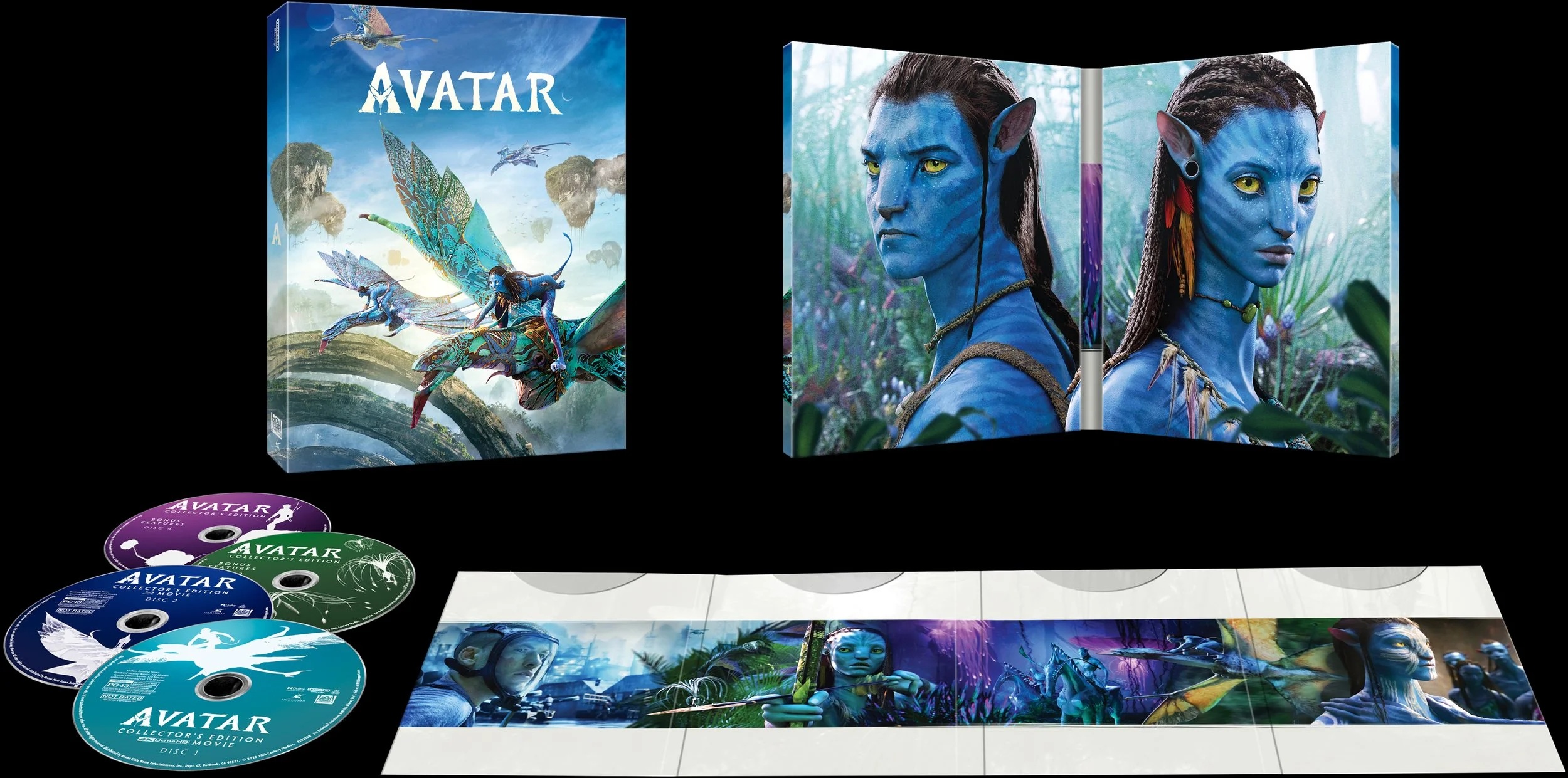
Look at the first film’s package. The outer cover presents an expansive landscape; the open interior brings two faces close. Along the bottom, a horizontal run of scenes spreads across the disc holder. The discs carry their own colors and silhouettes. The design has more than one moment to work: first on the shelf, then in the hands, then as the object opens.
That sequence is the interesting part. A collector’s edition can reward someone who already knows the story. It can use space for recognition, atmosphere and the pleasure of owning a coordinated object. The work asks the designer to think about adjacency: what happens when one panel meets another, and whether the parts still feel related when separated. In this example, the blue-green world supplies continuity without requiring every surface to repeat the cover.
Clio Entertainment
Avatar collector’s editions · Packaging
The portfolio carries that physical-media interest into other titles. Its Edward Scissorhands page includes a SteelBook layout and 4K presentation; The Fantastic Four: First Steps also appears with SteelBook and disc-package imagery. For a buyer assessing Foundry, these are relevant examples to compare. A useful question is how a designer carries a title’s identity around an object, including the surfaces that never appear in the first product thumbnail.
One billboard, several kinds of appetite
The Disney bundle assignment changes the viewing conditions. In the billboard image shown in Foundry’s portfolio, Stitch and an Alien character occupy the same composition as sports figures. A large block of type organizes the offer on the right. Entertainment and live sports have to share a single field of attention, without making the viewer untangle a miniature catalog.
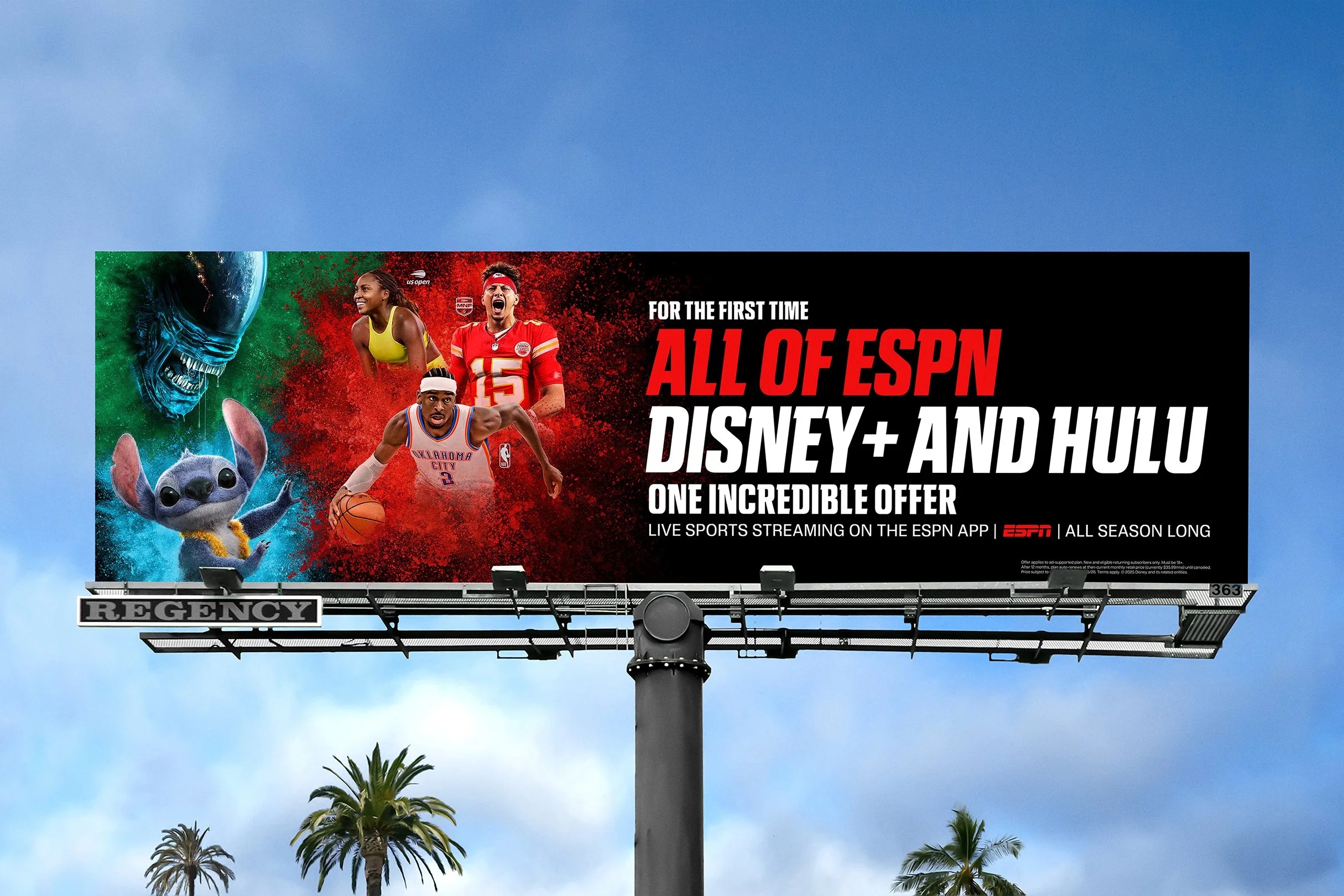
Read as a design exercise, the composition uses contrast to sort that variety. Figures gather on the left; the offer occupies the right. Dark space gives the typography room. Red helps connect the sports imagery with the main message, while the character side introduces cooler color. The result shows a different skill from the collector’s edition: making several reasons to subscribe coexist in one quick encounter.
A prospective client can copy the question behind that arrangement: what must a viewer understand first? For a bundle, the answer may be the breadth of the offer. For a specific film, it may be a character, relationship or mood. Those priorities should shape the brief before anyone argues about the placement of a logo. This is an editorial reading of the visible work, rather than a claim about Foundry’s internal process.
Can the image communicate at a small size?
Does the main message survive a quick glance?
Does opening the package reward a closer look?
An editorial guide to the formats in Foundry’s portfolio, not performance data.
The thumbnail has its own assignment
Foundry’s streaming work supplies another useful comparison. The Queer Eye season-six page presents a wide ensemble image and multiple portrait-format versions. The Never Have I Ever season-three page likewise includes different artwork configurations. Even without an accompanying process essay, the examples make a basic production problem visible: the same entertainment property needs to be legible in more than one shape.
Changing the shape changes the available emphasis. A horizontal arrangement can give several people breathing room. A narrower image places more pressure on faces, title treatment and the relationship between foreground and background. For a marketer, this makes format planning part of the creative assignment. A list of dimensions may look administrative, but those dimensions affect what an image can say.
The @sonypicsathome project adds social promotional content to the mix. Elsewhere, the portfolio includes a Gulf Coast Symphony poster series and Marionnettiste, a documentary short connected to the Bob Baker Marionette Theater. Together, these examples widen the picture beyond studio releases. The recurring service is a visual invitation to watch, attend or collect, adapted to the entertainment being offered.
What a client is actually buying
Foundry’s business model is creative services for other businesses. The practical buyer is an entertainment marketing team with an assignment: a title to promote, a package to develop or a campaign to express across formats. The deliverable may be an image file, but the purchasing decision also concerns taste, familiarity with the material and confidence in the people handling the work.
For someone preparing an inquiry, the portfolio suggests a sensible way to make it concrete. Identify the audience, describe the desired response and list the places the artwork must appear. Bring the relevant approved material and explain who will review the result. A useful cost conversation starts with that scope: how many concepts, versions and deliverables are needed, and what production responsibilities belong to each party. These are briefing recommendations, not published Foundry contract terms.
The alternatives depend on the job. An in-house team may already know the property and its approval history. A freelance specialist may suit a tightly bounded illustration assignment. Other entertainment agencies also compete for packaging and promotional work; BOND, for example, appears in the same 2024 Clio packaging category. Foundry’s case rests on the particular work and people a client sees, rather than a claim that one agency structure wins every brief.
Its portfolio makes the strongest argument when the commission resembles those examples. A request to develop an enterprise software interface would need a different body of evidence. Even within entertainment, a strong collector’s package cannot establish that a social campaign will meet a particular sales target. Matching the reference project to the actual assignment is a more useful buying habit than treating every recognizable title as interchangeable proof.
Fans who also talk shop
Foundry’s interest in physical media extends beyond its project pages. A WonderCon panel announcement shared by Scanavo brought together Yee, Tunkel, Espinosa and Chris Kawagiwa with Scanavo’s Matthew Marone. The subject was home-entertainment marketing, from VHS to 4K. It places the team in a conversation with people who design, market and collect the objects its artwork helps sell.
That is a fitting place to leave Foundry LA: close enough to the audience to care about the package after the transaction. Its portfolio moves between the hurried glance of a passerby and the deliberate attention of a collector. The viewing time changes. The designer’s question stays concrete: what should this person see, feel and understand when the image finally reaches them?
Look closer at the work
Browse Foundry’s portfolio, explore the Avatar packaging or visit the studio website. Follow the team on Instagram and LinkedIn.
For more: the 2024 team interview, Kasey Yee’s Clio jury profile and the Avatar award entry.