The accountant’s advice was to slow down sales. For a founder who had borrowed money to buy a printing business, this was an awkward definition of progress. Marina Poropat Joyce had orders. What she needed was enough cash to keep up with them. Growth had arrived carrying its own bill.
That moment belongs in her story alongside the awards and the book. It catches the difference between knowing how to win work and knowing what work will demand of you. A print shop has a particularly direct way of delivering the lesson. Paper must be bought. Equipment must run. The finished job has to leave the building.
Joyce founded Intaglio in Los Angeles and eventually wrote Designing for Print. Across those two projects, she kept returning to the same territory: the practical decisions that sit between an attractive idea and an object somebody can actually use.
The customer gets the keys
Before owning a printing business, Joyce worked for a holding company, helping establish new businesses. Her printer offered to sell her his shop. She knew the business as a customer and understood how to run companies. Production would have to be learned.
She began with estimating. There were presses to understand, employees to retrain and standards to raise. Being able to accept computer discs gave her an opening with customers at a time when that capability was less common. The computer could bring work through the door; the shop still had to deliver it.
It is an origin with useful friction. The person selling the work and the person producing it can understand the same request very differently. Joyce’s early education put her in both positions. Every promise had somewhere physical to land.

Her later management advice retained that awareness of consequences. She advocated being direct with customers and declining work when necessary. The same candor extended to employment: assess people’s work promptly and objectively, rather than waiting for a conversation about pay to force the issue.
“The difference between expectation and reality is stress.”
Marina Poropat Joyce
The line has the compactness of something learned while a job was already moving. It also explains why a designer would care about production before a file is finished. An expectation becomes much easier to manage while the choices are still open.
A page has more than one deadline
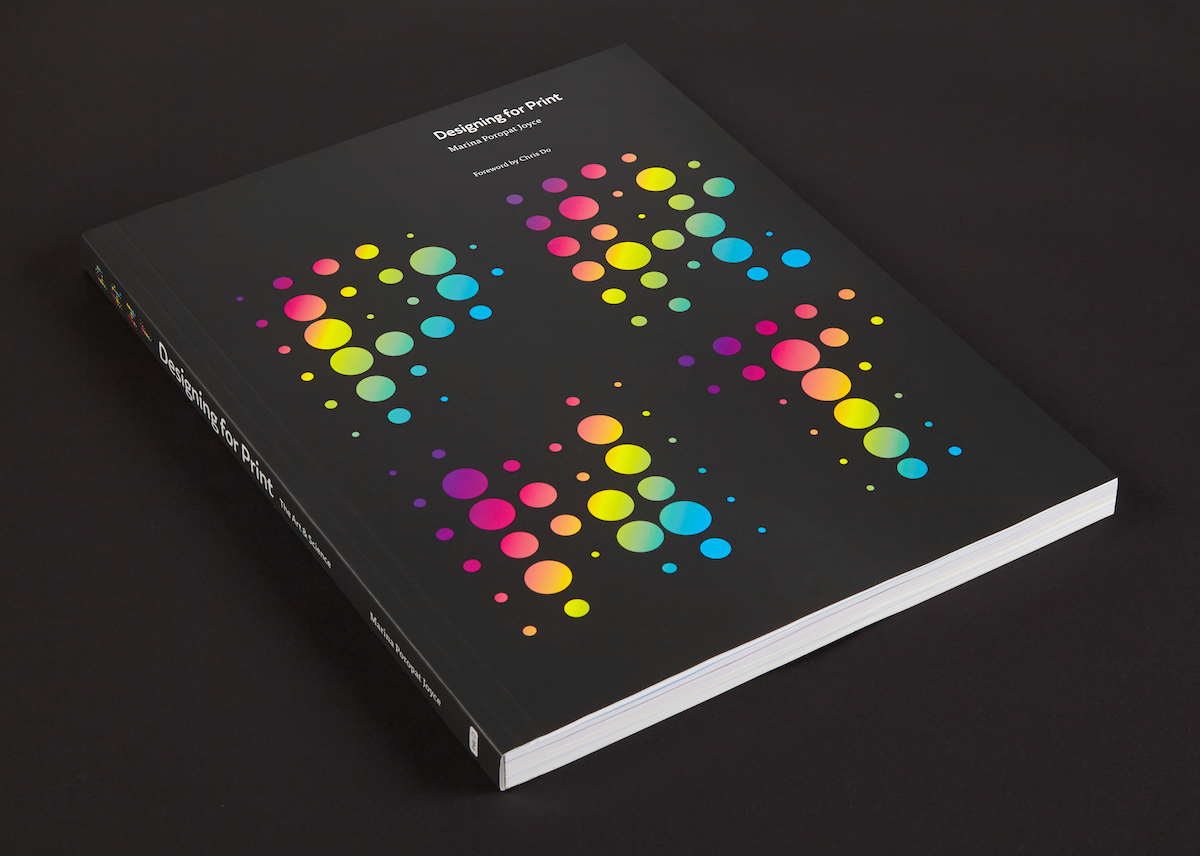
Designing for Print gives those choices a place to live. Its press kit lists a 208-page softcover, published by Inez D Inc., with a January 2018 publication date. The subject includes the different methods of putting a design into print, and the consequences of selecting one process over another.
The premise is generous to a working designer. You may be experienced in one kind of work and suddenly responsible for another. You may know exactly what you want a piece to look like, while needing help with how it will be made. A useful manual meets you at the question you have.
Recognition arrived around the same period. In 2017, the Printing Industries Association of Southern California named Joyce its Executive of the Year and Ben Franklin Award recipient. At the time, she was president of consulting firm Inez D, applying her experience to branding and rebranding.
She had also served on the association’s board and as its chair. Intaglio’s record included recognition among fast-growing American print businesses and Los Angeles women-owned companies. Those distinctions describe a career with commercial and professional standing. The more revealing detail is what she chose to do with its accumulated knowledge: explain it.
Show the fold. Bring the lunch.
Joyce’s advice to printers can be disarmingly ordinary. Use a phone to show a designer what a machine does. Film a cutter. Photograph two folded samples so the difference in paper grain becomes visible. Sit down with swatch books and explain how to read them.
There is an appealing lack of ceremony here. The teaching materials are already in the building. The camera is already in your pocket. A useful explanation does not need a conference room and a presentation remote.
Her press-check guidance brings the same attention to the relationship. A customer should arrive with the approved proof and be ready to make decisions. A printer should have the materials ready, explain the options and resist pushing someone into a choice. Both parties have responsibilities; neither gets to make confusion the other person’s job.
She includes coffee, somewhere quiet to wait, and a snack. Anyone who has watched a meeting deteriorate around lunchtime will appreciate the production value of a sandwich.
There is a sharper anecdote, too. An art director noticed a problem with tiny type against a solid background and asked for a loupe. She was right. Joyce remembered the incident as an example of a client earning respect through technical knowledge. Expertise could come from either side of the counter.
Her wide-format advice also starts with the circumstances of the finished object. Will it be outside? How will it be viewed? Does it need to match something produced by another method? These are the questions that make a design brief more useful to the people doing the making.
She encourages designers to consider materials beyond paper, including fabric, wood and metal. The range invites experimentation, while the practical questions give the experiment a chance of arriving intact. Curiosity and preparation can share a desk.
The old laptop stays
Her writing about older fonts supplies a smaller, telling episode. Facing the end of Type 1 support in Adobe applications, Joyce described trouble editing a book. Replacement fonts did not include all the features used in its styles. The apparently routine revision required more work.
She decided to keep an older MacBook Pro available for legacy projects. She sorted her fonts and considered how future edits would be handled. The advice included allowing time for the transition and accounting for the work commercially.
It is a useful glimpse of a working designer’s relationship with technology. The new version arrives; the old files remain. Somebody has to reconcile them. In Joyce’s account, preparation includes preserving a machine that can still do a particular job.
She had used the older fonts in character and paragraph styles, so a substitution could affect the structure of the document as well as its appearance. Small capitals, ornaments and figures were among the features she needed. The problem was specific enough to resist a breezy instruction to update everything. Her response was to investigate the files, separate the older fonts and prepare for the next request to edit them. She also urged people to discuss the additional time with customers in advance. Maintenance has a cost, even when the finished page looks familiar.
The episode sits comfortably beside her enthusiasm for newer printing techniques. On LinkedIn she shares digital color work and dimensional outdoor advertising with visible pleasure. Being interested in what equipment can do does not require forgetting what older projects need.
Her public writing and professional posts retain a practitioner’s scale of attention: the type style, the material, the detail that makes an idea work. A career can span several businesses and still turn on something as small as a missing character feature.
Experience, bound and passed along
In 2019, Joyce volunteered the design for the Ben Franklin Honor Society’s Book of Wisdom. Edited by Harvey R. Levenson, the first volume gathered 47 essays across 248 pages. Dave DeLana donated the printing, with other contributors helping assemble the society’s history and the project itself.
It was a different use for the same craft. Other people’s experience became a book that students and industry members could read. Joyce supplied the design that helped turn a collection of contributions into a finished volume.
The final supplement, in 2024, again credited her book design. There is a pleasing continuity between explaining production in her own book and giving an industry’s recollections a printed form. Both depend on making knowledge available beyond the room where it was acquired.
What the customer came for
By April 2025, Joyce was leading marketing and sales development at Lithographix. In conversation with Deborah Corn, she returned to the creative customer and the question of how a printer should approach that person. An equipment inventory was a poor opening. Relevant examples and practical help gave the buyer more to work with.
“Lead with what matters. Everything else is secondary.”
Marina Poropat Joyce
The following month, she appeared in the lineup for an Edge Long Beach marketing panel with Helen Smith, Jim Benedict and Luke Mysse. Her work had moved from running a design-to-print business to discussing how print businesses reach and serve their customers. The conversation still began with understanding somebody else’s project.
There is another journey in her biography: a rally from London to Mongolia with her husband, crossing 16 countries over 9,600 miles. It is a fine detail for a person whose work is so concerned with the distance between the plan and the arrival.
Back at the printed page, her contribution is practical and human. Make the important choices early. Give the other person enough information to choose well. Then get the thing made.