A designer can spend all day moving things a few pixels and still feel miles from the profession. AIGA Los Angeles offers several ways to close that distance. One involves coffee in a plant shop. Another involves showing unfinished work to strangers. A third begins much earlier, in a public-school classroom, before a student knows which kind of designer they might become.
That range explains this organization better than its famous founding names alone. AIGA LA is a volunteer-run nonprofit chapter of the professional association for design. Its business is bringing people into contact with the knowledge, colleagues and opportunities around them. The calendar is the visible part. Behind it sit education projects, member resources, donated spaces and people willing to arrive early to set up chairs.
A famous guest list, an unfinished invitation
The Los Angeles chapter was founded in 1983 by a group that included Deborah Sussman, Saul Bass and Jim Cross. That is a formidable set of names to inherit. It also leaves later generations with an interesting assignment: how do you honor an established design community while making space for people who have never met anyone in it?
The chapter’s answer takes several forms. Its stated mission covers professional craft, ethical practice, education and design’s cultural influence. Its audience includes students, working designers, educators and creative leaders. The specialties extend from graphic design and typography to motion, product design and user experience. AIGA LA gives those overlapping occupations somewhere to talk to one another.
Its Fellow Award record reveals another part of the organization’s taste. The award considers education, writing, leadership and reputation alongside design practice. Local recipients include Deborah Sussman in 2002, April Greiman in 2003 and Doyald Young in 2006. The underlying proposition is appealing: contributing to a profession includes what you teach and who you help, as well as what you make.
Three unfinished projects. Everyone gets a voice.
At the January 2026 Type Thursday collaboration, the basic mechanism was pleasingly specific. Three presenters would show projects in progress. A dialogue lead would invite responses from the audience. Experience level was no barrier to speaking. After the critique came time to meet people, with pizza, snacks and drinks included in the listing.
There is a practical difference between looking at a polished portfolio and discussing a decision that has not been settled. The second lets a newcomer observe how designers reason: what they notice, what they challenge, what they leave alone. It also gives the person presenting a reason to meet the people listening. The work supplies the opening line.
The chapter’s February 27, 2026 event with Hybrid took another route into professional practice. Dora Drimalas and Caleb Kozlowski were the featured speakers; emerging designers were encouraged to attend. Adobe’s Creative Apprenticeship Program was scheduled to be there to discuss career readiness and freelance or apprenticeship possibilities. OUTFRONT Media hosted the event, and both OUTFRONT and Adobe were credited as sponsors. Registration was free.
For someone choosing between a class, a social meetup and a professional association, this is AIGA LA’s useful territory: contact with working practice across disciplines. A formal course can offer a more structured sequence of instruction. A specialist critique group can go deeper into one craft. The chapter connects several kinds of experience, often through those very groups as collaborators.
Free admission has a back office
Several recent listings make the cost of trying the community unusually clear. The Hybrid conversation was free. So was registration for the May 2026 pictogram exhibition tour at JAPAN HOUSE Los Angeles, though spaces were limited. The August 1 Coffee with Creatives gathering at Tansy in Burbank also offered free registration, with Kaleido Coffee part of the setting.
Listed registration prices for these specific past events. Travel, purchases and other expenses are separate.
Membership is a broader commitment. The chapter lists local and national continuing education, webinars, discounted event access, professional connections and leadership opportunities among its benefits. Its membership page directs prospective members to AIGA’s national enrollment system. A visitor can therefore sample an open event before deciding whether ongoing membership matches their needs.
Those free doors still need someone to open them. AIGA LA explicitly solicits cash, donated refreshments, complimentary event and meeting spaces, and professional time. Its volunteer page names communications, social media, membership outreach and event operations as work people can take on. For an in-person presentation, volunteers are generally asked to arrive an hour early, help prepare, then enjoy the program.
This is a membership-and-support model with a substantial contribution of unpaid labor. A sponsor can supply a venue; a volunteer can handle registration; a member can support the institution beyond a single evening. For another community organizer, the transferable lesson is to make contributions concrete. A room, a shift and a speaker introduction are assignments people can understand.
The classroom is part of the network
Some of AIGA LA’s consequential work happens far from a networking event. In 2022, the chapter began a partnership with the California Department of Education’s Arts, Media and Entertainment Career Technical Education sector. An advisory group brought together educators, practitioners and professionals from historically underrepresented backgrounds to develop design curriculum standards.
By April 2024, the chapter reported that the standards were being used in more than 30 California schools, with sharing and implementation also taking place in Washington and Oregon. The content included accessible design, interpreting briefs, developing concepts and preparing client proposals with pricing. It also addressed environmental impact and designing responses to community needs.
Using the curriculum standards, according to AIGA LA’s April 2024 report.
That is an expansive definition of career preparation. Learning to make an image is one task; understanding a brief, a budget and the people affected by the result is another. The partnership places those questions inside the educational starting point. Adobe’s design team also hosted a student-oriented career speaker series from September 2023 through May 2024, connecting descriptions of the work to people doing it.
Twenty-four hours, five teams, a real brief
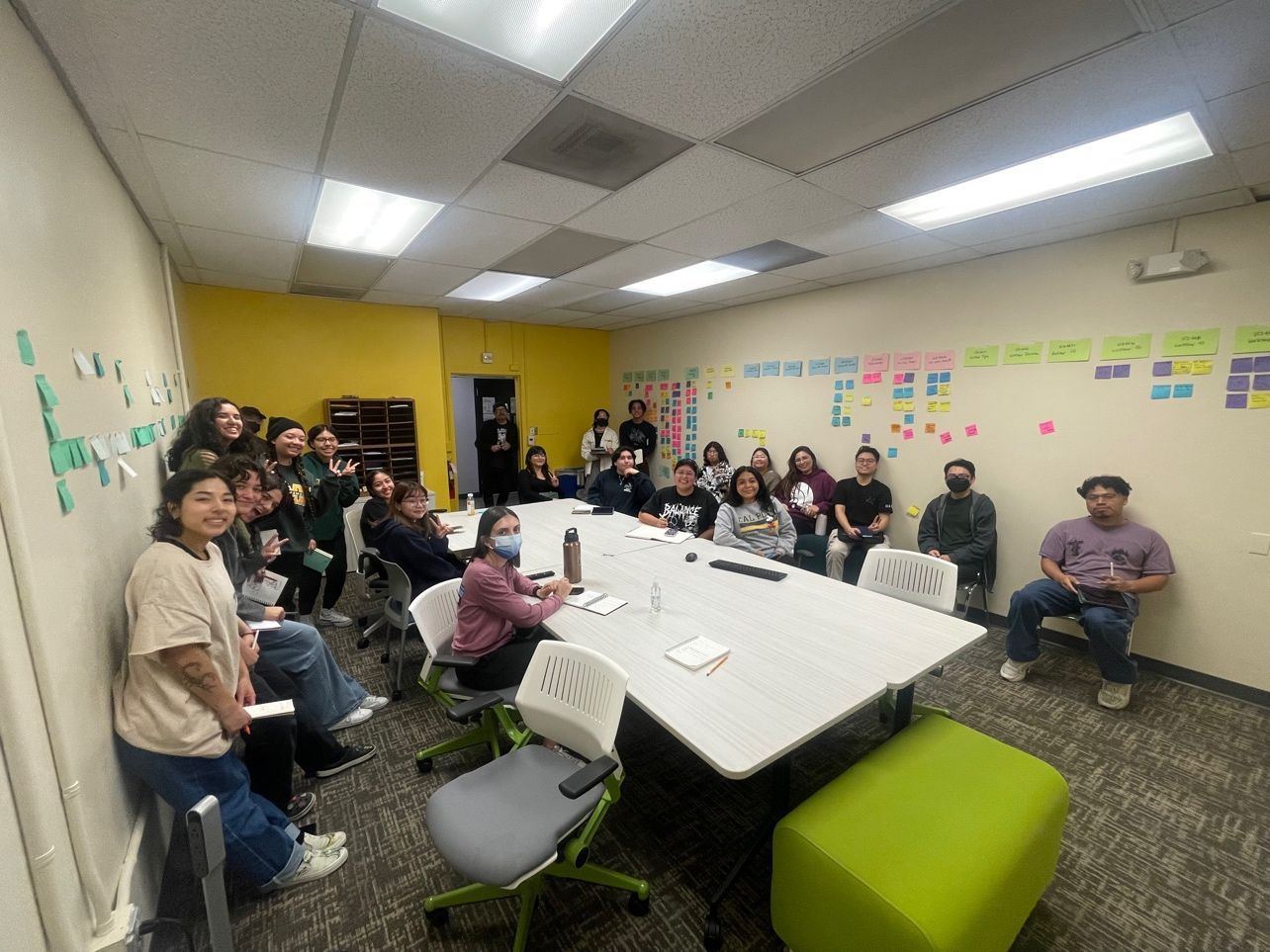
The student side of the community has a tangible example in Cal Poly Pomona’s fifth annual Design for Good Marathon, documented in February 2024. Working for the nonprofit It Gets Better, students divided into five teams and used a 24-hour format to develop materials supporting its work with LGBTQ+ youth.
The deliverables ranged across social templates, motion graphics, trade-show booths, activation spaces and digital assets. AIGA LA credited the student leadership, participating designers, Associate Professor Anthony Acock and the wider local design community. It is a useful reminder that professional experience can begin with a shared problem and a demanding deadline, before anyone has a permanent job title.
There is also a refreshingly candid detail about where the format came from. Cal Poly Pomona modeled its marathon closely on Creative Engine, an annual event run by the AIGA student group at the University of Central Missouri. A good community program can travel. Organizers can borrow its structure, choose a relevant local cause and give students a brief with an audience beyond their own classroom.
A pause that changed the brief
The chapter’s account of 2021 is less celebratory than a conventional anniversary story. Its town hall recap describes the pandemic and racial injustice as reasons to reconsider how it served its community. The board spent time on nonprofit governance training, participated in workshops about exclusion and internal culture, and created opportunities to listen.
The priorities it articulated were career development, ethical and equitable practice, and greater access to the profession. The account also identified Sam Cabrera as the chapter’s first Latina woman of color president. The emphasis was on changing who could participate and how leadership understood its responsibilities.
“Help designers adapt and grow in our industry throughout the arc of their careers”AIGA LA · 2021 town hall recap
Read alongside the chapter’s current mission, that reset helps explain why its vocabulary includes well-being and belonging as well as knowledge and professional pride. A community needs reasons for people to return at different stages of their lives. A conversation about work can include the person doing it.
The next archive is asking for entries
In June 2026, AIGA LA published a call for a logo book, IN COMMON PRACTICE: LA. The invitation accepts work from emerging and established designers, including client commissions, personal projects and experiments. Nonmembers may submit up to three logos. Members may submit without a numerical limit. Submission is free.
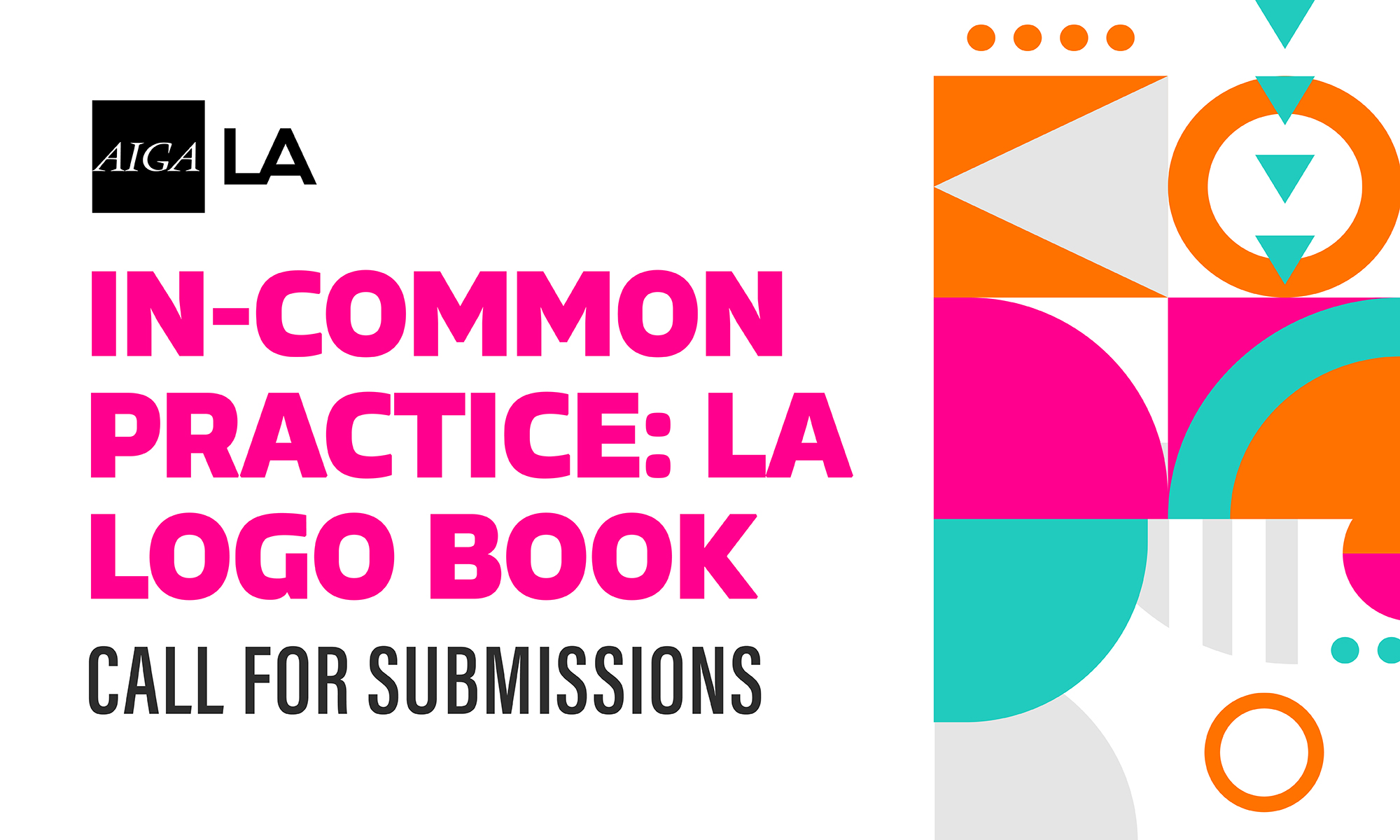
The choice of an open call matters. An archive assembled through familiar contacts can reproduce the same circle of names. Asking people to contribute offers a route for work that organizers might otherwise never encounter. The announcement presents the project as a record of a community’s shared practice, giving a familiar design-book format a local organizing purpose.
For a reader, the next step depends on the need. Bring unfinished work to a critique. Attend a career conversation with a specific question. Volunteer if you want to practice organizing alongside other designers. Check the open call if you have a logo that belongs in the city’s visual record.
These routes require participation, and they serve different purposes. Someone seeking a prescribed course sequence should inspect the program before committing; someone seeking clients should treat introductions as a beginning, with no promised commercial outcome. AIGA LA’s offer is more immediate and more usable: places to enter a conversation, contribute something and get to know the people who might keep it going.
Find your way into the room
Explore the AIGA LA website, event archive, chapter news and volunteer opportunities. Read the logo-book invitation or browse studio and designer interviews.