A six-foot table is an unglamorous place to build a design career. Yet the instructions for AIGA San Diego’s 2017 portfolio review made the proposition unusually clear: bring your work, arrange it properly, and prepare to discuss it with people who do this for a living. Student members entered free. Other students paid $20. No candles, no background music, no snacks on the display. The portfolio had to do the talking.
That combination of ambition and practical organization helps explain AIGA San Diego Tijuana. Established in 1987, the nonprofit professional association gives a scattered creative workforce places to gather, exchange criticism and make something together. Its territory includes two cities in two countries. The chapter describes itself as AIGA’s only binational chapter, a distinction that makes its calendar and its relationships especially interesting.
Its audience includes graphic designers, UX practitioners, illustrators, photographers, educators, students and creative entrepreneurs. What they get is access: to other professionals, to conversations beyond their immediate workplace, and to projects with a public purpose. AIGA SDTJ occupies the space between formal design education and the often solitary business of earning a living from creative work.
A chapter started on a dare
Founding member Ron Miriello remembers peers challenging one another to start a San Diego chapter. They wanted their work and their city to take a place in the national design conversation. “Peer pressure can be a good thing,” he wrote in a chapter profile. The line is funny because it catches a familiar professional impulse: sometimes the way to get braver is to stand near people with inconveniently high expectations.
The early chapter gave those expectations something substantial to work on. In 1989, Miriello and fellow founding board members helped bring 300 Soviet posters to San Diego for exhibition. The collection documented the era of glasnost and perestroika. International exchange was already part of the organization’s vocabulary, expressed through actual objects that audiences could inspect.
Then came a more repeatable gathering. The first Y Conference took place at San Diego City College in 1996. In a later retrospective, educator Candice López recalled students and professionals arriving from San Diego, Tijuana and Los Angeles. Over time, the event attracted speakers and attendees from farther afield. Its homegrown character mattered: a local gathering could put established practitioners and people just beginning their careers in the same room.
“The Y has always been about building community”
Candice López · educator and AIGA Fellow
The Y’s subject matter also reaches beyond a narrow definition of graphic design. Its Y26 speaker roster included visual identity designer Adam G, creative leader Theresa Fitzgerald, visual-effects practitioner Eric Alba and Máximo Escobedo. The range lets attendees encounter different ways of making a creative career. A designer working on a small brand can listen to someone thinking about immersive experiences, education or cross-cultural communication.
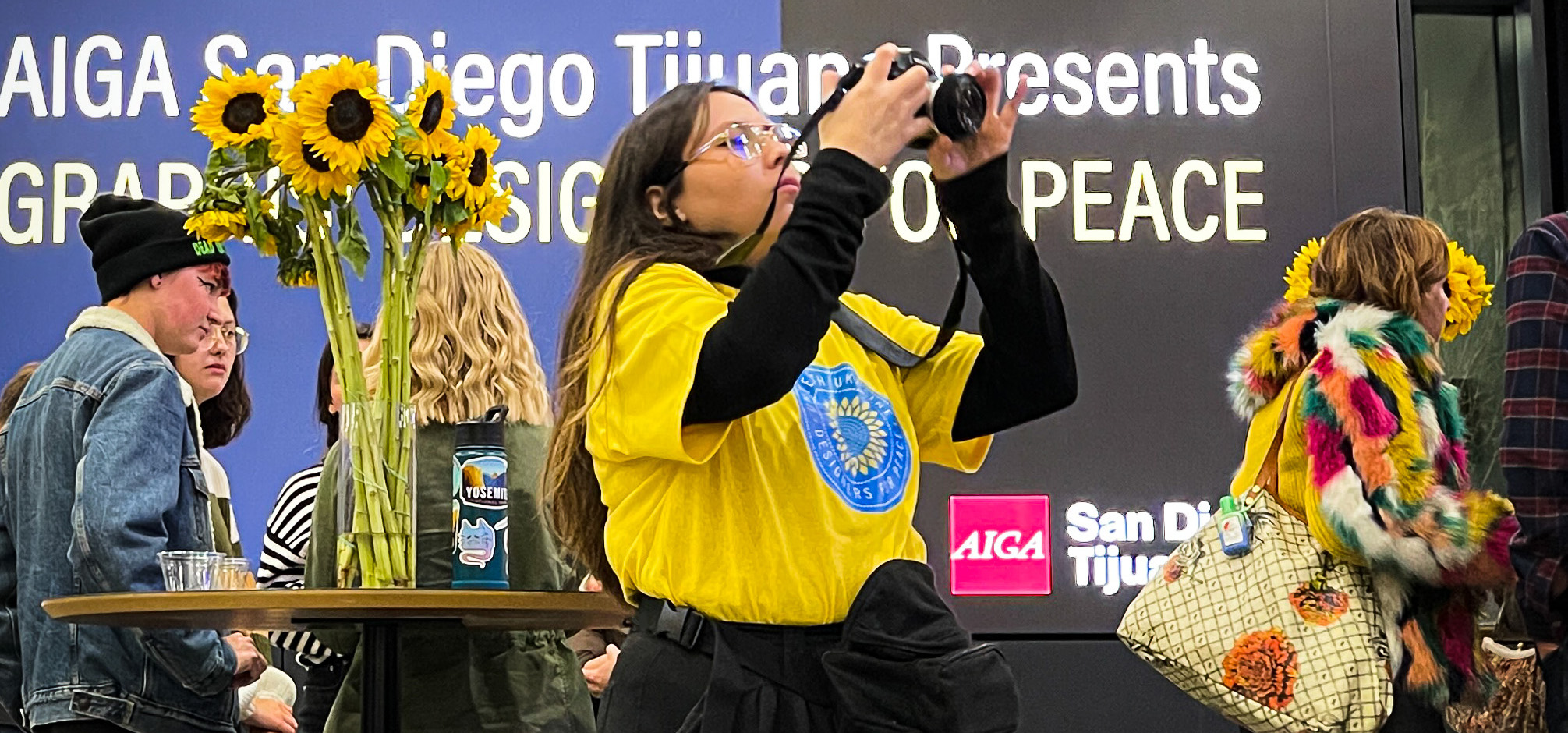
The border belongs in the brief
For this chapter, regional identity involves more than choosing a place name for the website. Current president Laura Araujo’s experience includes binational affairs, community engagement and the Tijuana side of the World Design Capital bid. The leadership roster also includes education, design practice and a Baja design community liaison. Those roles give the organization ways to hear from people whose professional lives take different routes through the region.
The international recognition arrived through a larger coalition. In November 2021, the World Design Organization named San Diego and Tijuana World Design Capital 2024, the first binational designation in the program’s history. Design Forward Alliance submitted the bid. AIGA chapter leader MaeLin Levine led the successful bid effort, according to the chapter’s account. The achievement belonged to a region and its collaborators.
Escobedo supplied another visible contribution: the World Design Capital brand identity. Having grown up in both cities, he brought a personal understanding of the binational community to that assignment. His 2024 San Diego Design Week presentation examined the identity’s development and its use as a platform for collaboration. The chapter’s connection to the designation ran through people doing specific work.

That wider audience also prompted the chapter to reconsider its own appearance. Its 2022 brand refresh brought together designers and brand leaders from both cities. The announcement connected the work to the approaching World Design Capital year and proposed a bilingual website strategy. A recurring 45-degree diagonal supplied a visual thread. The underlying decision was sensible: an organization representing a cross-cultural community needed its public identity to reflect it.
What $20 bought, and what money supports
The portfolio review offers a particularly useful look at the chapter’s product. In its published 2017 format, students displayed their work on tables, reviewers identified preferred specialties, and participants received scheduled individual feedback. Categories included branding, packaging, interactive work, typography and cross-cultural design. Structure made the encounter more purposeful than exchanging business cards and hoping for the best.
Historical event prices, not a current ticket offer.
Its broader access policy leaves room to try the community before joining. The chapter says membership is unnecessary for attendance, and that happy-hour mixers and hikes are free. Workshops and speaker events usually charge nonmembers more. The local about page advertises AIGA membership starting at $50 annually; the relevant membership category and current terms belong in the enrollment decision.
The operating model combines membership participation, ticketed programming, sponsorship, donations and volunteered expertise. Its board serves entirely as volunteers. Other volunteers help with communications, venues, event check-in and longer-running committees. This is a service organization whose capacity depends on people making time for it.
For someone deciding whether to participate, the useful question is specific: is there a critique, a workshop, a relationship or a project here that would help? In a published interview, Noble Intent Studio’s Angela Noble credited AIGA San Diego with connecting the studio to design leaders and to mentor Steven Morris. That is a concrete example of the association’s value traveling beyond the evening of an event.
Let the next generation into the room
LINK reaches young people before professional membership would be an obvious purchase. The chapter’s youth program connects students with creative professionals through workshops and mentoring. Its account of an earlier program year describes Saturday sessions with guest artists, an end-of-year art show and museum visits. Students were given opportunities to encounter both materials and the people who know how to use them.
Young people served in San Diego with support from the Coyne Foundation.
The figure is a measure of participation, not a claim that every student entered a design career. Its significance is still straightforward: the chapter reports bringing creative education to more than 1,200 young people with Coyne Foundation support. The foundation’s contribution helps make a professional community useful to people who are not yet professionals.
A newly announced collaboration with Media Arts San Diego gives that work a practical next assignment. The partners plan a free poster design workshop for people submitting to the 2027 San Diego Latino Film Festival’s poster call. Alongside design principles, the workshop is intended to explain preparing press-ready files. It sits within LINK, bringing the craft of making an image together with the less glamorous task of delivering a usable file.
The chapter’s Design for Good framework adds other routes into public-interest work: Diversity + Inclusion, Women Lead and Design for Democracy. These initiatives connect professional practice to questions of representation, leadership and civic participation. They also expand what counts as a useful contribution from a designer beyond a commercial commission.
A good conference still needs a workable budget
The region’s design history contains a caution about relying on enthusiasm alone. In an interview with UnderConsideration, organizer Jhoana Mora described efforts, supported by AIGA San Diego, to establish a Baja chapter. A shrinking group organized a conference in Ensenada in 2000. Financial losses helped end plans for a second edition.
Mora already had some speakers confirmed and decided to continue. After four months of work, she launched the independent Esquina Norte conference in Tijuana in 2001. This episode belongs to the wider Baja organizing story, rather than a financial account of today’s AIGA SDTJ. It does show how a failed event plan can leave useful relationships behind.
The present chapter has encountered a different vulnerability of gathering people. In March 2020, its pandemic update postponed public programming, including LINK’s in-person activities, and pointed participants toward virtual connection. An association built around meetings needs alternatives when meeting becomes impossible. Volunteer energy and a compelling program cannot, by themselves, remove logistical constraints.
Twelve designers, then a better question
A recent workshop with CETYS Universidad Ensenada brought together 12 local graphic designers to discuss the profession’s condition and identify where AIGA could help. Diana Robinson and CETYS colleague Scalia Mellink helped make it happen. The chapter described this as ongoing work and expressed interest in further workshops in San Diego, Tijuana and Mexicali.
There is an approach worth borrowing here: ask a defined group what it needs, choose a manageable activity, and give participants a role in shaping it. The portfolio review, the guest-artist workshop and the Ensenada discussion each put boundaries around a large ambition. People can understand what they are being invited to do.
For a newcomer, the practical first step is to check the calendar or join the mailing list. For an experienced designer, it may be to offer a workshop or help a committee. The chapter’s usefulness grows through that participation. AIGA San Diego Tijuana gives the region places to practice being a design community; the next conversation still needs somebody to pull up a chair.