There is a point at which a piece of paper stops being precious. Julie Markfield’s collage paintings make a persuasive case for reaching it. Scraps of her own artwork become material for another composition: torn, moved, reconsidered. A painted passage can have a second life somewhere else. For someone who spent decades working with corporate identities, the willingness to pull a picture apart has a certain charm. She knows how much effort goes into making something look resolved.
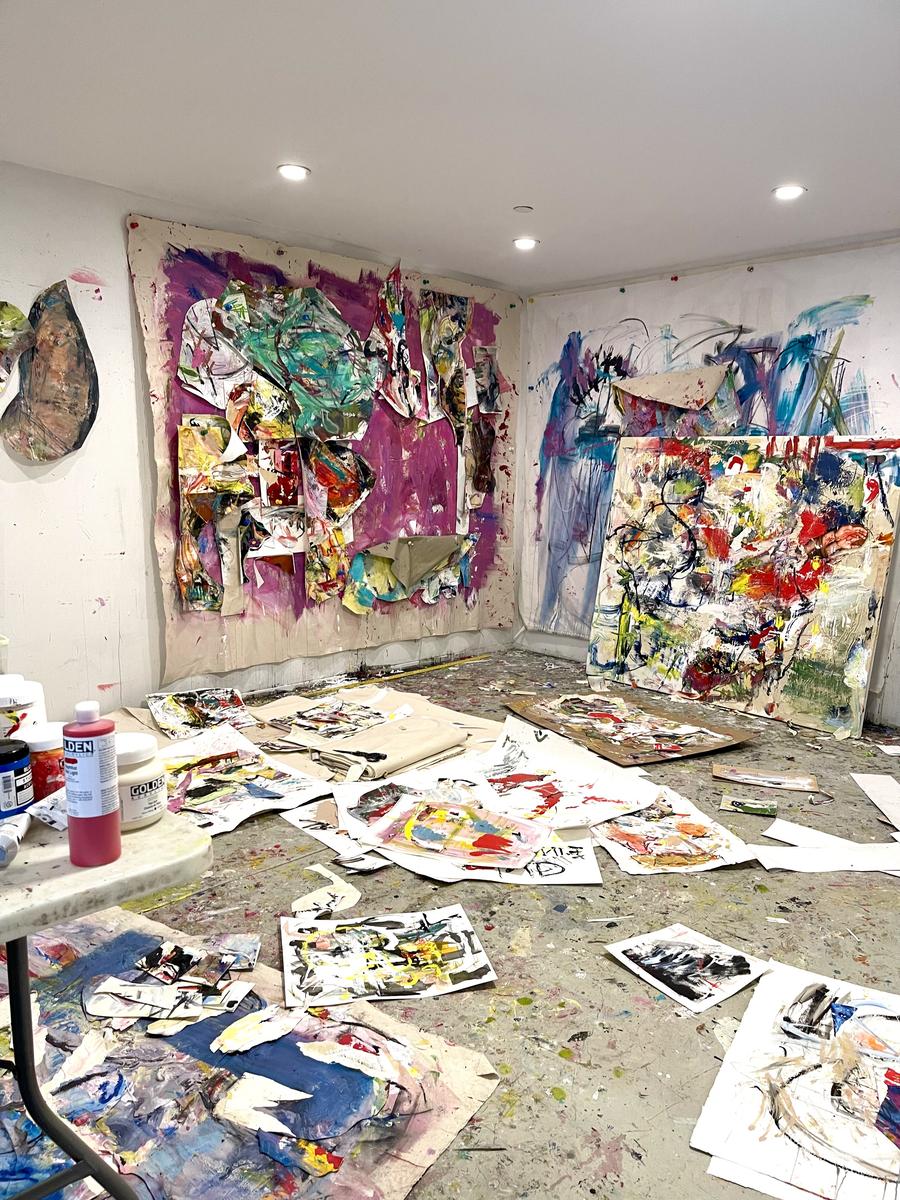
The studio photograph is practically an argument in color. Painted sheets cover the walls. Pieces scatter across the floor. A canvas leans into the room, its surface busy with marks. There is very little here to suggest that tidiness is the measure of a productive afternoon. The eye has plenty to do before it reaches the paint bottles.
Markfield co-founded CMg Design in 1992. Her later painting practice draws on the same questions that occupy a designer: how forms sit together, how color changes a surface, where a viewer’s attention goes. But a painting allows those questions to remain more open. The person who once helped organizations present themselves now makes work that invites a longer, less directed look.
Before the business card, a change of course
Growing up in Buffalo, Markfield found visual education in places outside a classroom. Temple Beth Zion, designed by architect Max Abramovitz, impressed her with its poured-concrete walls. The Albright-Knox Art Gallery gave her another way to think about art, light and space. Architecture and paintings were part of the same early discovery: a place could make you look differently.
At the University of Michigan, she began in political science before transferring to the School of Art. She had worked out that becoming a lawyer was not what she wanted. The creative alternative was less neatly defined. That is a useful detail in a career often described backward, with every early decision made to look like preparation for the final result. At the time, there was a course to change and an uncertain destination.
Her degree was a BFA in graphic design. Further study took her to Parsons School of Design, the New England School of Photography and Brunel University; she also studied with Wendell Castle and Lazlo Roth. Design and photography gave her practical ways to work with a frame. Painting would eventually give that training another outlet, though the route there included many years of running a company.
An education on the lake
Ask where business confidence comes from and an entrepreneur can usually produce a respectable answer involving a mentor or an early job. Markfield has another candidate: Camp Timberlane. She spent ten summers there, from eight to eighteen, and later connected the experience to her ability to run CMg. A childhood place became part of her account of professional adulthood.
Her memories are specific: the movement of swim docks, loons at dusk, bonfires, camp musicals and a friend named Sandy. She counted the days until she could return. The activities demanded participation, including the ones she did badly. The group required its members to get along. Trying, failing and having another go were ordinary parts of the day.
It is easy to treat those experiences as pleasant background scenery. Markfield gives them more weight. In her telling, independence and confidence grew through repeated attempts in company with other people. That is a plausible education for a design founder, whose work depends on making decisions while accommodating clients, colleagues and all the competing opinions a layout can attract.
The client still has to recognize the company
At CMg, visual decisions had public consequences. Consider Mercury Insurance’s refreshed identity, introduced alongside its first national advertising campaign in January 2015. Mercury credited CMg Design with the logo. The company wanted a mark that would work across digital media while maintaining a connection with its past. Recognition had to survive the refresh.
That brief contains a useful tension. A business wants to look current, but its customers should still know whose message they are seeing. The designer has to make change visible without spending the recognition already earned. A logo gets a small space in which to negotiate all that history. It can hardly ask the viewer to sit down while it explains.
Markfield’s work also included a very different exercise in identity: the Words2Action logo. The nonprofit, the parent organization for TEDxPasadena, supported opportunities including mentoring and educational programs for teenage girls. CMg built its mark from more than two dozen words connected with the organization’s values and community.
An arrow gave the composition direction. The typeface, Lulo Clean One, and a lively palette helped turn the words into an image. This was a logo that rewarded getting closer. The vocabulary was part of the structure, giving the organization’s purpose a visible place inside its identity.
Two kinds of studio work
Painting did not arrive only after the design career had ended. In June 2015, Markfield was already describing the difference between her work as CMg’s creative director and the tactile experience of entering her painting studio. Her solo exhibition at Curve Line Space in Eagle Rock ran that summer. The two practices overlapped, with different demands on the same person.
A client project required collaboration and coordination. The painting studio offered brush, paint and a surface to explore. That overlap matters because a career change can sound like an abrupt departure when viewed from a distance. Here, the next practice was being exercised alongside the established one. She could discover what painting offered while she still understood herself through design.
By 2019, Awakening & Remembering at Tufenkian Fine Arts brought her paintings on paper into a Glendale gallery. The works used bright, thick applications of paint alongside translucent washes. Lines and brush strokes gave the surfaces their own movement. These were intimate decisions made visible: a gesture, a layer, a color allowed to hold its place against another.
The exhibition title left room for discovery and recollection at once. It suits a painter who came to a new medium with a practiced visual memory. The experience of design remained available even when there was no corporate message to organize. Her eye had already done years of work. The materials were asking it different questions.
A garage, enlarged ambitions
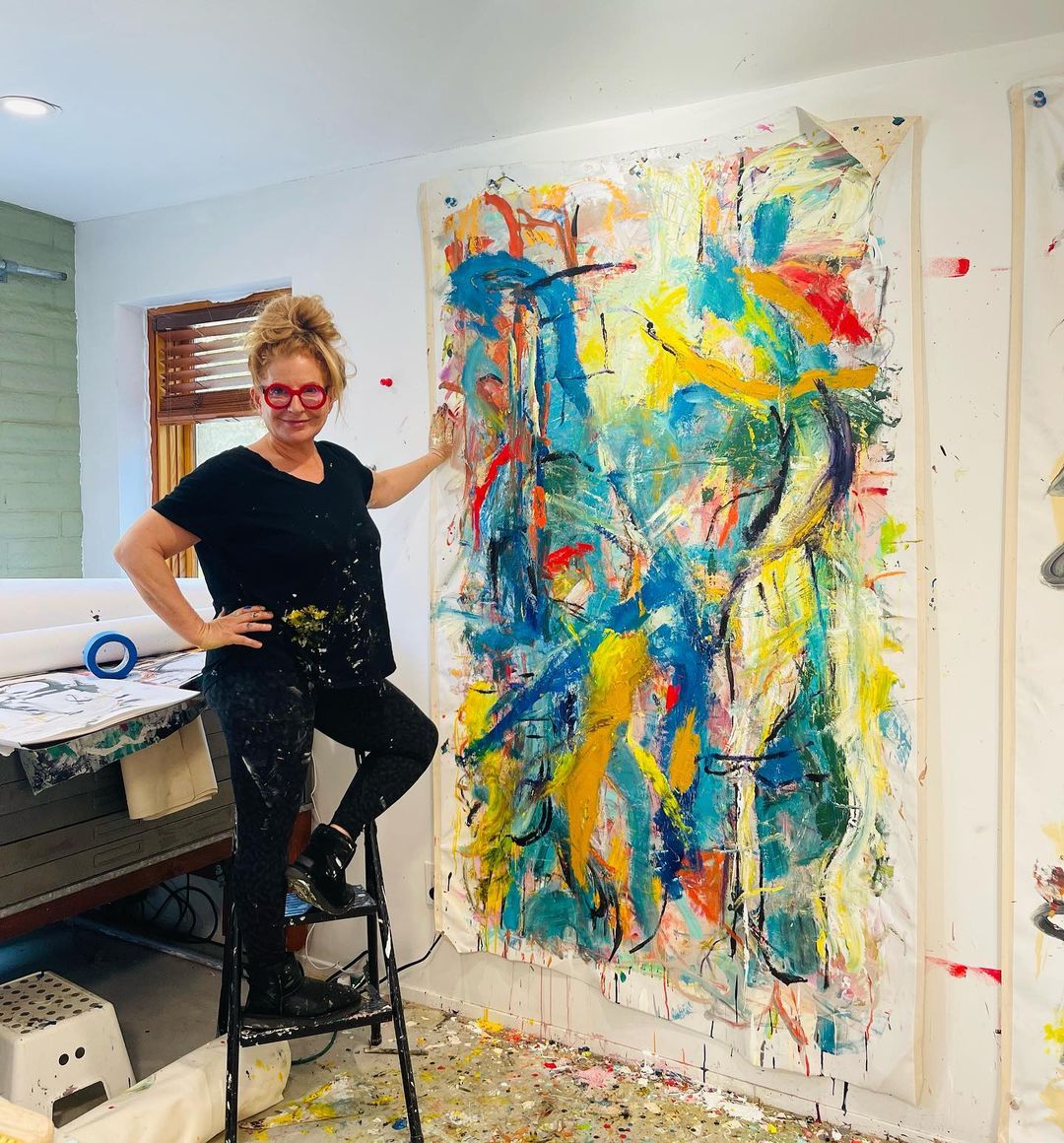
In June 2022, Markfield gave her new direction a brisk title: “Don’t Retire. Rewire.” A converted garage had become a painting studio. Some of the collage paintings reached nine feet in length and seven feet in height. Whatever else the next chapter involved, it was going to need wall space.
She connected the work directly to her years in design: an understanding of balance, tension, texture and color carried into a different format. Starting again did not require setting aside that experience. It meant finding another use for it, with enough room for a larger gesture and enough freedom for the result to surprise its maker.
There was a practical ambition alongside the excitement. She described a pop-up in a commercial space intended to become her home and studio and a place for other creatives. The wish to make things was accompanied by a wish to make a setting in which things could happen. Her language about the future sounded closer to a graduate looking ahead than a professional closing the office door.
Lengths and heights reached by some collage paintings described in her June 2022 essay. A scale reference, not the dimensions of a single identified work.
The room is part of the story
That interest in a creative setting runs through her life with architect Greg Crawford. Their former Glendale home grew out of an unpromising house in a wooded setting. The renovation made room for family, artwork and entertaining. A former garage eventually became her studio. Spaces changed as the people using them changed.
The couple’s taste included vintage finds and unexpected solutions. Their humor was equally domestic. Describing her husband in 2019, Markfield offered: “He’s not as funny as me, but he’s really smart.” It is an economical marital review, generous enough to keep the peace and pointed enough to establish the house comic.
In June 2024, she wrote that they had decided to sell the home and begin another project. Her account remembered parties, school events, wildlife and their daughter’s wedding there the previous November. The decision placed another change in a life already marked by them. A much-loved place could remain central to family memory while its owners looked toward something else.
“He’s not as funny as me, but he’s really smart.”Julie Markfield, on Greg Crawford, 2019
A new picture under the old one
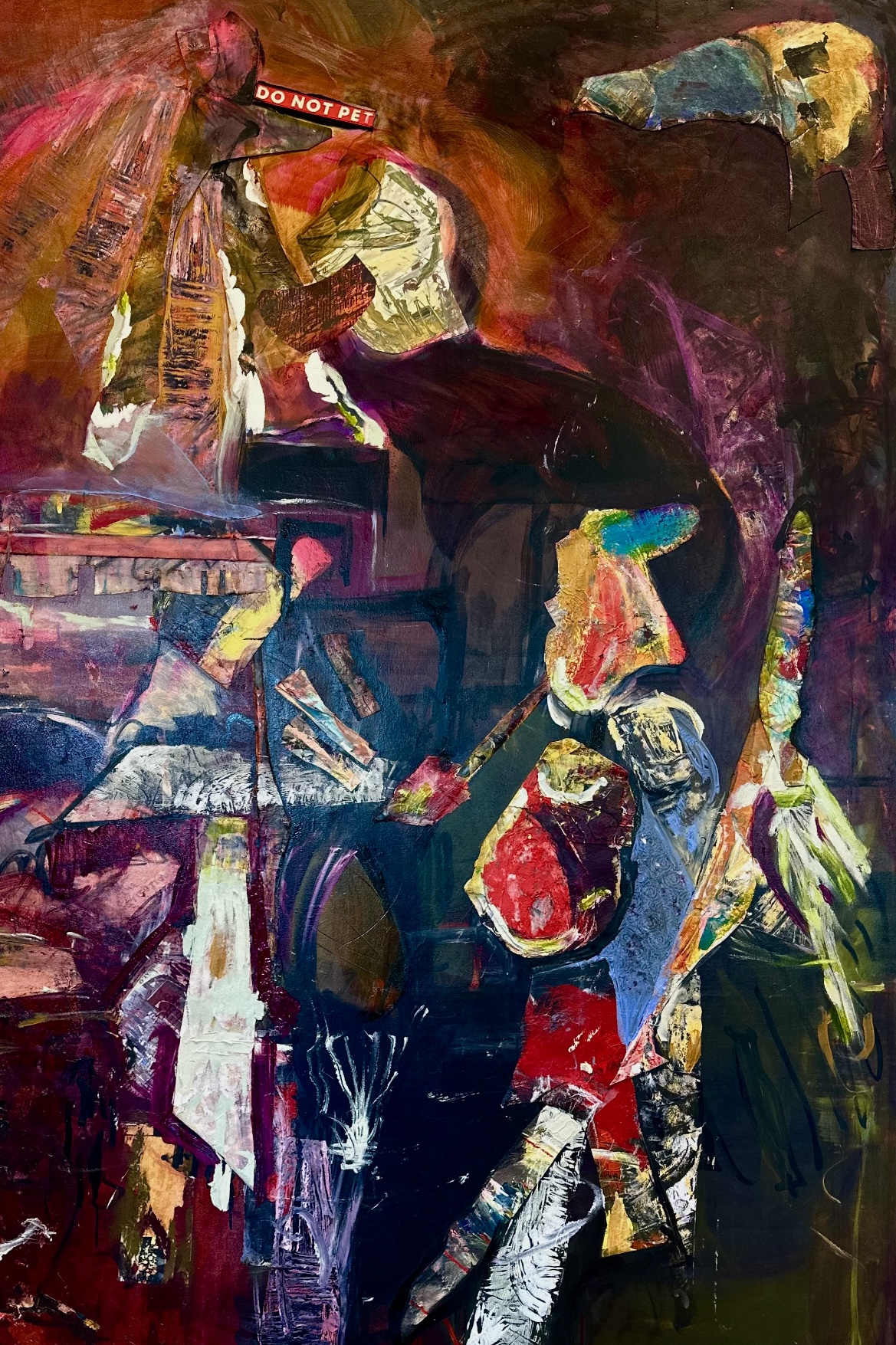
Her 2025 exhibition, POWER Obscured, introduced another way to approach an existing image. The works listed on her website pair new titles with the people in the original paintings: Ronald Reagan, Nancy Reagan, Gerald Ford, Rosalynn Carter and Calvin Coolidge among them. Warrior Man identifies its original subject as Millard Fillmore. The familiar task of presenting an identity now meets images that already carry one.
The titles offer little flashes of everyday life: Loafers and Whiskey, Watermelon, Joyful Noise. They sit beside the formal associations of presidential portraiture. Without requiring a single prescribed reading, that pairing creates a question for the viewer: what remains of the original subject when a painting acquires another surface, another title and another person’s decisions?
The exhibition was listed for September 27, 2025, at the Bilden Building in Pasadena. It joins a sequence of gallery exhibitions and pop-ups that has kept her painting practice public. Her work also moves through other settings: showroom display, commissions and art rental for film and television. A canvas has several possible destinations once it leaves the studio.
For Markfield, that next setting can be a collaboration. She works with collectors and interior designers on matters including scale, placement and framing. Those are recognizable concerns for someone trained to think about how one element affects everything around it. Even a painting made freely has to meet a room, a wall and a person who will live with it.
The distance from a corporate identity to a collage is considerable. The connection becomes easier to see in the decisions: keep this shape, move that passage, let one color change the balance. A career accumulates material too. Markfield has found room to rearrange hers. Somewhere in the studio, another piece of paper is available.
Spend a little more time with the work
Explore the paintings, her writing and a conversation about the studio.