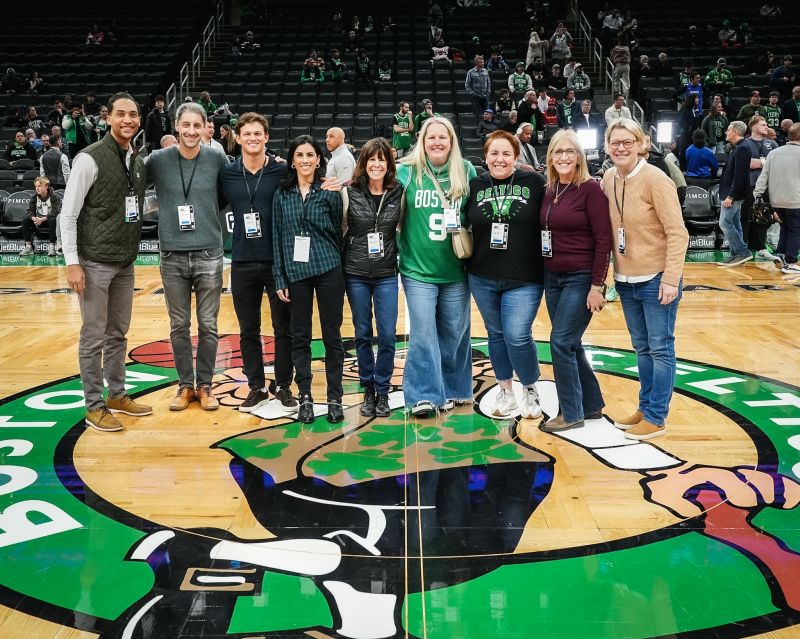
Alex Marcus got onto the Celtics' court. He did not get a shot. At a Mento gathering during a Celtics-Bulls game, the former college lacrosse player found himself on the parquet with his co-founder, Jamie Albers, and a group of HR leaders. In his account of the evening, he was grateful for the company, pleased with the business they were building, and still disappointed that nobody had handed him a basketball for a three-point attempt.
It is a useful place to meet him. Marcus sells the value of having someone in your corner, and here he was, assembling a corner of his own. There were customers to meet, a partnership to celebrate, and a game going on. The photograph has the happy informality of a work trip that briefly forgot to be work. Everybody has a lanyard. Nobody appears to miss the conference room.
Marcus and Albers share the title of co-founder and co-CEO at Mento, a company that pairs professionals with coaches who have experience doing their jobs. The proposition sounds obvious until you consider how much professional advice arrives without that qualification. A promotion can come with a new title, new expectations and a startling shortage of instructions. Marcus has made that gap his business.
Before the corner office, the face-off
Long before he had a coaching company, Marcus had a coach. At the University of Michigan, he played varsity lacrosse. The 2012 roster lists the Greenwich, Connecticut, freshman as a face-off specialist wearing number 32. His season included five appearances, two ground balls and three successful face-offs in ten attempts. These are pleasingly concrete details in a career that would eventually involve the rather less concrete business of developing potential.
The sporting life extended beyond lacrosse. His college biography records letters in football and wrestling at Brunswick High School. He went on to earn a bachelor's degree in Economics and Entrepreneurship at Michigan. The combination gives his later work an interesting vocabulary: competition and preparation on one side, incentives and building businesses on the other. It does not make his destination inevitable. Plenty of college athletes manage to graduate without establishing a company about coaching.
What it does provide is a practical point of reference. An athlete can be ambitious, capable and in need of instruction at the same time. Advice is part of showing up. In a workplace, asking for it can feel like an admission that the promotion committee made a clerical error. Mento's appeal rests partly on making that ordinary request for help easier to act on.
A résumé with several kinds of talent
Marcus's early career crossed some unusually different rooms. There was research and finance work at the UFC, followed by research and assistant roles at William Morris Endeavor. His account of the agency work includes tracking television networks' needs, organizing opportunities, following deals and servicing clients. That is the practical machinery behind an industry better known for its names on posters.
At Disney Accelerator, where his public professional history places him from 2016 to 2018, he worked on identifying new businesses and investing in startups. Slow Ventures followed. Sports, representation, corporate innovation and venture investing all appear in the sequence before Mento. The common subject was people trying to turn ability into a commercial result, though the job descriptions varied considerably.
It would be convenient to declare that each stop supplied one essential ingredient for the company he would later build. Careers rarely arrange themselves so politely. What the sequence does establish is that Marcus had seen several systems for recognizing talent and supporting it. The assistant servicing a client and the investor evaluating a startup occupy different seats. Both have to understand what another person is trying to accomplish.
- MichiganEconomics, entrepreneurship & varsity lacrosse
- UFC & WMEResearch, finance & agency work
- Disney AcceleratorStartup discovery & investing · 2016-18
- Slow Ventures → MentoFrom venture work to building a coaching company
The job search came first
Mento's early public offering was closer to the job hunt than the executive suite. In a 2021 announcement, Marcus invited people looking for a new role to apply for the company's beta program. The offer brought together coaching, résumé and LinkedIn support, practice interviews, workshops, and access to recruiters and employers. The company even offered to do the writing. Anyone who has spent an evening rearranging the same four résumé bullets can understand the attraction.
That early package matters because it puts a recognizable task underneath the later language of leadership development. People wanted to decide what came next, explain themselves to an employer and get through an interview. Those are specific moments with consequences. The current business addresses a different set of work problems, but the emphasis on useful help remains recognizable.
Albers brought another experience to the partnership. At Alphabet's Jigsaw, she had reached the C-suite before she had ever been a manager. A coach with operating experience helped her navigate the work. Finding that person had been difficult; making the relationship available to more people became part of Mento's founding rationale. Marcus's own experience with sports and career mentors gave the pair common ground.
Leave room for an actual answer
The method they developed gives most of the conversation to coaching and a smaller portion to mentorship. Mento calls the mix 80/20. Coaching asks questions that help the client think; mentorship allows the experienced operator to contribute practical guidance. A person can need both in the same meeting. One minute the difficulty is deciding what matters. The next, it is figuring out how to do it.
The ratio is an organizing principle, rather than an instruction to set a kitchen timer. Mento's explanation adapts the approach to a person's experience and commitment. Someone eager but inexperienced may benefit from more hands-on guidance. Someone with experience may need a conversation that helps them work out why they are hesitating. The coach has to notice the difference.
For Marcus, the attraction of that flexibility is personal as well as commercial. He has described receiving coaching himself from a founder who could move between the immediate detail and the wider business. He values uninterrupted time to think, alongside the ability to get practical. A supplier of guidance is also a customer for it. That is a more useful credential than pretending to have outgrown the need.
“80 minutes of uninterrupted time to think through your business is rare.”
Alex Marcus, on his own coaching experience
The work between the appointments
By 2026, the company Marcus was presenting had a substantial technology component. Mento joined SHRM's WorkplaceTech Accelerator cohort, and Marcus appeared with Albers on its All Things Work podcast in September. The conversation included the role of AI in leadership development. His description emphasized context and confidentiality: better support for the person being coached, with individual sessions kept private.
Mento's current product makes that proposition tangible through session summaries, preparation and insights across multiple conversations. The point is to help someone carry a useful discussion into the next workday. Even an excellent meeting has competition: another call, a deadline, a document that needs an answer. A coaching insight has to survive all of them before it becomes a change in conduct.
There is a less glamorous side to making that work, and Mento's platform gives it space. Members can choose topics, prepare notes, give feedback and manage their appointments. A growth plan connects a larger ambition to actions they can take. Self-assessments and feedback from peers offer another view of progress. Community events, introductions and a Slack community add contact beyond the individual coach. Taken together, those features show the operational problem Marcus has chosen: a useful relationship needs arrangements around it. Someone has to remember the goal, prepare for the conversation and return to the task afterward. Software can make those steps easier to organize. The person still has to take them, including on the busy days when an appointment feels easier to postpone.
The company also asks to be judged on outcomes. Its published figures say 93 percent of respondents report stronger performance after coaching and 98 percent consider it worth the investment. Those are Mento's reported assessment results, drawn from more than 1,400 survey responses across over 100 companies. They describe participants' assessments; they should be read at that scale. For Marcus, the business question remains practical: does someone return to work better equipped?
Company-reported pre- and post-coaching assessments · 1,400+ survey responses · 100+ companies
A promotion with the instructions attached
That question also reaches inside his company. In a public recruiting post, Marcus described sales associate roles with predefined goals that would trigger promotion and an opportunity to begin closing deals. He credited sales leader Clay Steel for the structure. For a business built around career development, explaining how a person can advance is a revealing place to apply the product's premise.
The Celtics evening offers a less formal version of the same interest in people. Marcus wrote about road trips with Albers for customer visits, fundraising, conferences and offsites. His ambition was to keep building an enduring business together. In those memories, the company acquires a geography beyond the platform: conversations in other cities, people met in person, a partnership measured in miles as well as meetings.

He was once a freshman whose contribution could be counted in face-offs and ground balls. Now he works on a problem with less obliging arithmetic: helping people improve at responsibilities they are still learning to carry. The business has changed since the job-search beta, and the tools keep changing with it. The request underneath is familiar enough. Someone has been asked to step up. They would appreciate a person who knows the game.