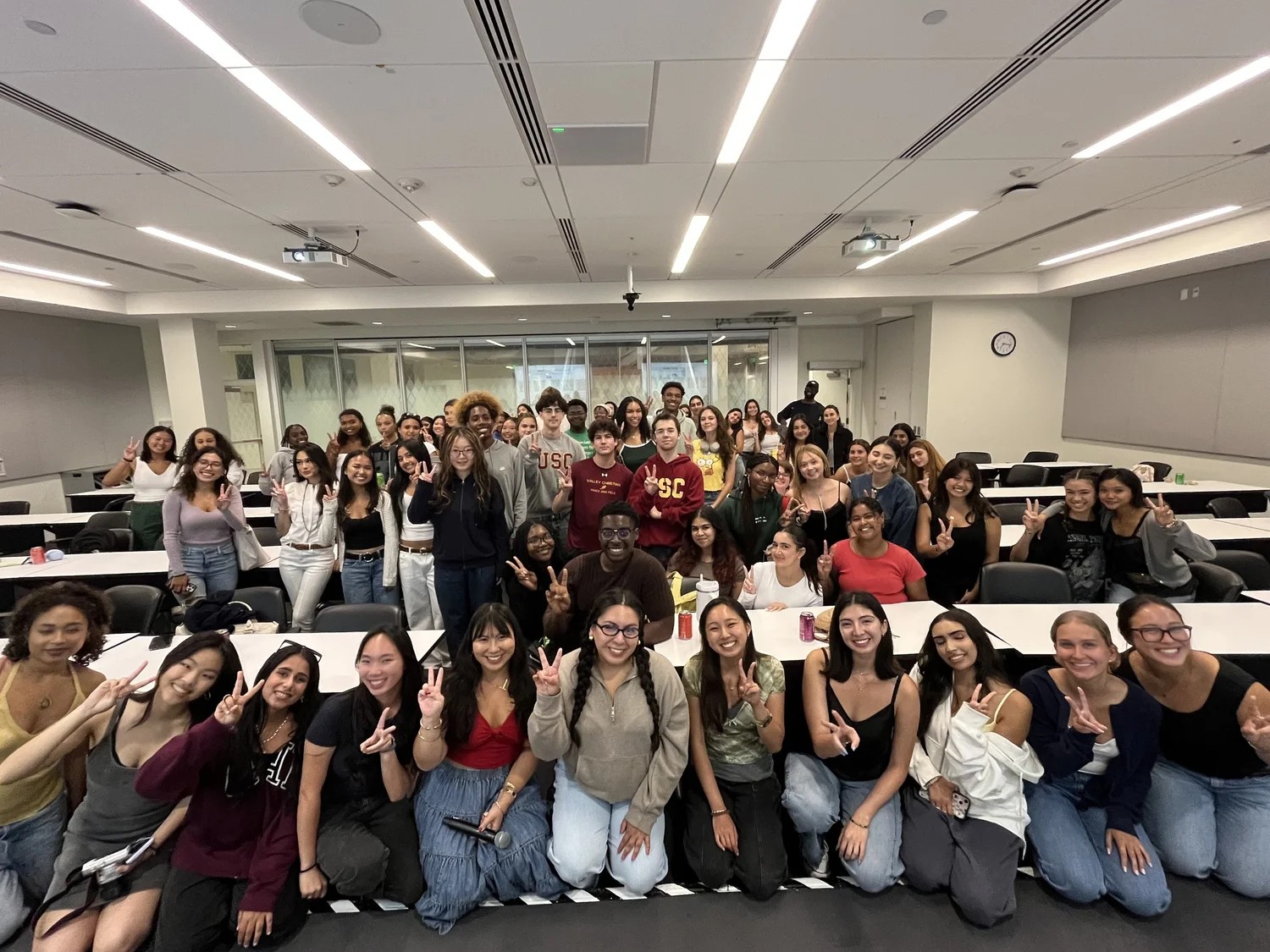
The room is full of people holding up two fingers. It is the familiar USC victory sign, multiplied across several rows of students in a bright Annenberg classroom. Some have come for a speaker. Some have come for the possibility of a job. A few, almost certainly, have come because a friend texted that they should. This is how a professional network begins when everybody in it is still carrying a backpack.
USC PRSSA is the University of Southern California chapter of the Public Relations Student Society of America. Calling it a club is accurate in the same way that calling Los Angeles a collection of streets is accurate. The description misses the traffic. More than 135 active members move through a system of speaker panels, mentorship, agency tours, workshops, scholarships, social events and live client work. The point is not merely to learn what public relations people do. The point is to make the first day of doing it feel less like the first day.
The first thing that fails is abstraction
Public relations looks tidy in a syllabus. There is research, then strategy, then a message, then an audience. In practice, the client changes a sentence at 4:57 p.m. The venue has a loading dock nobody mentioned. The reporter does not reply. The clever social post is not clever after legal review. The first casualty is abstraction: knowing the steps is different from carrying them out while somebody else is waiting.
USC PRSSA's answer is PRSC, its student-run public relations firm. Students work in teams on real marketing and communications assignments across entertainment, food, fashion and social impact. They handle media relations, social media and event production. Prior experience is not required. That detail matters because the usual entry-level riddle asks applicants to possess experience before anyone has allowed them to acquire it. PRSC removes the circular logic by letting the work create the qualification.
The assignments are conspicuously tangible. PRSC has arranged press screenings for Shazam! Fury of the Gods. It has brought a NASCAR stock car to campus. USC lists Warner Bros. Discovery, Apple TV+ and NASCAR among past or present clients. These are good names for a résumé, but the logos are not the real product. The product is the sequence of decisions behind them: finding an audience, writing the pitch, coordinating the room, discovering what did not land, and trying again while the event date refuses to move.
“Our deep passion for storytelling and strong sense of community are at the heart of USC PRSSA.”USC PRSSA, describing its own center of gravity
A network is more useful when it has a calendar
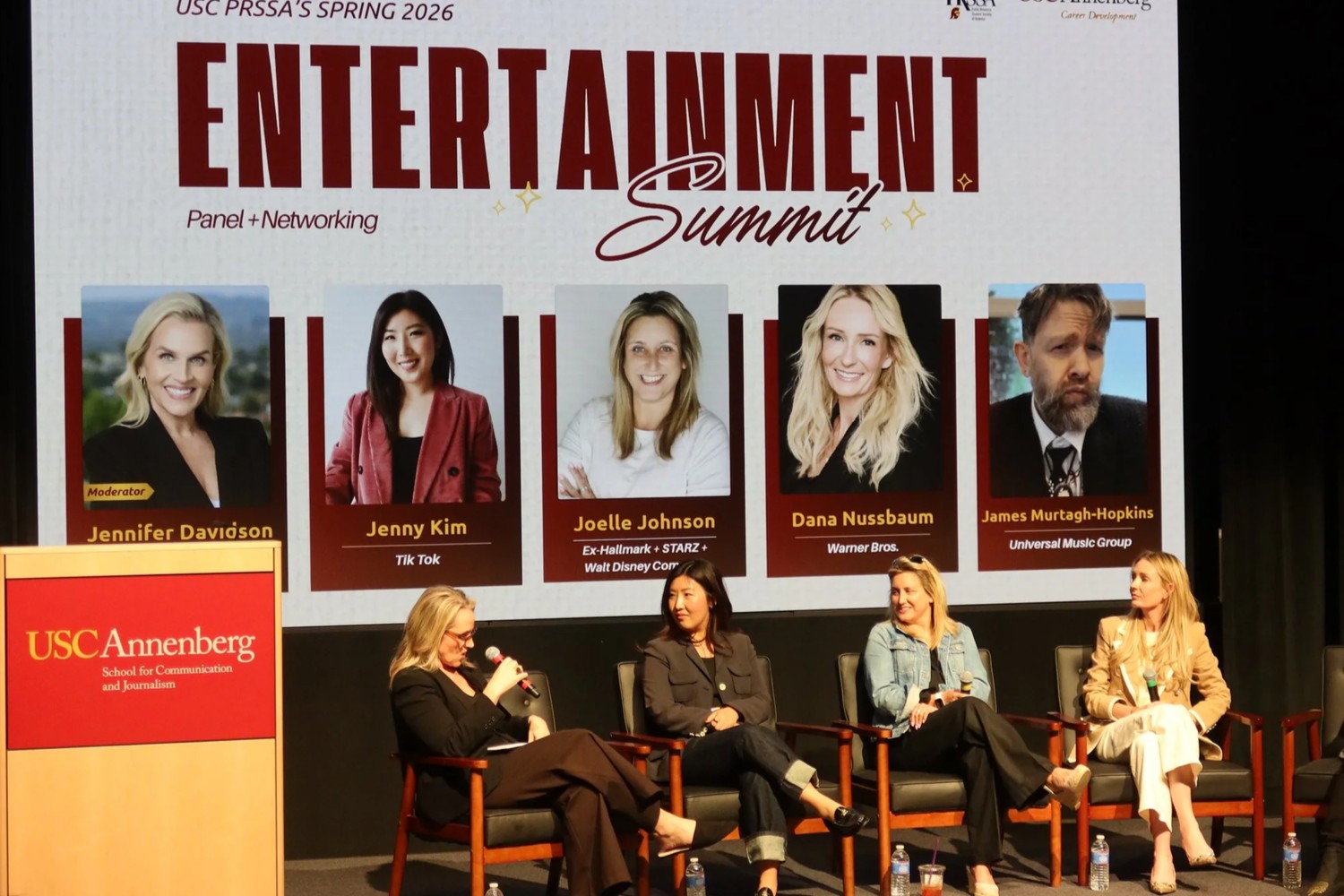
Students are routinely advised to network, which is not far from telling a person to “be lucky, but deliberately.” USC PRSSA makes the instruction concrete. It schedules the room. In February 2026, more than 150 students attended its Entertainment Summit to hear from professionals connected to TikTok, Warner Bros., Walt Disney and Universal Music Group, then stayed to network. The previous edition brought USC alumni from Variety, Billboard, Disney+ and Amazon Studios back to campus. An alumni mixer, a Women in PoweR panel, a virtual New York gathering and a personal-branding workshop with USC's Depop ambassadors all apply the same idea: professional access should be an event you can put on a calendar, not a favor you hope to receive.
The chapter's Los Angeles location sharpens the proposition. Entertainment publicity, brand marketing, sports communications, nonprofits and agencies are not remote industries here. They are neighbors. USC PRSSA's advantage over a generic career club is its ability to combine a national association, a major communications school and a city thick with practitioners. Its alternatives are familiar: internships, other campus groups, student media, independent networking and other PRSSA chapters. Its difference is the stack. Members can meet a practitioner at a panel, see an agency from the inside, join a campaign team and return to a social circle that speaks the same professional language.
What, exactly, does $70 buy?
The Spring 2026 membership form priced one full year at $70. The chapter said those dues kept the organization running and unlocked member access to scholarships, awards, certain events and other resources. Seventy dollars is not nothing to a student. The honest case for it is not swag or belonging, though both may help. It is reduced uncertainty. A tour answers whether agency life feels appealing. A mentor catches a weak portfolio before a recruiter does. A client brief exposes which skills survive contact with reality. A panel supplies the question a student did not know to ask.
Its business model is correspondingly modest. USC PRSSA is a member-supported student organization affiliated with national PRSSA. PRSC invites inquiries from potential clients and promises to review them within 48 hours, although it does not publish a client fee schedule. This is not a venture-backed training platform, and revenue is not the point. The customers arrive in two directions: students want experience and connection; client organizations want ideas and execution. PRSC makes each side useful to the other.
Practice, feedback, contacts and a portfolio without an experience prerequisite.
Panels and tours explain the field. PRSC makes students perform inside it.
Media relations, social strategy and events carried out in a supervised student setting.
The part anyone can copy
The transferable lesson is not “start a PR club.” It is to build a short circuit between explanation and consequence. Invite a practitioner, then give members a brief related to what they heard. Tour the workplace, then ask students to map its roles. Pair inexperienced members with experienced ones, but keep both accountable to something a client will actually see. Finish with a postmortem. The loop is simple: observe, attempt, receive feedback, show the work.
That loop depends on conditions USC can plausibly supply: a large student body, engaged alumni, advisers, client trust and a city dense with communications work. Copying only the visible parts - the panel, the group photograph, the impressive logo slide - would produce theater. A smaller chapter could still use the method, but it would need narrower briefs, dependable local partners and enough supervision to protect both students and clients. Live work teaches precisely because the stakes are real; without guardrails, the lesson can become an avoidable client problem.
There is a revealing thread in the chapter's history. In 2016, a USC PRSSA essay argued that communicators would need fluency in analytics, technology and digital platforms, not merely the ability to post on social media. A decade later, the tools have changed and the warning has aged well. The chapter now occupies the place where such predictions become behavior: personal brands are built, digital campaigns are run, industry people are questioned and students discover the inconvenient details that no trend report can rehearse for them.
That is why the crowded classroom matters. Every person in the photograph has access to the same lecture notes. What differs is how many times each person has had to make a decision with an audience, a deadline and another human being on the other side. USC PRSSA sells no shortcut around the work. Its $70 shortcut leads directly into it.