There is a small absurdity at the beginning of many public-relations careers. The applicant is young because the job is junior. The applicant is rejected because the job requires experience. Everyone agrees experience matters; nobody volunteers to provide the first piece of it. At California State University, Fullerton, a student organization has spent decades constructing a way around this loop. It costs $80 a year.
That fee - $55 for national PRSSA membership and $25 for the local chapter - buys no guaranteed job and no magic credential. It buys proximity: to working communicators, to peers who care about the same odd blend of words and persuasion, to offices on agency tours, and, for students selected into Titan Public Relations, to clients with opinions and deadlines. This is a more consequential product than it sounds. Careers often begin not with knowledge but with a room in which knowledge must be used.
01 / The useful middle
A club, an agency and the space between
CSUF PRSSA calls itself a pre-professional organization. The phrase is accurate but bland. In practice, the chapter is a small communications ecosystem. Nearly 250 members can attend speaker panels, workshops, career tours, mixers and conferences. They can work on committees or run for an executive-board role. They can access national scholarships, competitions, publications, internship listings and events. Membership is open across majors and even to students from nearby colleges.
Then there is Titan Public Relations. Founded in 2009 by alumnus Aria Fadakar, the student-run firm organizes volunteers into account teams serving real organizations. Its menu resembles that of a modest agency: social and brand management, outreach campaigns, media relations, cross-channel marketing and in-person promotion. Most projects are pro bono, though the chapter says occasional paid work occurs. A restaurant may need attention; a record label may need pitches; a local shop may need content. The student must discover that “creative” and “approved by Friday” are not always the same thing.
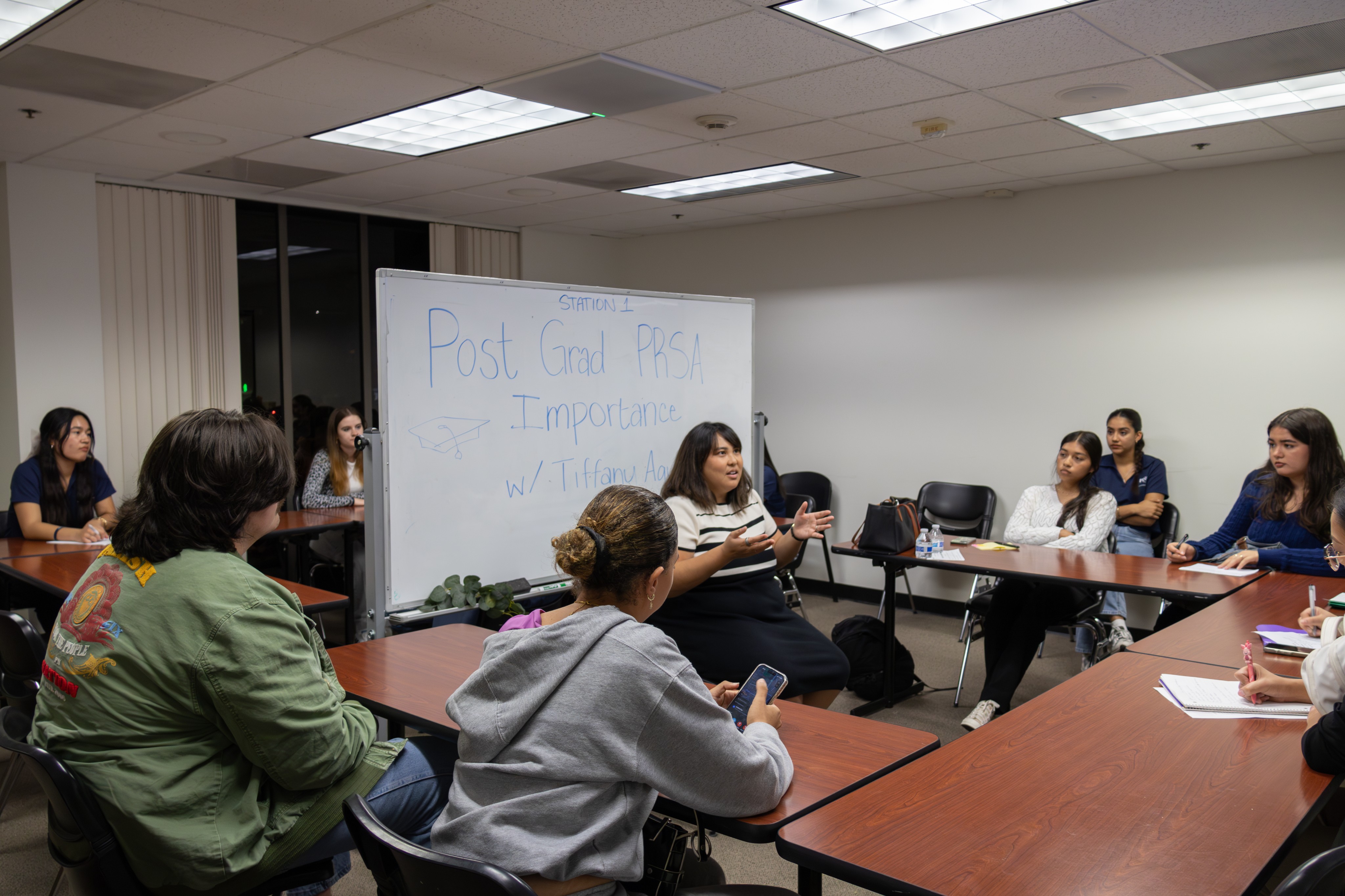
“Titan Public Relations is CSUF's student-run PR firm that allows students to get hands-on experience with real clients.”Ava Kendrena, former account executive
This is the chapter's distinction. An internship places a student inside someone else's system. A classroom explains a system. CSUF PRSSA lets students operate a simplified system of their own, under advisers, where they can make decisions before they have an impressive title. The alternatives - another campus club, a career center, independent networking, even a separate student agency - may provide one piece. PRSSA stacks the pieces: national affiliation, a local professional chapter, recurring events, leadership and client work.
Panels + tours
Workshops + peers
Clients + deadlines
Portfolio + references
02 / The doughnut-shop test
The first thing to fail was the message
In 2020, faculty adviser Ken Hagihara stopped for doughnuts. In conversation, the shop owner revealed a problem shared by small businesses during the pandemic: they might be open, but customers did not know it. The first failure was not necessarily the product. It was the information flow.
That ordinary exchange changed the scale of the assignment. Hagihara organized “Tuff It Out,” bringing together 50 upper-level communications students and recent graduates. They split into nine teams, paired with professionals and helped nine Orange County and Los Angeles businesses communicate through the shutdown. A classroom exercise became a local service operation because one person noticed that a doughnut shop's problem was, at least partly, a public-relations problem.
The move is worth copying. Start with a narrow client need. Build a small team. Set a weekly cadence. Put an experienced practitioner close enough to review the work. Finish with measurable outcomes and artifacts the student can discuss in an interview. The aim is not to imitate a giant agency. It is to create low-risk rehearsal with real stakes.
| Route | What it gives | What it asks |
|---|---|---|
| Classroom | Concepts, critique, structured instruction | Tuition and coursework |
| Internship | Workplace context and employer supervision | Competitive access and fixed hours |
| CSUF PRSSA | Network, events, leadership and a chance at client work | $80 dues, time and initiative |
| Going alone | Maximum flexibility | You must find the people, work and feedback yourself |
There are boundaries. Titan Public Relations has limited space; members apply and interview. No chapter can promise a client seat to every person who pays dues. The model also depends on good advisers, properly scoped clients, quality control and students who have time left after classes and jobs. Pro-bono work makes sense for community organizations that need help; it becomes harder to defend when it substitutes for professional labor a client could afford. The bargain is valuable because it is bounded, not because volunteer energy is infinite.
The dues are easy to quote. The larger cost is attention: evening meetings, independent work, deadlines, applications and travel. The return rises only when a member participates.
03 / Recognition as a receipt
Awards are the wake, not the boat
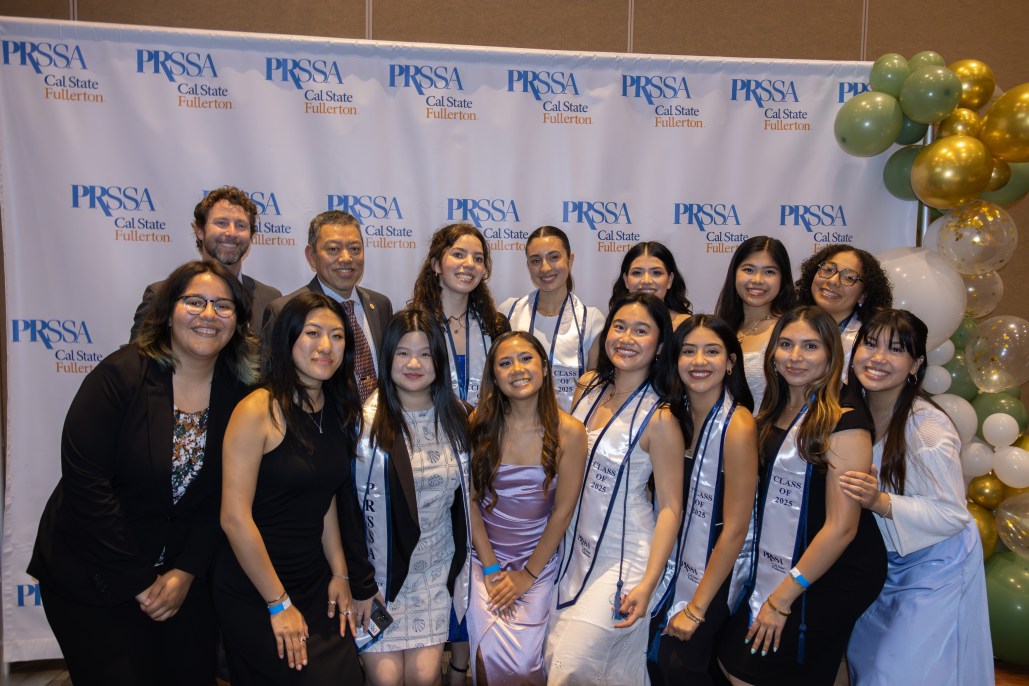
The chapter's trophy list is unusually long: national Outstanding Chapter honors in 2020 and 2022; a national diversity award in 2023; a community-service award in 2021; repeated Star Chapter designations; ethics awards in 2007 and 2010; and a second-place finish in the 2007 Bateman case-study competition. Three members received National Gold Key awards in 2025. These marks matter, but mainly as receipts for the less photogenic work - bylaws, sponsor follow-up, accurate emails, room bookings, budgets and deadlines.
Its bylaws are wonderfully unromantic. Executive posts are unpaid and carry no course credit. Board members must answer sponsors, meet deadlines and keep personal drama out of meetings. The document compares some positions to a full-time job. This is not glamorous copy. It is an admission that student leadership becomes educational at precisely the moment it stops feeling like a résumé line and starts feeling like work.
04 / From attending the room to running it
Two hundred people show up
By March 2026, the chapter was not merely sending students to a professional gathering. It was hosting one. PR Next, the Western District Conference, brought more than 200 students and professionals to Fullerton for three days. It began with Orange County agency tours and moved into sessions on ethics, artificial intelligence, gaming, multicultural marketing, tourism and entertainment. More than 20 practitioners participated. The event sold out.
Conference production is public relations stripped of abstraction. Speakers cancel. Sponsors need answers. Attendees need schedules, food and a reason to have come. The chapter offered sponsorship levels and assembled support from brands, agencies, nonprofits and the university. The students who once needed a room in which to meet professionals had learned to build the room themselves.
That is the quiet logic of CSUF PRSSA. A first-year student can begin by sitting in the audience. Later, the student may ask a panel question, join a committee, pitch a client, manage an account, solicit a sponsor or coordinate a conference. Confidence arrives by installment. The chapter cannot remove the uncertainty of a communications career. It can make the first encounter with that uncertainty happen among peers, with an adviser nearby, before a paycheck depends on the answer.
The chapter's real product is not networking. It is the conversion of a stranger into a peer, a classroom idea into a deliverable, and a nervous first attempt into evidence.
For the student who only pays and never appears, $80 is just another charge. For the student who enters the loop - exposure, rehearsal, responsibility, proof - it can be the inexpensive beginning of a professional identity. The shortcut does not skip the work. It simply lets the work begin sooner.