career-development
(27)
The $80 Shortcut From Classroom Theory to Client Work
At Cal State Fullerton, a student chapter has built a practical answer to the entry-level experience trap: charge less than a textbook, open the room to every major, and put real clients on the other side of the table.
The $70 Shortcut From PR Class to the Client Room
At USC, the useful distance between a lecture hall and a live brief costs $70 a year. Inside that gap, students meet executives, tour agencies and run campaigns before anyone hands them a diploma.
Fresno State TASTE puts a career on the lunch menu
A student gets a mentor. A professional picks up the meal. Inside Fresno State’s student-run program for making the first career conversation easier to have.
Before the elevator pitch, a board game: inside Lambda Mu
At University of the Pacific, Delta Sigma Pi’s Lambda Mu Chapter puts friendship on the same calendar as professional practice. Its recruitment sequence offers a small, useful lesson in making introductions less awkward.
PRSSA Long Beach gives students something to show for it
A banned-book game. A student-run agency. A published byline. At Cal State Long Beach, a public relations chapter gives career preparation a tangible form.
Oakland had the talent. BRIDGEGOOD built the first assignment.
A furniture-store meeting became a nonprofit design studio with a practical answer to a familiar problem: how do you get experience when nobody has hired you yet?

The PR Habitat is building the network you weren't born into
Damaryan Benton turned a LinkedIn post into a community for young communicators. Its real subject is everything a PR degree leaves between the lines: introductions, unwritten rules, and who pays to keep the door open.

LeapSchool Africa puts the homework to work
Monthly tuition gets learners through the door. Projects, career coaching and a taste of remote teamwork reveal what LeapSchool Africa wants them to do next.

You can leave Google. Xoogler keeps you connected.
What began with 40 people over drinks now connects tens of thousands of Google alumni. Inside the community turning a former employer into a source of new colleagues, companies and capital.
8200 Alumni Association Opens Its Address Book
An Israeli intelligence-unit alumni network has built a civilian second life: helping founders, advancing careers and putting experienced operators to work on the problems of small businesses.

The Spreadsheet Was the First Casualty: How Chronus Turned Mentoring Into Enterprise Infrastructure
Chronus took the warmest idea in corporate life - finding a mentor - and gave it matching logic, nudges, dashboards and a budget line. Now it is betting that AI can widen access without flattening the human relationship that made mentoring useful in the first place.

Product Marketing Alliance Tried to Sell T-Shirts. The Community Bought a Profession.
A failed merch table exposed the better business hiding in plain sight: build the room product marketers needed, then sell the education, events and tools that make the room more valuable.
Cakap Is Turning Indonesia's Language Gap Into a Skills Business
The Jakarta company started with live language lessons. Now it sells a broader promise: skills that travel from the classroom to the workplace.
The internet's great résumé drawer has become a $19.8 billion market for work itself - part identity system, part hiring engine, part trade publication, and increasingly part AI assistant.

Nobody Cares Where You Sit. They Care What You Ship.
A Go2 Newsroom perspective on widening access to professional remote work regardless of geography. The piece argues that where a person physically sits should not determine their access to good work, and lays out Go2's stated commitment to treating candidates as professionals, developing their skills, judging people by performance and attitude rather than location, and supporting them long after they are placed. It draws on Go2's own hiring philosophy and company background, and is clearly presented as Go2's own point of view.

Hispanic Scholarship Fund
The Hispanic Scholarship Fund (HSF) is a national nonprofit, founded in 1975, that empowers Latino families with the knowledge and resources to complete a higher education, while providing scholarships and support services to as many students as possible. Beyond financial awards ranging from $500 to $5,000, HSF connects roughly 10,000 selected Scholars each year to mentoring, career conferences, internships and employer partners. Through 2022 it had distributed more than $700 million in scholarships, and it now serves over 40,000 Scholars, alumni, parents and community members annually across the United States and Puerto Rico.
Gloat
Gloat is an enterprise HR-technology company that pioneered the internal talent marketplace: an AI platform that maps a company's people by their skills rather than their job titles, then matches them to internal roles, projects, gigs and mentorships. Founded in 2015 in Tel Aviv (originally as Workey) by Ben Reuveni, Amichai Schreiber and Danny Shteinberg, Gloat now runs on a proprietary Workforce Graph and has expanded into skills intelligence and agentic HR tools used by global enterprises such as Mastercard, Unilever, Novartis, Spotify and HSBC. It has raised roughly $190 million, including a $90M Series D led by Generation Investment Management.
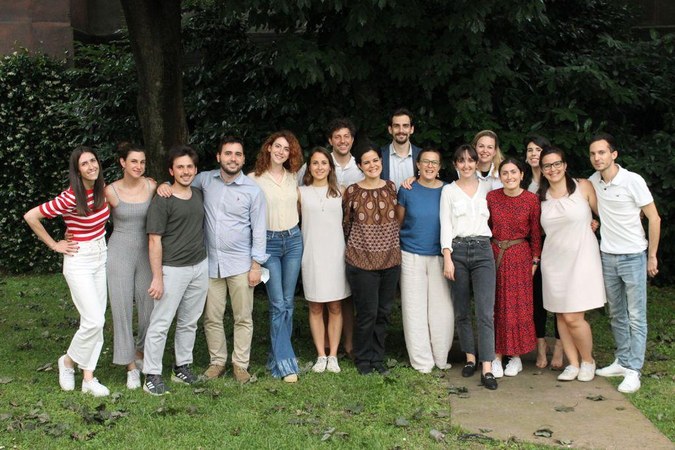
Futurely
Futurely is a Milan-based edtech startup that builds a digital orientation pathway to help middle and high school students figure out what to study - and who to become - before they pick a university. Founded in 2019 by two Politecnico di Milano engineers who went on to MIT and Harvard, the platform mixes self-assessment, gamified courses, expert sessions and one-on-one mentorship to cut university dropout rates and the mismatch between young people and the jobs they end up in. It reaches students through schools, corporate welfare programs and directly, and raised $1.5M in 2021 from Italian Angels for Growth, Angels4Women and notable tech angels.

Stagetime
Stagetime is the professional network for the performing arts - a single hub where artists, agents, artistic administrators and companies build multimedia profiles, connect with 18,000+ industry peers, post opportunities, and manage auditions and applications end to end. Founded by opera singer and designer Jennie Moser after she grew tired of stitching together websites, PDFs and social feeds to chase gigs, the Bloomington, Indiana company replaces the field's scattered tools with one accessible community for showcasing talent and finding work.

Holloway
Holloway is a San Francisco-based digital publisher of book-length, expert-written guides on the practical realities of work - raising venture capital, equity compensation, technical recruiting, remote teams, and more. Each guide is searchable down to the paragraph, annotated by editors, and updated over time so the page never goes stale the way a printed book does.

Women In Product
Women In Product is a 501(c)(3) nonprofit and global community of more than 30,000 women and non-binary product professionals. Founded in 2016 out of a casual networking event in Silicon Valley, it equips members to thrive as builders, leaders, and changemakers through an annual conference, local chapters, leadership programs, peer mentorship, and online resources - with a particular focus on closing the gender gap at the mid-career, senior, and executive levels where it is widest.

Teal
Teal is a Miami-based AI-powered career platform built for job seekers rather than recruiters. Founded in 2019 by former WeWork executive David Fano, Teal bundles an AI Resume Builder, Job Tracker, job board, Chrome extension, AI Interview Coach, and offer/salary tools into one workspace that helps professionals find, apply for, and land jobs they actually want. The company has grown to roughly 4 million members, has helped facilitate hundreds of thousands of interviews, and has raised about $19 million in venture funding, capped by a $7.5M Series A in January 2025.

The New York Academy of Sciences
The New York Academy of Sciences is one of the oldest scientific organizations in the United States, founded in 1817. A nonprofit professional society with more than 20,000 members across 100 countries, it convenes scientists, students, policymakers and the public to advance research, education and expertise. Its work spans flagship recognition programs like the Blavatnik Awards for Young Scientists and the Tata Transformation Prize, global STEM education through the Junior Academy and Global STEM Alliance, crisis-response coordination via the International Science Reserve, and the long-running peer-reviewed journal Annals of the New York Academy of Sciences.

来Offer (LaiOffer)
LaiOffer is a Silicon Valley-based career and technical training company founded in 2013 that prepares software engineers, data scientists, and AI practitioners for jobs at top tech companies. Through project-based courses, mock interviews, and mentorship from FAANG engineers, it has helped more than 8,000 candidates land roles at Google, Meta, Amazon, Microsoft and similar firms.

Elizabeth Ames
Elizabeth Ames is a technology executive and advocate for women in product management, best known as the CEO who led Women In Product from 2019 to 2024. Under her leadership, the nonprofit community doubled to over 34,000 members across 24 local chapters, growing from a single annual conference into a year-round platform for training, coaching, and career development. Before Women In Product, she spent five years as SVP of Strategic Marketing, Alliances, and Programs at AnitaB.org, the organization behind the Grace Hopper Celebration of Women in Computing. Her earlier career spans marketing and strategy roles at Apple, Verifone, Netcentives, Vontu, Certive, and Plastic Logic, plus a stint as Founder and CEO of RETHINK Partners.

Leonard Adler
Leonard Adler is the founder and CEO of Green Jobs Network, a San Francisco-based social enterprise he launched in 2008 to connect job seekers with careers in sustainability, conservation, and clean energy. A Stanford-educated political scientist who went on to earn a J.D. from Georgetown Law and an MPP from Harvard's Kennedy School, Adler parlayed his early work in public-interest law and poverty research into building one of the internet's most active communities dedicated to green and climate careers. Under his leadership, Green Jobs Network has grown to run the largest LinkedIn group focused exclusively on green jobs—135,000+ members worldwide—while publishing a newsletter with more than 100,000 subscribers, hosting the Green Jobs Pod, and launching ClimateJobs.AI, an AI-powered career coaching platform. An Echoing Green Global Fellow and serial social entrepreneur, Adler has spoken at Stanford, the Commonwealth Club's Climate One, the National Career Development Association, and the Green Festivals, making him one of the most visible connectors in the climate workforce ecosystem.

Swizec Teller
Swizec Teller is a Slovenian-American software engineer, bestselling author, and educator based in San Francisco who has spent 20+ years turning hard-won startup experience into actionable career wisdom. Best known for his Senior Mindset newsletter and books like 'Scaling Fast' and 'Senior Engineer Mindset,' he teaches engineers how to stop writing code and start building leverage. Currently building web UX for gene sequencing at Plasmidsaurus, he's the rare person who codes all day and then writes about coding all evening - and makes that seem entirely reasonable.