The most honest number in illumin's marketing library is not a victory. It is $332.35 - what an Oakley campaign paid, on its first day, for a single visit to one of 172 stores. In the old version of advertising, that number might arrive in a handsome post-campaign deck, just in time to be useless. In illumin's version, it arrived while the six-week campaign was still breathing. The team moved money toward verified location audiences, adjusted geography and placements, and ended at $5.35 per store visit.
That arc captures the Toronto company's proposition better than its collection of fashionable nouns. Yes, illumin uses AI, an identity graph, predictive analytics and real-time bidding. The interesting bit is more ordinary: it tries to give a marketer enough visibility to say, "This route is failing," before the budget is gone.
A media plan you can point at
illumin began in 2009 as AcuityAds, one of the companies automating the auction behind digital ads. Its programmatic platform buys impressions across display, video, mobile, connected TV, native, audio and digital out-of-home. Brands and agencies can hand over the campaign as a managed service or operate it themselves. Media owners can sell inventory through illuminX, the company's exchange marketplace.
That makes illumin a demand-side platform, but management would prefer you not stop there. A conventional DSP is good at turning a media brief into thousands of bids. It is less good at letting a human see the campaign as a sequence: first introduce the product, then show a different message to an engaged viewer, then ask for the sale, with a side road for someone who visited a store.
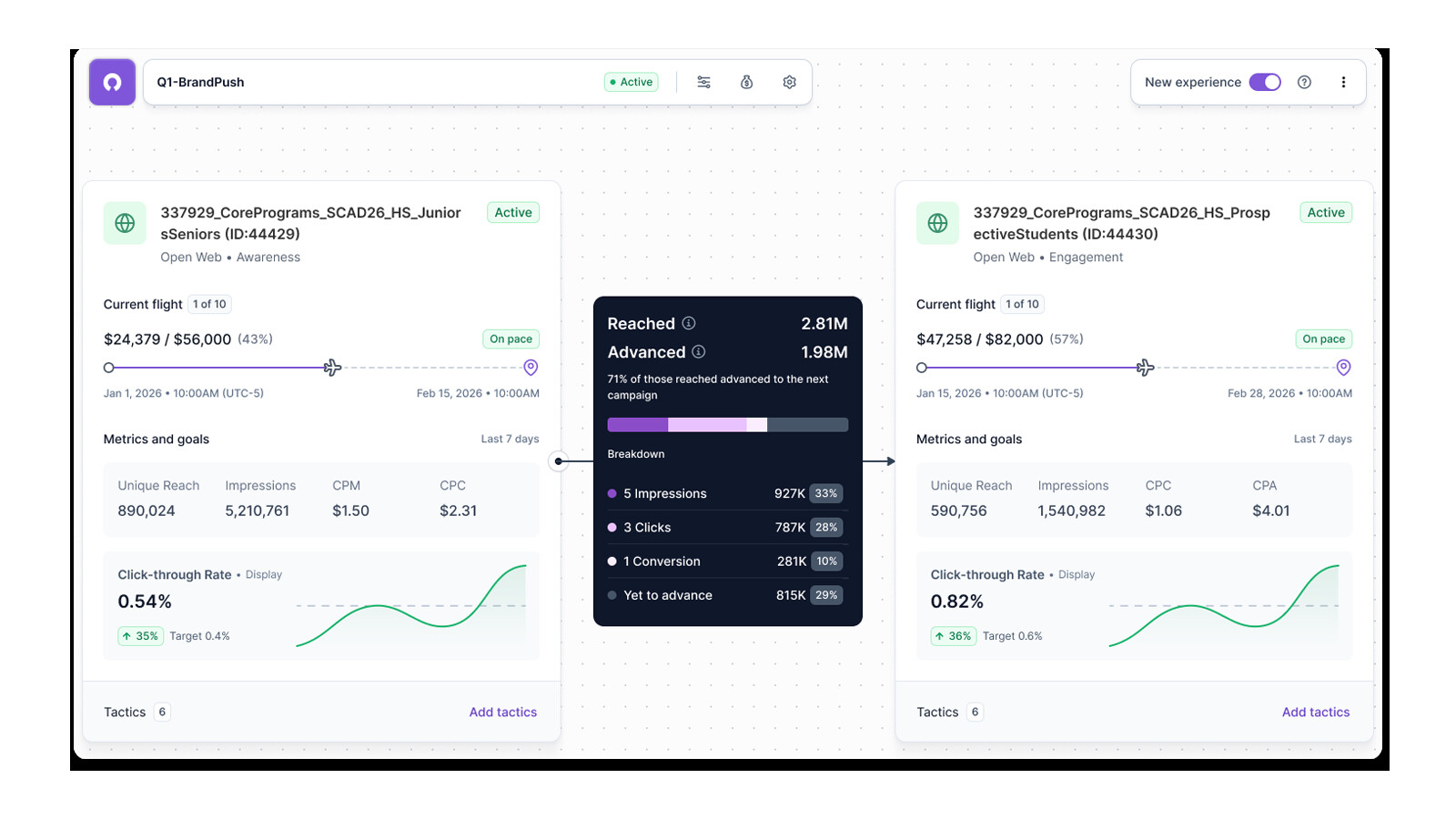
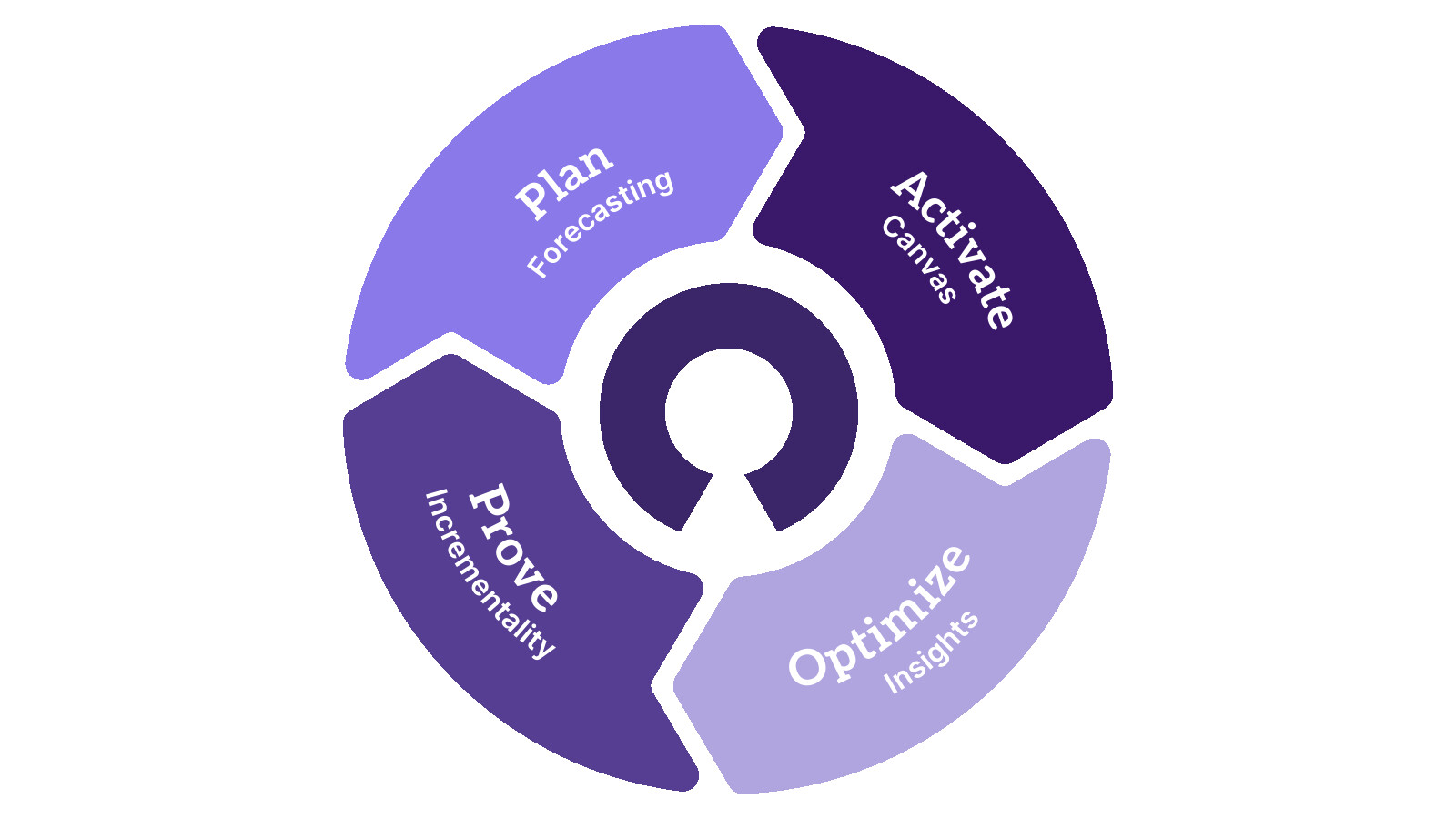
The illumin Canvas turns that sequence into a drag-and-drop flowchart. Teams place audiences, creative, channels and conditions on one workspace. The same map becomes the plan, the buying interface and the reporting view. In 2025, Forecasting added pre-launch scenarios for reach, spending and impact across multiple tactics. In 2026, integrations pushed brand lift and incrementality closer to the live campaign rather than the funeral luncheon afterward.
The future of advertising won't be defined by who has the most data. It will be defined by who has the most trusted intelligence.
Oren Hisherik, illumin COO
The product ate the name
Four founders - Tal Hayek, Nathan Mekuz, Rachel Kapcan and Joe Ontman - started AcuityAds in Toronto. Hayek had already built and sold an ad-tech business. Mekuz brought machine-learning research; Kapcan brought systems and operations experience; Ontman brought sales and business development. By 2013, revenue had passed C$10 million. The company entered Canada's public markets in 2014, bought social-data company 140 Proof for up to US$20 million in 2016, and paid about US$10 million for video analytics company Visible Measures in 2017. Adman Media and Magnetic assets followed in 2018.
Acquisitions widened the machinery, but the change of mind came from a product built inside it. AcuityAds launched illumin in 2020 because buying one impression at a time was not a satisfying way to explain a customer's path. Adoption convinced management that journey advertising was not a side feature. In 2023, AcuityAds renamed the entire company illumin. A 14-year-old public business put the product's name over the door.
reach + spend
audiences
across channels
and reroute
That decision explains what is different about illumin. The Trade Desk, Google Display & Video 360, Amazon DSP, Yahoo DSP, StackAdapt and Basis all compete for media budgets. A resourceful agency can also stitch together separate planning, social, email and analytics tools. illumin's argument is that the stitching itself is the problem. Its advantage is not access to an ad format no one else can buy. It is the shared visual model connecting the brief to execution and outcomes.
What the transition cost
The company does not publish a neat price tag for building Canvas or changing the brand. Its public results show the wider cost of the shift. In 2025, revenue edged up to C$143.6 million from C$140.4 million, yet gross margin fell from 47 percent to 40 percent. Adjusted EBITDA swung from a C$6.3 million profit to a C$2.2 million loss. Net loss reached C$14.7 million. Two large managed-service engagements had rolled off in late 2024, self-service growth was uneven, and the fast-growing Exchange business carried lower margins.
What failed first, then, was not demand for every part of the platform. It was the smooth handoff to a prettier revenue model. In the third quarter of 2025, self-service revenue was roughly flat year over year and managed service weakened amid market uncertainty. Gross margin dropped to 38 percent as Exchange became a larger share. illumin cut costs, paid severance and reorganized around scalable platform revenue. The awkward truth of marketplaces appeared: they can make the top line grow faster while making each dollar worth less.
By the fourth quarter, self-service revenue rose 23 percent sequentially and 41 net new clients joined. Then Q2 2026 delivered the clearest repair signal: record revenue of C$50.2 million, up 52 percent from a year earlier; Exchange doubled; managed and self-service both grew by double digits; adjusted EBITDA reached C$2 million; net income was a barely-there C$19,000. Gross margin, however, fell again to 35 percent. The rebound is real. So is the mix problem.
The trust layer
Advertising technology now has a second problem beyond fragmentation: many of its identifiers are disappearing or becoming less useful. illumin's recent partnerships look like an answer assembled piece by piece. Adsquare sends daily foot-traffic attribution into the platform. FSBD contributes privacy-conscious audience segments built with postal-code modeling. Audience Acuity adds deterministic identity and demographic intelligence, and chose illumin as its preferred buying platform. Cint puts self-serve brand-lift studies inside campaign setup, where awareness, recall and purchase intent can be read while the ads are running.
The customer list crosses mattresses, sunglasses, education and nonprofits. Public cases feature Casper, Oakley, Purple, Mohawk College, the Kidney Foundation of Canada, Diamond Films and travel company Redtag. An illumin study with Purple reported a 20 percent higher average order value for consumers exposed to a connected full-funnel journey. A Casper campaign with agency WITHIN and measurement company Measured reported C$2.59 in incremental value for each dollar spent. These are selected case studies, not universal promises, but they show the job customers hire illumin to do: decide whether an ad caused a useful action, then spend accordingly.
The part worth stealing
You do not need illumin to copy illumin's best operating habit. Before a campaign launches, draw the route a customer might take. Attach one behavior and one metric to every stage. Decide what evidence will cause money to move. Make sure the evidence arrives daily, not after the invoice. Then give one person permission to reroute the budget.
- Map the customer journey as a sequence, not a list of channels.
- Forecast reach, cost and overlap before launch.
- Name the first failure signal and its threshold.
- Keep a small test budget available for alternate audiences or creative.
- Review live outcomes on a fixed cadence and move money without ceremony.
Oakley's opening cost per visit did not trigger denial or a week of deck-making. It told the team that broad and third-party segments were losing to verified location audiences. That is the behavior to steal: treat a bad early number as a routing instruction.
When the canvas becomes wallpaper
This approach is not automatic. It needs enough volume for the signal to mean something, reliable conversion or visitation data, creative built for different stages, and a team allowed to change spend in flight. A small local advertiser running one search campaign may find the machinery excessive. A brand with a six-month approval cycle may admire the live dashboard and still be unable to act. If identity matching is weak, purchase cycles are long, budgets are tiny or channels cannot share audiences cleanly, the connected journey can become an attractive diagram of guesses.
Several channels share a goal, spend is large enough to test, outcomes arrive quickly and an operator can reallocate budget.
Signals are sparse, approvals are slow, attribution is disputed or the campaign is too simple to justify another platform.
There is also a strategic risk for illumin itself. It operates on both sides of programmatic trading while selling clarity and control. Customers must trust the measurement, the audience data and the economics of the marketplace. The company has C$33.7 million in cash as of June 2026 and a founder back in the chief executive's chair. It has momentum, but Q2's lower margin says scale alone will not settle the argument.
Still, the product bet is coherent. AcuityAds began by making media buying smarter. illumin now wants to make the whole campaign legible. In an industry that often delivers certainty after the fact, seeing the leak in time to reach for the wrench is a useful place to stand.