A person forwards a link to a friend. The friend opens it, watches a trailer, and signs up for a streaming service two weeks later. To most marketers in the early 2010s, the first move in that sequence was a blank space. It happened in email, a text, or a chat, far from the tidy counters beneath a public social post. RadiumOne saw a business in that blank space.
The San Francisco company built tools that could register sharing and the activity around it, then turn those signals into audiences for digital ads. Its name survives in the “Careers at RadiumOne” profile, though the operating company no longer stands alone: RhythmOne bought selected assets in 2017. The story is worth revisiting because its product idea was sharp, its customer work was tangible, and its accounts had a different opinion of success.
The short version
- What it did: connected sharing, app behavior and programmatic ad buying.
- Who paid: brands and agencies buying media; published material said its data tools could be used without a separate license fee.
- What worked: iflix and RadiumOne reported one million acquired subscribers in six months.
- What cost: RhythmOne reported $141 million of 2016 revenue alongside a $17.5 million pretax loss.
The quiet half of social
RadiumOne began with a useful objection to the public web. A like is visible; a recommendation to one particular friend may be more revealing. Founder Gurbaksh Chahal described an early ad network that relied on other people's data. The company then set out to generate its own signals. Po.st, its sharing widget and link shortener, gave publishers a way to see where content went. ShareGraph modeled the connections and interests suggested by that traffic. The buyer of a campaign could use those audience segments to reach similar people elsewhere on the open web.
In the company's own language, this was “dark social”: sharing through email, messaging and other private routes that ordinary referral reports often left obscure. The phrase made the invisible sound dramatic. The machinery was plainer. Put a sharing tool where people already pass content; classify the resulting signals; use those classifications to choose and price ads. RadiumOne's patent filings described connections in terms of the type, recency, frequency and direction of sharing. An advertising system was being built from small social acts.
A share button was the beginning of a media transaction, not the end of a social one.
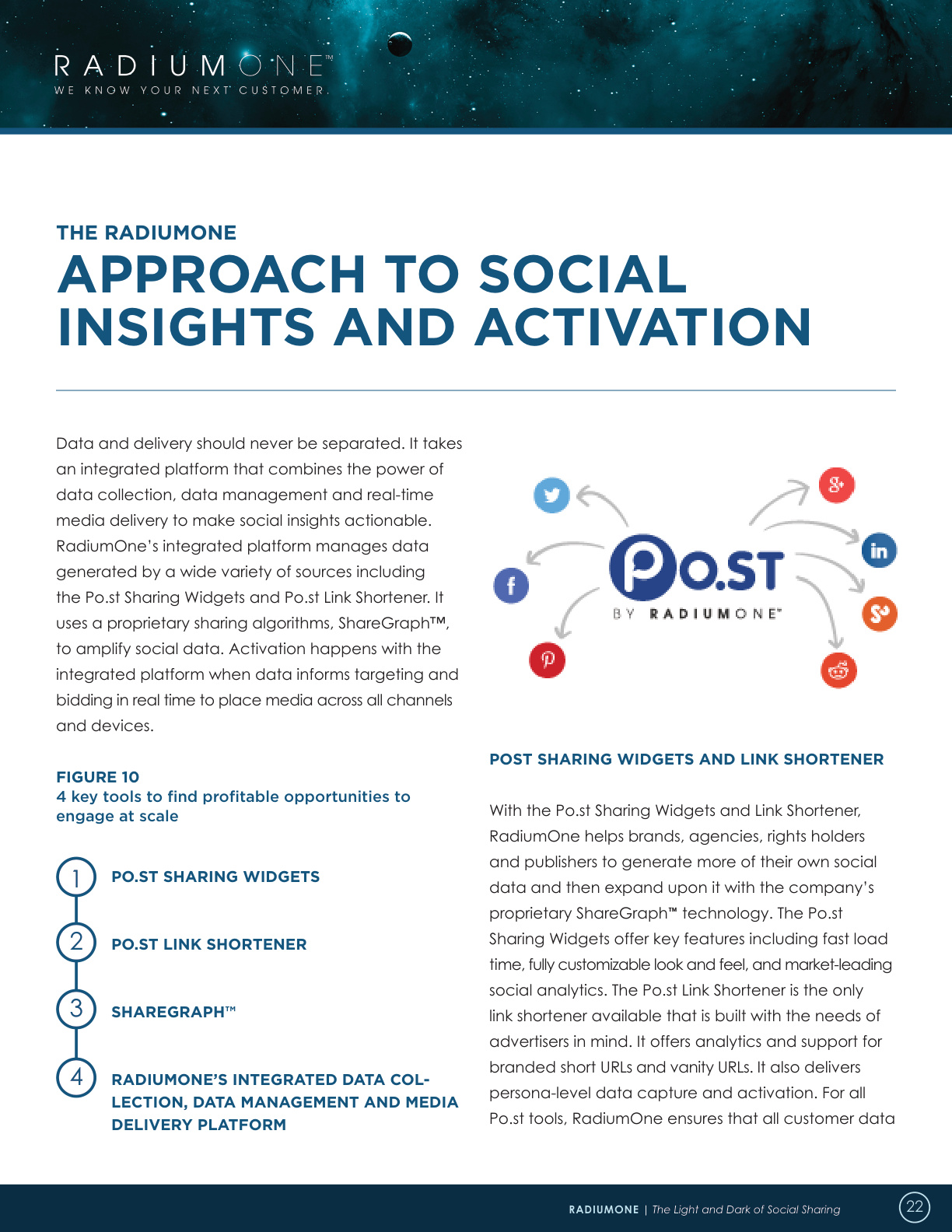
That combination distinguished it from a stand-alone share-button vendor such as ShareThis or AddThis, and from an ad buyer dependent entirely on outside audience data. RadiumOne offered both the signal and a route to spend against it. Connect later added app events, location and push notifications. Activate joined data management to media delivery. Smart Links offered more control over where a click led. This was software for advertisers, agencies, app marketers, publishers and rights holders, not a consumer social network.
A customer, a cost, a conversion
The cleanest example came from iflix, the streaming service competing for subscribers in Southeast Asia. It had the usual new entrant's problem: little brand recognition, plenty of possible viewers, and an expensive hunt for people likely to pay. RadiumOne combined app events, search and sharing behavior with iflix's own customer data. It scored likely lifetime value, adjusted bids and creative, and re-engaged people whose subscriptions had expired.
The companies reported one million new subscribers in six months, brand awareness rising from zero to 25 percent, and new customer acquisition cost falling from $25 to $3. An expired subscriber, they said, was 50 times more likely to become a paying customer after re-engagement than someone new to iflix. These are campaign claims, not a controlled proof that one vendor caused every gain. They do show the practical question the system answered: whom is it worth paying to reach, and when?
“Data and delivery should never be separated.”RadiumOne's 2014 sharing report
The Jockey Club used similar thinking for a very different product. It joined activity across racecourse websites and social feeds to find engaged racing fans beyond its own properties. A three-month trial reported £11 in sales for each £1 of programmatic spend. O2 used Connect to put MyO2 app analytics, geofencing and push notifications in one place. The clients differed; the pitch did not. Read a meaningful action, act quickly, then check whether the campaign changed a business outcome.
The arithmetic behind the applause
RadiumOne could boast considerable reach. Its 2015 financing announcement said the firm had secured $54 million in equity and debt financing, on top of the $33.5 million reported by 2011. By 2016, a UK executive said the company employed more than 400 people across 12 countries. A later buyer announcement said about 200 staff would join RhythmOne. None of those numbers answers the question that finally mattered: how much of each advertising dollar did the company keep after paying to acquire and serve the ad?
The 2016 figures were unaudited standalone numbers disclosed by RhythmOne. The 2017 amount covered selected assets and related liabilities, not a sale of the whole company.
RhythmOne's acquisition disclosure described $141 million in 2016 revenue, a $17.5 million pretax loss and a $5.6 million adjusted EBITDA loss. It said RadiumOne had a history of operating losses. In June 2017, RhythmOne bought selected assets and related liabilities for consideration of up to $22 million, plus the assumption of roughly $3 million to $4 million in net liabilities. A later filing put the booked consideration at $20.4 million. The transaction was an asset purchase, and those numbers must not be read as a simple valuation of the entire company.
The buyer wanted the technology, audience segments, advertiser relationships and staff to strengthen its own supply and demand platform. That is a rational outcome for useful assets. It is also a sobering one for anyone who assumes impressive campaign results automatically make an independent adtech business durable. A 2014 leadership crisis had already tested the firm: its board removed Chahal as CEO and chairman after he pleaded guilty to misdemeanor domestic violence charges, and COO Bill Lonergan took over. The product kept developing under new leadership. The financial problem remained.
What survives the sale
There is a useful lesson here for a marketer without a patent portfolio. Start with an action that shows more intent than a page view or a public reaction. Measure it where it happens. Connect that signal to an offer before its relevance fades. Then measure customer acquisition cost, retention and gross margin together. RadiumOne did the first three with unusual confidence; its disclosed final-year accounts show why the fourth belongs in the same sentence.
The method needs enough consented, useful data to reveal a pattern, enough media reach to act on it, and a customer outcome worth buying. Thin sharing volume, weak identity matching or expensive inventory can make a clever model uneconomic. A forwarded link is still a remarkable little piece of evidence. It simply cannot pay the bills by itself.