The first thing Newton Research tried to kill was not a competitor. It was the dashboard. John Hoctor had spent years building media-analytics companies whose answers reliably produced a peculiar customer reaction: six requests for answers the dashboard did not contain. The joke inside those companies was that customers did not need more dashboards. They needed extra data scientists. In 2023, Hoctor, Matthew Emans and Steven Bennett decided to take the joke literally.
Their Needham, Massachusetts startup builds specialist AI agents for the chores and judgments surrounding advertising data. One agent prepares messy tables. Another segments audiences. Others design incrementality tests, forecast campaign performance, build marketing-mix models, flag anomalies or assemble reports. The newer work goes further: Newton can turn an approved plan into a media-buying workflow, converse with seller-side systems and keep learning from results.
This is enterprise software, not a cheerful chatbot with a media-planning costume. Newton is containerized and designed to run where a client's data already lives - AWS, Azure, Google Cloud, Snowflake or Databricks. It exposes its steps and generated code. The customer supplies its own notebooks, data dictionaries, scripts and preferred methods. In Newton's metaphor, the agent arrives like a junior analyst, then gets trained on the house rules.

The expensive answer to a cheap-looking question
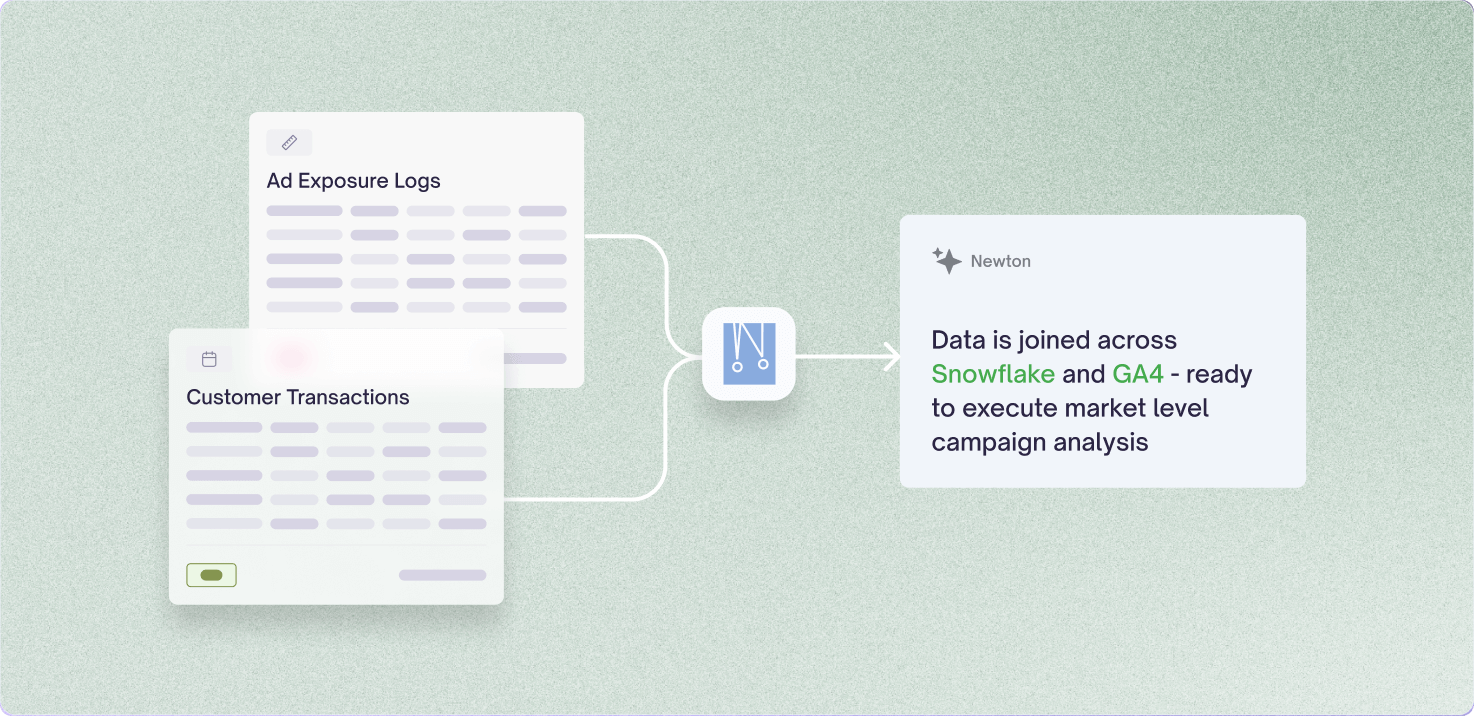
Marketing analytics is full of innocent questions with expensive plumbing underneath. Which channel caused the lift? Where should the next dollar go? Did the campaign create sales or merely follow people already likely to buy? Answering can require log files, identity data, transaction records, test and control groups, statistical models and several specialists who would prefer not to spend Tuesday joining CSVs.
That labor is Newton's opening. The product connects to internal and partner data, writes and runs analytical code, and packages repeatable work into multi-agent workflows. Brands use it for customer journeys, audience development and budget allocation. Agencies use it to repeat reporting and measurement across many clients. Publishers use it for audience intelligence and yield. Platforms can place specialized analytics in front of business users without exporting the underlying data.
What did it cost? For Newton, slightly more than $5 million in seed capital and a $9 million Series A, co-led by Greycroft and Bessemer Venture Partners in August 2025. The round included S4S Ventures, LiveRamp Ventures and Aperiam Ventures. The company said the money would fund product development, expansion and hiring across engineering, customer success, sales and marketing. What it costs a customer is less clear: Newton offers a 30-day trial but publishes no paid rate, a familiar sign of customized enterprise contracts rather than swipe-a-card SaaS.
The economics hinge on throughput, not novelty. Newton says a typical user can offload as many as 126 hours of repetitive work each month and that some workflows produce ten times the output. Those are company-reported figures, but they reveal how the sale is framed: compare software and implementation against analyst time, delayed campaign decisions and work that never reaches the top of the queue. The pitch is strongest at an agency repeating similar analyses across dozens of accounts, or at a publisher inspecting vast daily datasets. A company running one modest campaign a quarter will have a much harder time making that arithmetic sing.
“Once you put a dashboard in front of a customer, you will immediately get a half a dozen requests for things not currently in your dashboard.”John Hoctor, co-founder and CEO
What failed first
The old dashboard model failed first. It froze yesterday's anticipated questions into menus and charts, while today's urgent question bounced to an overbooked BI team. Then generic chatbots failed the specialist test. Hoctor has said broad models made naive methodological choices, hallucinated and scored poorly on Newton's marketing-analytics benchmark. A system that sounds certain while choosing the wrong control group is not an analyst. It is an expensive improv partner.
That result changed the product thesis. An early description of Newton was horizontal: an AI-powered data analyst for decision-makers, potentially useful in finance, health care or supply chains. The founders' advantage, however, was two decades of scar tissue in television, advertising and measurement. They narrowed around media and marketing, encoding a curated “handbook” into specialist agents and testing them on more than 110 questions and tasks. The move is instructive. When the general model is dazzling but unreliable, domain rules and evaluation become the product.
There is another differentiator hiding in the plumbing. Newton does not demand that a company pour sensitive records into a new external warehouse. Its agents operate in the customer's environment, use different foundation models as appropriate, and preserve an audit trail. That matters in a category where privacy, governance and the ability to reproduce a number can decide whether a pilot survives procurement.
From answering to doing
A consequential move is taking the company from analytics assistant to operating layer. In January 2025, Newton and agency RPA described agent-to-agent collaboration with Yahoo DSP and Locality. A year later, Newton, RPA, NBCUniversal and FreeWheel demonstrated a cross-platform premium-video buy spanning linear television and streaming inventory. The first planned execution included live football placements - territory normally governed by calls, spreadsheets, negotiations and enough institutional memory to fill a stadium.
At CES, the workflow began with a marketing-mix model, reviewed earlier performance, generated a revised allocation and turned it into publisher-specific buying briefs. Seller agents handled their side. Humans supplied objectives, guardrails and approvals. In June 2026, dentsu expanded a 2025 Newton pilot across Carat, dentsu X and iProspect in the United States, with global expansion planned. In August, Newton bundled the direction into Unlimited Analytics: causal modeling, faster MMM, agentic buying, optimization and measurement in one layer.
The agentic loop
The named customer list gives the pitch some weight. Horizon Media says multi-hour workflows run in minutes while retaining visibility into generated code. Backbone Media reports faster test design across its client portfolio. Relo Metrics uses Newton to automate checks across large daily datasets. Dentsu says the attraction is interoperability: direct and programmatic systems can be connected to a client's stack instead of becoming one more isolated lane.
The bit worth stealing
A founder can copy Newton's sequence without copying its software. Start with the unanswered request that appears after every product demo. Choose a domain where errors are costly and workflows repeat. Turn expert practice into explicit playbooks. Test against realistic tasks, not vibes. Deploy beside the customer's data. Show the work. Add action only after users trust the recommendations. Keep an approval step where money, rights or reputation move.
Also steal the wedge. Newton did not begin by promising an autonomous advertising department. It automated data preparation, reports and measurement - annoying work whose baseline cost was visible. Once agents earned trust, the product moved upstream into recommendations and downstream into execution. That is a more believable adoption path than asking a chief marketing officer to hand a fresh chatbot the budget on day one.
Works best when
Data is accessible, methods repeat, outcomes are measurable, experts can teach the system, and approvals are explicit.
Falls apart when
Inputs are chaotic, objectives conflict, decisions are rare, nobody owns governance, or speed merely automates a bad strategy.
Those limits matter. “Unlimited analytics” is a memorable product name, not a law of nature. Causal models still depend on assumptions and data quality. A workflow that saves hours at a large agency may be needless machinery for a small advertiser. Customer-cloud deployment can reduce data movement, but it also asks the buyer to support integration, security review and change management. And agent-to-agent commerce needs standards that sellers, buyers and platforms actually adopt. Newton supports AdCP, MCP and A2A, but the advertising industry is still arguing over its common language.
Newton sits between enterprise AI platforms, traditional BI, specialist measurement firms and the in-house data-science team. Its bet is that the defensible layer is not the underlying language model. OpenAI, Claude or Gemini can change beneath it. The durable value is the encoded marketing science, the orchestration, the customer's context, the audit trail and the connections that let an answer become an approved action.
That makes the company less a replacement for analysts than a test of what analysts should spend time doing. If Newton works, people stop rebuilding the same report and start arguing about the decision. If it does not, they will have a very elegant new system for producing questions. The dashboard, somewhere, will enjoy the joke.