The joke at John Hoctor's earlier analytics companies was that customers did not need another dashboard. They needed more data scientists. A dashboard would arrive looking polished and complete, then a customer would ask half a dozen questions it could not answer. Somewhere, a busy analyst opened a notebook, joined fresh tables, and began again. Hoctor heard the same punchline often enough to treat it as product research.
That habit explains Newton Research, the company he co-founded in 2023 with Matthew Emans and Steven Bennett. Newton does not begin with a grand theory of artificial intelligence. It begins with the overworked person behind the chart. Its specialized agents prepare data, segment audiences, design incrementality tests, build marketing-mix models, forecast performance, and assemble reports. The pitch is additional analytical capacity without pretending judgment has become unnecessary.
Hoctor's route to this idea winds through autonomous robots, set-top boxes, three startups, two acquisitions, Microsoft, Rovi, and LiveRamp. Yet the route is straighter than it appears. For roughly two decades, he has kept asking variations of one engineering question: how do you turn a huge, unruly system into something a person can use?
The engineer takes a scenic route
At MIT, Hoctor studied mechanical engineering, earning both bachelor's and master's degrees. He has recalled designing early sensor systems for self-driving cars and helping design and build an autonomous robot. More durable than any single machine was a method. The two important lessons, he has said, were learning to think like an engineer and learning to break down complex problems.
MIT also supplied what Hoctor calls the entrepreneurial bug. Hardware, however, looked like a difficult road for venture funding at the time. Software startups offered a more navigable path, and that path curved into advertising. Asked years later what had gone wrong when an engineer ended up in ad tech, he answered with dry economy: building AI agents that perform data-science tasks for large brands, agencies, and publishers was still “pretty MIT-worthy.”
“The two most important things I learned at MIT were how to think like an engineer and how to break down complex problems.”John Hoctor
Advertising turned out to be an engineer's playground wearing a sales badge. Television generated enormous quantities of viewing and exposure data. The business was fragmented, the feedback loops were slow, and nearly everyone was willing to experiment. At Navic Networks, Hoctor worked in business development and marketing as the company built advanced advertising tools and collected data from millions of set-top boxes. Microsoft acquired Navic in 2008, and Hoctor led sales and business development for Microsoft's television advertising operation.
Mechanical engineering at MIT, including autonomous systems and sensing work.
Navic Networks is acquired by Microsoft; television advertising remains the laboratory.
IntegralReach is founded, then acquired by Rovi for its predictive audience analytics.
Data Plus Math makes TV attribution faster, then joins LiveRamp in a roughly $150 million deal.
Newton Research turns repeated analytics work into specialized, inspectable agent workflows.
Two exits, one recurring collaborator
Hoctor's most persistent professional connection is Matthew Emans. They worked together at Navic and Microsoft, then co-founded IntegralReach in 2012. IntegralReach developed predictive analytics for television, including what was described as an early audience-based sell-side system. Rovi acquired it in 2013 for about $10 million plus contingent consideration. Hoctor stayed to lead analytics work as the technology was folded into Rovi's audience-management business.
In 2016, Hoctor and Emans returned with Data Plus Math. Television attribution then tended to arrive like a school report after summer vacation: expensive, slow, and too late to change the outcome. The new company connected advertising exposure across linear television and streaming to real-world behavior, aiming to make measurement fast enough to guide a campaign while it was still running.
“What really gets me excited is closing that loop,” Hoctor said in 2019, describing the chance to move from post-campaign scoring to in-flight optimization. LiveRamp acquired Data Plus Math that year for roughly $150 million in cash and stock. Hoctor became its general manager of measurement and later spent nearly three years as an adviser.
There is a useful lesson in his return to the startup bench. Serial founders are often celebrated for moving on. Hoctor's craft has come from staying put, at least intellectually. He and Emans keep returning to media data with another layer of the problem exposed. Steven Bennett, a key colleague at Data Plus Math, joined them as Newton's third co-founder. Familiarity here does not read as nostalgia. It reads as reduced meeting time.
The six questions hiding behind the chart
Newton's origin sits inside that dashboard joke. At IntegralReach and Data Plus Math, the team would ship a useful interface only to discover that today's urgent business question had not been anticipated when the interface was designed. Handling the follow-up required scarce data-science talent. Across the industry, those teams were already drowning in requests.
The loop Hoctor wants to shorten
The first Newton pitch was an AI-powered virtual data scientist with broad potential. The team soon concentrated on a domain it knew intimately: media, marketing, and advertising. Instead of asking a general model to improvise, Newton trains specialist agents on particular workflows. One can handle audience segmentation. Another can prepare a marketing-mix model. Others tackle measurement, planning, forecasting, clean-room analytics, benchmarking, or reporting.
Hoctor compares the system to onboarding a junior analyst. A company can supply its notebooks, scripts, data dictionaries, preferred methods, and review rules. Newton runs inside the environment where the customer's data already lives, including cloud and data platforms such as AWS, Google Cloud, Azure, Snowflake, and Databricks. The data need not make an unnecessary trip outside. The system also exposes its steps and generated work so a human can inspect how an answer was reached.
That design reveals Hoctor's temperament better than any adjective. He is enthusiastic about agents, but allergic to magical thinking. In a 2025 interview, he described the agents as sidekicks that give people “superpowers.” The important noun was still people. The software handles repetitive preparation and analysis so analysts can work on more strategic questions, supervise more work, and put judgment where it matters.
The agents leave the lab
Newton announced a seed round of just over $5 million in early 2024, backed by Bessemer Venture Partners, Greycroft, and LiveRamp Ventures. In August 2025, it announced an oversubscribed $9 million Series A co-led by Greycroft and Bessemer, with S4S Ventures, Aperiam Ventures, and LiveRamp Ventures participating. Total funding rose to just over $14 million. Hoctor said the money would support hiring across engineering, customer success, sales, and marketing as demand grew.
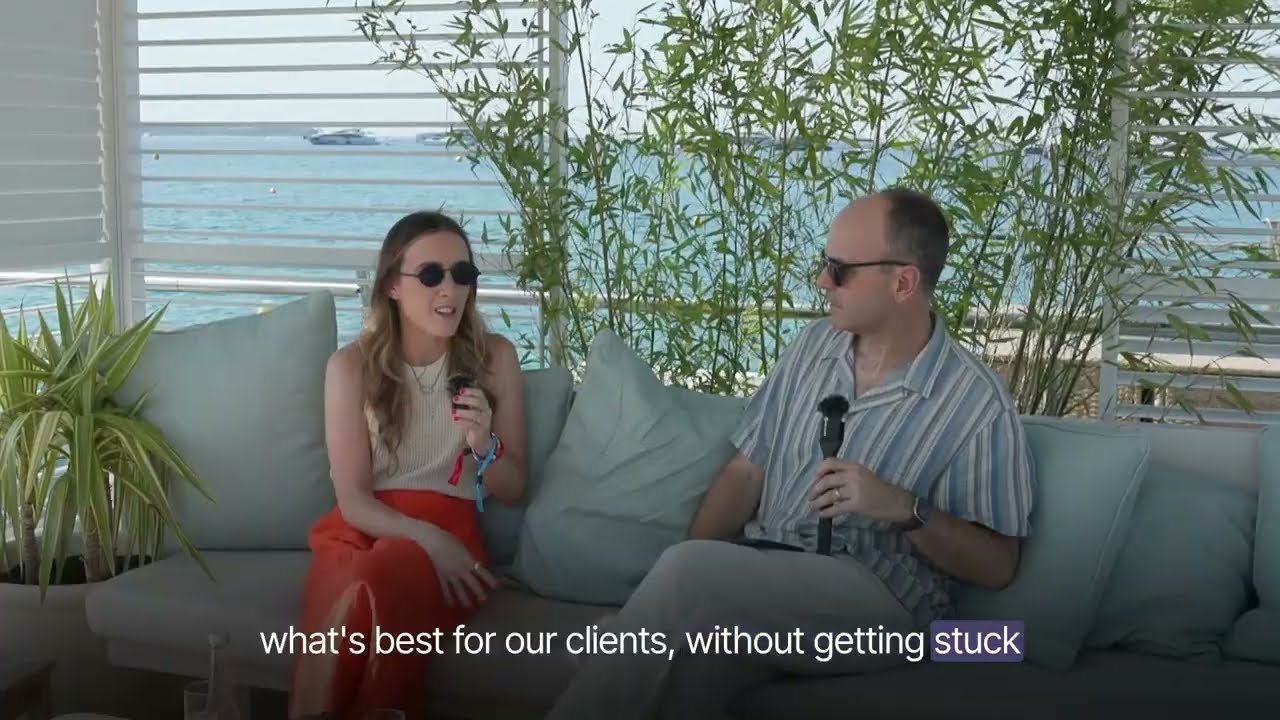
By 2026, the idea had moved beyond helping an analyst produce an answer. Newton joined NBCUniversal, RPA, and FreeWheel in a proof of concept for agent-assisted buying across linear television and streaming. Buy-side and sell-side agents coordinated across systems while people retained strategic oversight. At Cannes Lions, a Newton partnership with dentsu showed the same progression: connect direct and programmatic lanes, respond to performance as it changes, and leave the strategy with humans.
Hoctor's ambition now includes the connective tissue between agents. He has argued for independent systems that can communicate across clouds, platforms, and the advertising ecosystem using open protocols. Without that interoperability, he warns, agents inside large platforms could simply build taller walls around existing gardens. With it, a marketer's agents could coordinate with buying tools, creative systems, publishers, and measurement partners without surrendering the entire plan to one vendor.
“To be clear: Agentic AI is happening. Whether agents work collaboratively is up to us.”John Hoctor
A practical name for a practical bet
The company name carries two respectable meanings and one wonderfully ordinary one. Hoctor and Emans lived in Newton, Massachusetts. Isaac Newton offered a scientific double meaning. They also needed to incorporate that day. “Newton Research” was available, sufficiently broad, and unlikely to object. The company's own team page continues the joke by listing Isaac Newton as its “Father of Calculus” beside the modern founders.
That small story fits Hoctor's larger one. He enjoys the grand possibility of autonomous systems, but he builds from the practical obstruction directly in front of him. In college, it was sensing and navigation. In television, it was addressability, fragmented audiences, and slow attribution. At Newton, it is the pile of analytical work between a fresh question and a defensible decision.
The newest tools are more capable than the dashboard, but Hoctor's standard remains stubbornly human. Does the system help someone think faster? Can the person see what it did? Can it learn the organization's methods? Can it work with others without quietly taking control? The questions sound modest beside the louder promises made for AI. That may be why they are worth asking.
After three companies, Hoctor has not escaped the follow-up question. He has organized a company around welcoming it.