The first useful clue in Holly Washington’s career is not a marketing campaign. It is an underwriting desk. Before she spent her days shaping brands, customer journeys and go-to-market strategy, Washington worked at AIG, evaluating risk. It was the late 1990s, and the job trained attention on a question that follows every consequential decision: what are we missing?
That question still fits her work. Today Washington is Chief Marketing Officer of S&P Global Market Intelligence, a business built around helping institutions see markets more clearly. She leads its global marketing organization, sits on the division’s Operating Committee and works across brand building, customer engagement and demand generation. The products have changed. The instinct to locate the hidden variable has not.
Her route between those two points resists the tidy geometry of a corporate ladder. It moves through the collapsed world of Lehman Brothers, the information business of Thomson Reuters, business development at the law firm Orrick, capital-markets marketing at J.P. Morgan, an eight-year first tour at S&P Global, and four years leading marketing at SS&C Technologies. In 2023, Washington returned to S&P Global Market Intelligence with a larger mandate and a place at the operating table.
A portfolio beats a ladder
Washington once offered a career idea more flexible than “follow your passion” and more practical than “have a five-year plan.” Think of a career as a portfolio to curate. A portfolio expects variety. It accepts that one asset may produce the skill another role needs later. It is designed to be rebalanced when the world changes.
Her own portfolio accumulated capabilities before it accumulated authority. Underwriting supplied a language for risk. Marketing solutions at Lehman Brothers put her near the mechanics and clients of capital markets. Thomson Reuters added the information business, where the value of a product often rests on whether a user can trust, understand and act on what appears on a screen. Orrick brought the partnership culture of professional services. At J.P. Morgan, she led marketing and branding across prime brokerage, futures, options and over-the-counter clearing.
Each move widened the frame. By the time she joined S&P Global in 2011, Washington could see a financial product from several angles: the institution pricing risk, the specialist building the service, the salesperson explaining it and the client deciding whether it belonged in a workflow. Marketing, in that setting, is not a coat of polish. It is the connective tissue between expertise and action.
“Try to see what is invisible.”Holly Washington’s career advice
The line works because it is both imaginative and operational. When the obvious picture is blurry, change the focal point. A marketer might ask which customer is absent from the brief. An executive might ask which incentive prevents a team from saying what it knows. A person planning a career might stop looking for the prescribed next title and identify the missing capability instead.
The product is confidence
Market intelligence is a peculiar thing to market. Its raw materials include data, software, research, benchmarks and analytical models. Its customers operate across banking, investment, private markets, credit and risk. The output is not certainty. Markets do not permit that. The useful promise is better-grounded judgment.
That creates a demanding brief. Simplify too aggressively and the product loses the rigor that makes it useful. Explain every feature and the customer must do the synthesis alone. Washington’s job is to make a sprawling system coherent: connect the problem a client recognizes to the expertise, data and workflow that can address it, then carry that story consistently across regions and channels.
The translation loop
Washington has described the marketing leader’s responsibility in customer terms: champion the customer’s voice, help sales move with greater velocity and build differentiated experiences. Those objectives reveal an operator’s view of the function. Brand matters, but brand is tied to what a customer encounters. Narrative matters, but narrative must survive contact with a sales conversation and a product screen. Demand matters, but measurable growth is the test.
What returning makes possible
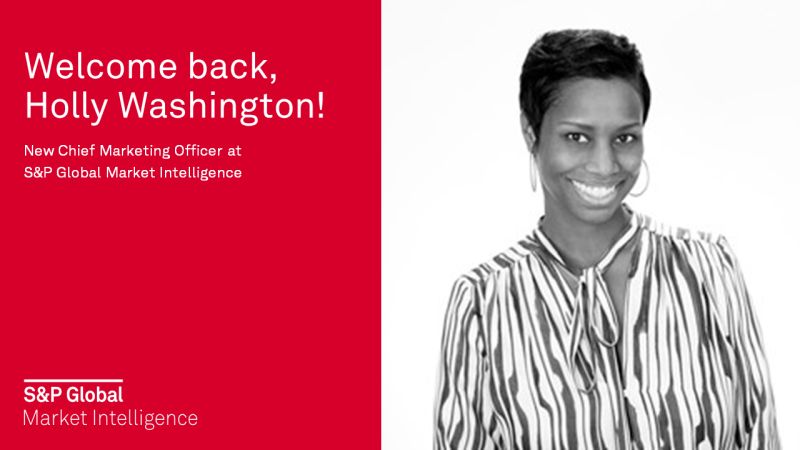
Washington’s 2023 appointment is more interesting than a conventional promotion because it followed a departure. She had spent eight years at S&P Global, ending that first run as the marketing lead for capital markets. At SS&C, she worked in enterprise software during a period of expansion. Then she came back.
A returning executive carries two kinds of memory. There is the institutional memory of how decisions get made and why particular habits exist. There is also the fresh memory of another system, with different customers, constraints and possibilities. The combination can make old assumptions visible. It can also shorten the distance between diagnosis and action.
Her return coincided with a broad remit. Washington helps shape go-to-market strategy and the division’s position in global financial markets, in addition to leading its marketing organization. Her recent public work reflects that span: private-markets data following the With Intelligence acquisition, a new performance taxonomy developed with Cambridge Associates and Mercer, AI-supported credit workflows, lending operations and major capital-markets events. The subjects vary. The recurring task is to turn specialist capability into a reason for a client to pay attention.
Washington placed seventh on INvolve’s 2025 Top 100 Women Executives list. Her other public recognitions include the Financial Narrative 50, a Network Journal 40 Under Forty honor and a Working Mother of the Year award from S&P Global.
Recognition can turn an executive biography into a trophy shelf, but the more revealing part of Washington’s record is the range of systems in which she has learned to operate. A bank organizes around risk, capital and clients. A law firm organizes around partners and expertise. A data company must maintain confidence in both its information and its methods. An enterprise-software company lives inside the daily habits of its users. Moving among them requires more than changing vocabulary. It requires noticing who holds authority, how customers define value and which proof will move a decision.
That range is especially relevant now. The boundaries around market intelligence keep expanding. Private-market assets need more consistent comparison. Credit teams are testing where artificial intelligence can accelerate work without displacing governance. Loan operations still carry the friction of email, spreadsheets and manual checks. Each problem combines information, workflow and trust. The marketer cannot solve the underlying analytical or operational challenge alone, but can insist that the customer’s problem remains visible while specialists build the answer.
Washington’s public updates tend to follow that pattern. She points first to an operating constraint, then to the product or partnership meant to address it. A borrower portal is framed around fragmented communication and auditability. Private-market performance work is framed around like-for-like comparison. AI in credit is framed around speed alongside human judgment, governance and accountability. The details belong to different corners of finance, but the narrative discipline is consistent: begin with the job a client is trying to do.
Making the room useful
There is another line through Washington’s public life: convening people. She serves on the alumni council for NYU’s Media, Culture, and Communication program, where she earned her master’s degree in 2003 after completing a bachelor’s at New York University. Her favorite program memory is hosting one of the council’s early networking events. The detail is small but telling. She remembers not merely attending a useful room, but helping create it.
That instinct extends into civic work. A friend and former S&P Global colleague, Valerie White, invited Washington to a United Way Women United luncheon. Washington was struck by the mission, the clarity of its leadership and the energy across a varied group. She later joined the executive committee and now serves as a co-chair of the New York City leadership committee. Her civic involvement also includes the Apollo Theater’s EmpowHER initiative.
The appeal, in Washington’s telling, is action. She admired a committee of accomplished women who made time, spoke plainly and acted on behalf of others. The same ingredients make a good operating group inside a company: candor, intention and the willingness to convert discussion into a decision. Community leadership and corporate leadership are not identical, but both depend on people who can make a room useful.
Washington lives in Brooklyn with her husband and three teenagers. She has described herself with three compact adjectives: smart, witty, ambitious. The wit matters. So does the willingness to say that ambition can coexist with a slower pace. Her advice to aspiring women leaders has included recognizing when to step back and reset. In institutions that measure motion constantly, choosing the right speed is its own form of judgment.
A career portfolio is never finished. It holds gains, losses, experiments and a few positions whose value becomes obvious only later. Washington’s began with risk and grew through communication, customer experience, financial software and organizational leadership. The result is not a straight ascent. It is a system: one in which every earlier vantage point helps make the next complicated thing a little easier to see.