On Sarah Stansberry’s marketing team, Taylor Swift is not merely a person. She is a verb. To “Taylor Swift” a message is to know it backward and forward, to consider every channel with a record executive’s calculation, and to repeat the central idea with the stamina of a stadium tour. The phrase is funny enough to survive a meeting. The discipline beneath it is stern: good work cannot influence anyone if the people who made it grow bored before the audience has even noticed.
That private bit of office grammar offers a tidy introduction to Stansberry, who became Sprinklr’s chief marketing officer in July 2026 after nearly five years at Fiserv. Her territory is full of language that can collapse under its own weight: unified customer experience, real-time signals, automation, enterprise software, artificial intelligence. She has spent more than 30 years in businesses where the product is complex, the buyer is busy and the committee reviewing the copy is plentiful.
Her answer is not a grand theory. It is a set of sturdy habits. Pick an audience who can be pictured as a real person. Say something only your company can credibly say. Make the next action plain. Then carry the message into the world often enough that it has a chance to become familiar.
“It’s our job as marketers to make ‘the complex simple and the simple compelling.’”Sarah Stansberry on the work of B2B messaging
The useful suspicion of too many words
Stansberry’s instincts come from direct marketing, a tradition with little patience for decorative fog. A message has to reach somebody and cause something to happen. In a 2023 conversation about B2B messaging, she reduced her test to three elements: audience connection, specificity and “what’s next?” She asks writers to imagine speaking to a living person, not addressing a persona assembled in a spreadsheet. She asks whether the message remains true if the logo is covered and a competitor’s name is substituted. If it does, the work has not yet found the brand.
There is a managerial corollary. When three, five or ten internal stakeholders must each be pleased, every review can wash away another useful edge. Her prescription is almost mischievously simple: at the start, appoint one decision-maker. Others may advise. One person remains accountable with the marketer for the final words.
She is equally wary of over-messaging. A trade-show wall does not improve when burdened with a hundred words. A website does not become more persuasive because every feature has been escorted onto the page. Stansberry tells marketers to write as though they were face-to-face with the audience. Conversation is the standard; corporate wallpaper is the enemy.
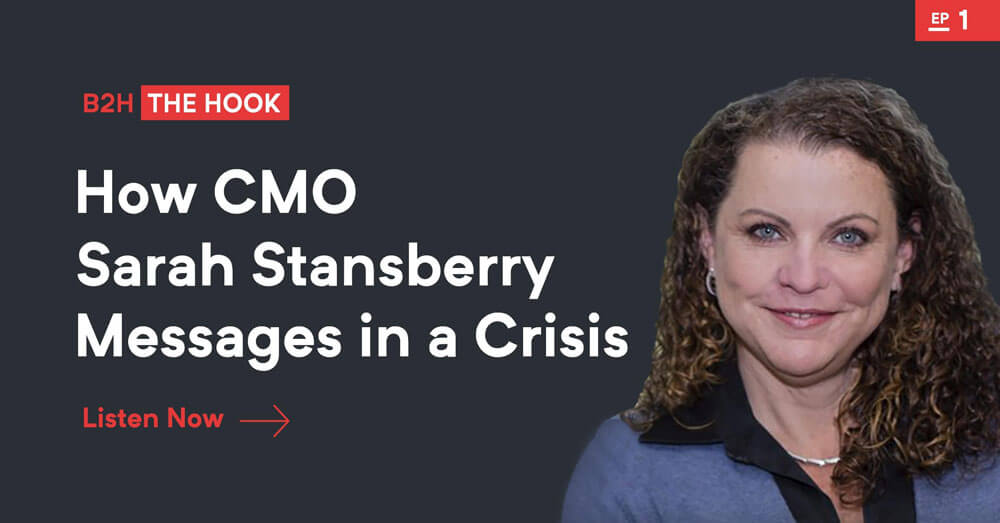
A career built in complicated rooms
The chronology matters because Stansberry did not develop this taste for clarity while selling simple pleasures. Her early career included marketing positions at PLATINUM Technology, RR Donnelley and Click Commerce. She moved through senior leadership at AccuData Integrated Marketing and became vice president of marketing at LexisNexis Risk Solutions. These were businesses made of databases, software, risk information and services that rarely explain themselves over lunch.
She joined Equifax in 2013 and accumulated responsibilities rather than merely titles: product marketing, digital strategy, web experiences, product and solutions training, and marketing operations. By March 2019 she was interim CMO. Her stated ambition for the function was organizational, not cosmetic - align people, processes, tools and team dynamics so marketing could stop behaving like a reactive sales-support queue and become a partner in growth.
At DTN, where weather and operational data inform decisions in agriculture, energy and other industries, she served as CMO and helped shape the company’s move toward a SaaS growth model. At Fiserv, the subject changed to money movement and financial technology, but complexity remained. Her remit ranged across segment, enterprise and financial-solutions marketing. At the company’s Forum conference in 2023, nearly 3,000 clients attended. Her public reflection did not celebrate herself. It ran into the limits of LinkedIn’s tagging system while thanking the colleagues who thought of every detail and made hard work look easy.
Tiny books, green boxes and future leaders
Stansberry appears to understand a useful paradox of management: serious ideas often travel better in unserious packaging. At Equifax, she developed what became known as the “Tiny Book of Teamwork.” Its purpose was to give specialized teams a common set of principles and tools. Its vocabulary included “educate, enable, empower,” “many ways for many brains,” and even “green boxes of love,” a phrase used to clarify expectations. Another maxim asked people to check themselves before adding needless negativity. Corporate life has produced thicker manuals and less memorable ones.
Stories, in her account, let people examine behavior without converting every disagreement into a trial. A shared phrase can become an invitation: here is a way to discuss the work, not a verdict on the person. Templates play a similar role. They save teams from starting at zero, make expectations visible and turn expertise into something colleagues can borrow.
“Mentorship for young people is a powerful catalyst for confidence, career advancement, and personal growth.”Stansberry, speaking ahead of a 2025 EmpowHER Hour
That emphasis on developing people extends beyond the office. Stansberry served for more than eight years on the board of Big Brothers Big Sisters of Metro Atlanta, contributing to strategy and external communications. In describing mentorship, she focused on guidance, shared wisdom and helping young people lean into opportunity. The 2025 Bridge Award from Executive Women of Goizueta recognized the same pattern: creating opportunities, advocating for diversity and driving change in workplaces and communities.
The message gets a pressure test
Stansberry’s preference for human language should not be mistaken for distrust of evidence. Before a large campaign or product launch, she tests two or three messages with a small slice of the intended audience, often an advisory group, user group or clients. The questions are basic: What did people remember? What did they understand? A small group will usually reveal a winner or at least a direction.
If the answer remains muddy, she does not recommend summoning a larger sample to dignify the confusion. Refine the message and test again. Research, in her phrase, is knowledge and power, but the useful insight comes from seeing patterns across analyst briefings, annual reports, earnings calls, news and customer perspectives. Information earns its keep only when it sharpens a choice.
This is also why she resists refreshing a message simply because internal teams have heard it too often. Markets learn slowly. Brand consistency takes longer than a planning cycle. When the message works, she advises conviction - then, with a grin, says to “Taylor Swift the heck out of it.” The repetition is not laziness. Each channel demands adaptation, and each asset must still carry the recognizable tune.
The new complexity: AI that talks back
Stansberry arrived at Sprinklr during a shift from software that reports customer signals to systems expected to interpret those signals and act. The company’s platform spans social media, marketing, advertising, customer feedback and contact-center work. Its 2026 releases emphasize AI-assisted campaigns, analysis of public conversations and quicker movement from insight to response. It is a formidable amount of capability to place inside one sentence.
In announcing the move, Stansberry said she was drawn by a bold vision, a meaningful market opportunity and a leadership team passionate about the future it was building. Her responsibility covers global strategy, brand, communications, analyst and influencer relations, and demand generation. The job is partly to make a broad platform legible without sanding off what makes it distinct.
AI makes that old problem more urgent. Machines can now produce variations at thrilling speed; they can also multiply empty phrases before breakfast. Stansberry’s habits offer a counterweight. Start with the person on the other side. Insist on specificity. Test comprehension. Appoint an owner. Repeat what works. The tools may be learning to speak, but someone still has to decide whether they have said anything.
Her career has been a long migration through the systems modern companies use to know customers: direct-marketing lists, risk data, digital platforms, weather intelligence, payment networks and now unified customer experience. The connecting idea is almost modest enough to miss. Every sophisticated system eventually meets a person deciding what to do next. Stansberry has made a profession of clearing the sentence between them.