Kevin Bryla has sold the meaning of power turbines, payroll platforms, cloud treasury systems, small-business loans and restaurant software. Before all of that, he washed dishes. He did kitchen prep. He made cold calls and sold magazine subscriptions, taking whatever work he could find to pay for college. The résumé eventually became very polished. The origin story remained pleasingly covered in soap suds.
That early tour of unglamorous jobs explains something about the way Bryla now talks about technology. He rarely lingers on machinery for its own sake. He moves toward the person working the shift, the operator watching a margin, the server trying to avoid another trip across the dining room. The device matters. The relief matters more.
At SpotOn, the San Francisco restaurant technology company, Bryla holds two jobs that are often placed on opposite sides of an org chart: Chief Marketing Officer and Head of Customer Experience. Marketing makes the promise. Customer experience discovers whether anyone believes it after Tuesday's dinner rush. Putting both under one executive creates a useful lack of escape routes.
When the software works, the room feels more human
Bryla grew up in New Jersey and studied Communication Theory and Practice at Montclair State University. His professional path began in corporate communications, first at Henkel and then across Ciba, Ingersoll Rand and Trane. At GE, he led communications and marketing for the company's Power and Water business, a $30 billion operation. These are not products that explain themselves over lunch.
By 2012, he had moved to ADP as its senior marketing and communications officer. Public biographies credit him with helping reinvent the brand and marketing function during a stretch of record growth. Then came two sharper turns into financial technology: National Funding, a lender to small businesses, and Kyriba, a cloud platform built for treasury and risk management. In each place, the task was translation. Complicated system, busy buyer, limited patience. Please make the value legible.
The route also widened his field of view. Industrial communications meant speaking across engineering, public affairs and global operations. ADP put a familiar human activity, getting paid, inside an enormous enterprise system. National Funding brought him closer to owners whose business plans could turn on access to capital. Kyriba addressed finance leaders watching cash and risk move across borders. By the time Bryla reached restaurant technology, he had spent years near the invisible infrastructure of a working company. A payment terminal may sit in public, but the decisions around it reach backward into labor, inventory, marketing, financing and the night's cash position. The cheerful little screen at the table has quite a lot on its mind.
One career, five increasingly close views of the customer
Bryla first appeared around SpotOn as a board advisor in 2017. He joined the operating team in September 2020, when the pandemic had forced neighborhood businesses into a frantic digital migration. Online ordering, contactless payments and digital loyalty stopped looking optional. The technology case was easy to make. The humane case was harder: how could small businesses adopt more software without becoming servants to it?
“Industry-defining brands are always driven by great products and an obsession with the customer.”Kevin Bryla, on joining SpotOn in 2020
His answer has remained consistent. Technology should remove administrative friction while protecting the experience a customer came for. Handheld ordering can save a server's steps. Integrated systems can spare a manager from reconciling half a dozen dashboards. First-party ordering can help a restaurant keep both the customer relationship and more of the check. None of this is romantic. That is precisely what allows the restaurant to be.
Nick Cave, Japanese Breakfast and the point of dinner
The clearest window into Bryla's temperament arrived in a short 2025 essay that began with his week at concerts. He had seen Bartees Strange, Nick Cave and Japanese Breakfast. Rather than produce a playlist, he wrote about the current between performer and audience. A great show depends on both.
He saw the same exchange in restaurants. A server finds the rhythm, drinks arrive properly, food lands at the right moment, and the guest gives something back: attention, delight, another reservation. Hospitality is live. It cannot be warehoused or replayed. The best restaurant software, in this account, is more stage crew than lead singer.
“There is something about being with others, a sense of community, that just makes things better.”Kevin Bryla, “How Knowledge + Community = Profit”
This is also why his writing tends to leave the boardroom. He remembers local bookstores with staff recommendations, concert venues where he grew up seeing shows and the restaurant with the best meal in town. He has written that he would be devastated to see such places close. “Small business” is an economic category. In Bryla's vocabulary, it is also where memory keeps its furniture.
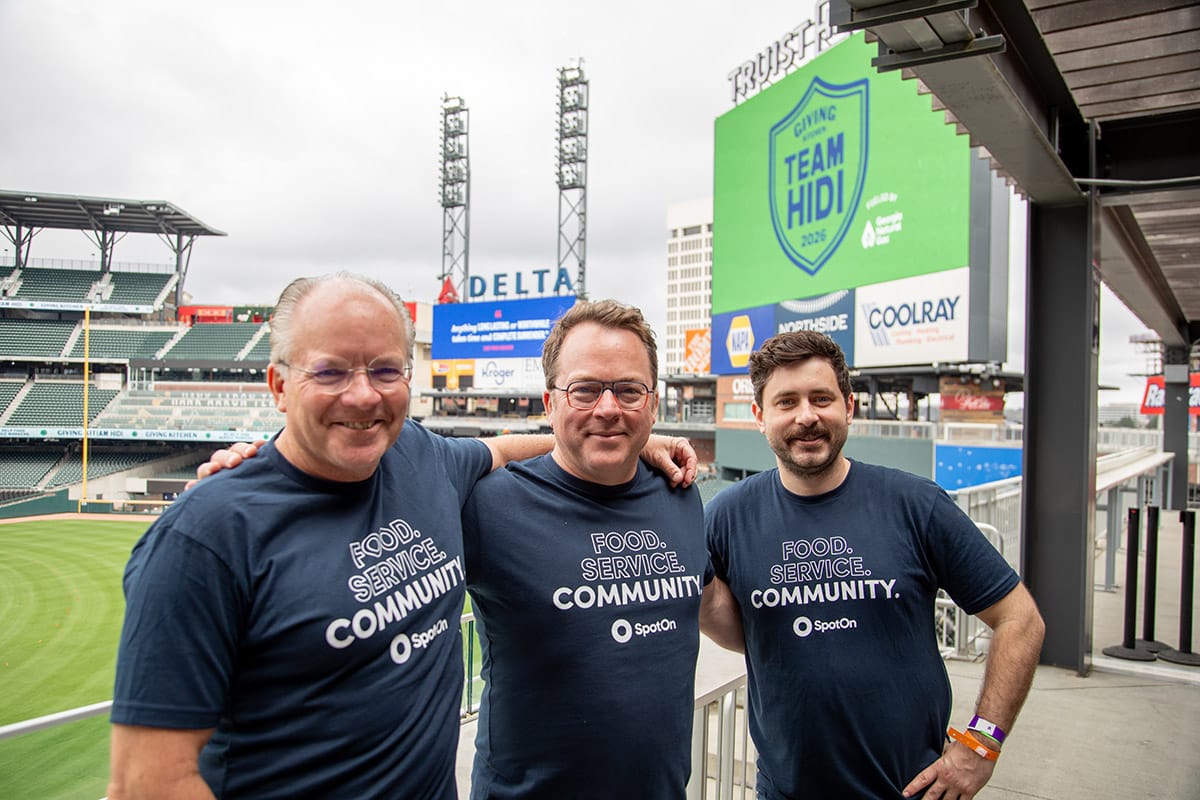
In March 2026, that language became literal service. Bryla and SpotOn colleagues volunteered at Giving Kitchen's Team Hidi fundraiser in Atlanta, passing out gift bags during the pre-event family meal. Giving Kitchen supports food-service workers with emergency assistance and community resources. It was a fitting scene for a marketing executive whose preferred nouns are “operators,” “staff” and “community,” and whose corporate campaigns keep trying to turn sentiment into a useful act.
A slogan is merely a debt with better typography
One of SpotOn's franker campaigns began when a client told the team, with grateful profanity, that they actually cared. The company printed the idea. Bryla's more revealing move came afterward. A company could not congratulate itself on the line and wander off. If it claimed to care, he wrote, it had to prove it for customers and for restaurants that did not buy from SpotOn.
The follow-up campaign, “Knowledge + Community = Profit,” turned toward operator meetings, templates and playbooks. Bryla joined sessions led by SpotOn's restaurateur-in-residence, Scott Youkilis, where owners traded fixes in real time. The topics included vendor negotiations and, wonderfully, how to sell more crab ravioli. Bryla called these some of the most creative and productive discussions of his career. After GE turbines and global payroll, the ravioli held its own.
Bryla can be combative when the data asks for it. In 2024, he challenged the “tipflation” story with SpotOn's transaction figures. Average tips were 18.99 percent in March 2024, against 19 percent a year earlier. Customers might feel a higher dollar amount because menu prices had risen, he argued, but the percentage was steady. The larger point was not etiquette. Restaurant margins often sit around 5 to 7 percent, and tipped workers depend on the system that public irritation was flattening into a catchphrase.
He applies the same suspicion to technology enthusiasm. On the National Restaurant Association's Order Up podcast, Bryla joined Boqueria's Emma Blecker to discuss “tech bloat”: the accumulation of specialized platforms that add training, logins and brittle handoffs. Digital transformation sounds less magnificent when a manager has to reconcile it at midnight. Bryla's advice favors consolidation and the experience of the people who use the tools, not novelty for its own sake.
Artificial intelligence, with an operator at the head of the table
That restraint now shapes SpotOn's message around artificial intelligence. At the 2026 National Restaurant Association Show, Bryla discussed “sleepability,” a sly measure for software aimed at owners kept awake by labor, costs and unpredictable demand. The company does not need to explain AI as a glittering feature, he said in a show-floor conversation. It needs to do the work behind the scenes and surface what actually moves the restaurant.
In June 2026, SpotOn opened beta access to Profit AI, designed to flag changes, suggest causes and recommend possible actions. Bryla emphasized both speed and jurisdiction: the system should help an operator understand the business faster, while the operator keeps the decision. The machine may notice the weak beverage mix. It does not get to rewrite the menu in a fit of silicon confidence.
The stance fits a career spent reducing complexity without pretending it has vanished. Bryla knows large systems. He also knows the person on the receiving end has a job to finish. His aspiration for restaurant technology is therefore modest in tone and substantial in practice: clearer numbers, fewer administrative knots, stronger direct relationships with guests, and a little more control for the people whose names are on the lease.
There are louder ways to market the future. Bryla's version sounds more like a good server: present when needed, informed without being theatrical, and possessed of the judgment to step away while the conversation is going well.