There is a special sort of difficulty in explaining a company that can do many useful things. Each new capability arrives bearing good news for customers and bad news for the sentence meant to contain it. By 2024, Priority Commerce had merchant services, automated payables, banking and treasury tools. Acquisitions had widened the offer. They had also left a house of brands in which every room possessed its own nameplate.
Dave Faupel, Priority’s chief marketing officer, had to make the house legible from the pavement. His brief was blunt enough to fit on a sticky note: “Success is Priority being known for payments and banking and one platform that brings it all together.” No mist, no brand sonnet, no plea to “reimagine possibility.” He wanted the market to understand what the company did and how the pieces belonged.
The answer became the Priority Commerce Engine, a platform story organized around four verbs: collect, store, lend and send. The phrase had to do more than decorate a conference booth. It needed to connect the company’s products, guide a website, survive an earnings presentation and make sense when a salesperson said it without a creative director nearby. A good brand line enjoys applause. A useful one endures ordinary conversation.
The useful patternOne brand, not twelve channels
Faupel had rehearsed the principle years before Priority, though in a different technological costume. In an IBM marketing report, he warned marketers to remember that a customer encounters “one brand,” not 12 channels. An app action, an email click, a shop visit and a service call might live in separate departments. To the person on the other side, they are one experience. The org chart is not a customer benefit.
That thought has followed his career. Faupel began in public relations and corporate communications, including agency work, before taking senior marketing roles at McKesson. At Silverpop and IBM, he rose to head worldwide marketing and led the global launch of IBM Marketing Cloud. At Sage, where he was vice president of North American marketing from 2017 to 2020, he helped increase marketing-driven revenue and launch a newer cloud portfolio for small businesses in the United States.
The logos are recognizable, but the more revealing continuity is the problem he keeps accepting. Enterprise software is crowded with invisible machinery and internal distinctions. Marketing must preserve what matters while stripping away what only the maker needs to know. Faupel’s recurring job has been to translate the system without insulting its complexity.
An IBM-era example makes his instincts unusually concrete. To explain smarter retargeting, Faupel imagined a shopper browsing hockey sticks and leaving without buying. The crude response was to follow that person around the web with the same stick. The more useful response depended on context: offer a first-time visitor a buying guide, give a recent customer advice on caring for the gear, and invite a repeat buyer into a loyalty program. The technology mattered, but the point was human. Relevance came from recognizing a journey rather than merely recording a click.
He extended the same argument to mobile. A phone was not a tiny marketing department entitled to its own detached strategy. It was one doorway into the customer’s relationship with a brand, alongside email, stores, websites and service conversations. Data should connect those encounters, he argued, while the distinctive qualities of the device should still shape the experience. It is the balance at the center of his later Priority work: join what belongs together without pretending every part is identical. Unification, in Faupel’s version, is not a steamroller. It is a well-drawn map.
“Remember: You’re one brand to a customer, not 12 channels.”Dave Faupel, writing during his IBM years
The renovationA rebrand with load-bearing walls
Priority began the rebrand project with Walker Sands in January 2024. The work started with a competitive audit, nearly 20 interviews with people inside and outside the company, and brand-perception research. More than 20 agency team members ultimately put in 4,500 rebrand and retainer hours. These are not romantic numbers. They are evidence that the final simplicity was manufactured, not discovered under a napkin at lunch.
The team removed sub-brand names, consolidated the product architecture and sought agreement across marketing, the executive team and the chief executive. That last part matters. If a company presents one idea outside while preserving rival kingdoms inside, the logo soon becomes expensive camouflage. Priority’s project linked the public identity to internal organization, leaving room for future products without reviving the old thicket of names.
The refreshed identity launched in September 2024. In its first months, the campaign reported 4.5 million impressions among selected audiences, 36 earned-media placements and a 17 percent increase in organic website conversions. Search visibility improved as well. Those results belong to a large joint team, and the public case studies are explicit about that collaboration. Faupel’s role was to set the initial ambition and serve as Priority’s primary stakeholder - the person responsible for helping the simple answer survive a complicated organization.
His verdict after launch was almost comically modest for a marketing executive discussing a rebrand: “We have never been able to tell our story so easily and so clearly.” Ease was the achievement. The company did not need more adjectives. It needed fewer explanations.
The anti-conferencePlease leave the canned answer at home
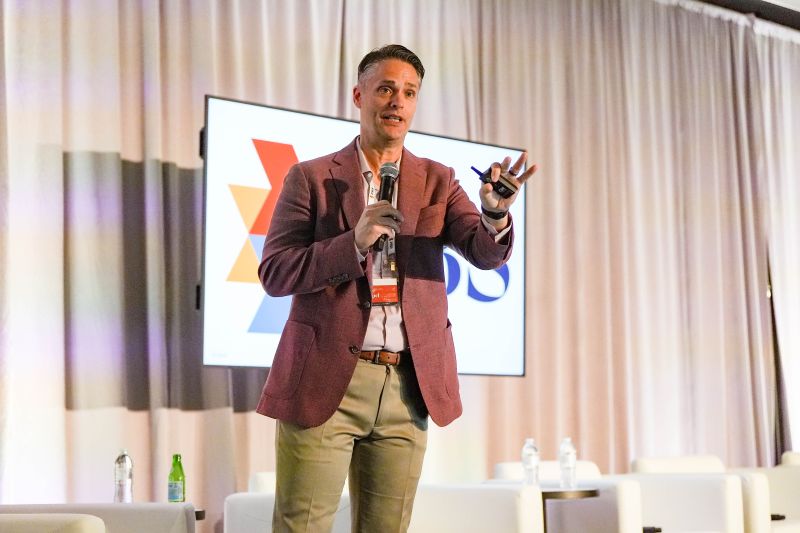
Faupel’s public writing becomes most vivid when he discusses conferences. “I’m allergic to panel theater and pre-approved talking points,” he wrote after Priority’s 2025 Payments and Banking Symposium. He compared the usual circuit of repeated keynotes and sanitized slides to warmed-over fast food. The Symposium, which he helped create and curate, was pitched as the anti-conference: a room for bankers, fintech leaders and even competitors to argue about embedded banking, payment rails and the movement of capital.
The language tells us something his corporate biography cannot. Faupel likes the live wire of disagreement. He wrote that he would not apologize for wanting it, because tension could help build a healthier industry. The stance is theatrical, but its target is theater. He is not rejecting preparation; the event had a blueprint. He is rejecting a conversation so prepared that nobody present can alter it.
This appetite has old roots. At Hofstra University, where he earned a bachelor’s degree in communications, Faupel competed in speech and debate, hosted a morning show on WRHU-FM and co-captained the men’s volleyball team. A microphone, a debating room and a volleyball court all punish the same vice: failing to notice what just happened. Each requires response, timing and a willingness to send the next thing somewhere useful.
“We won’t all agree, and I won’t apologize for wanting disagreement.”Dave Faupel on the Payments and Banking Symposium
Colleagues describe a complementary pragmatism. One client recommendation says Faupel acted like a member of the client’s team before he was hired, learning the business first, offering unusual ideas and remaining focused on execution. Another praises his relationship management and restless thinking. Then there is the smaller office memory: an old colleague joked on LinkedIn that she knew him when he kept candy bars in his office to win favor. Every theory of stakeholder management deserves a confectionery department.
What clarity changesThe sentence becomes company furniture
Brand work is often judged by what the public can see: a symbol, a palette, a line of copy. Priority’s more consequential move was architectural. The Commerce Engine gave employees a shared map of products that had arrived by different routes. It let the company describe merchant services, payables, banking and treasury as coordinated parts rather than neighbors exchanging polite nods over the fence.
This is why Faupel’s plain opening ambition matters. “Payments and banking” identified the territory. “One platform” imposed unity. “Brings it all together” supplied the customer benefit. Each phrase removed a possible detour. In a field where a product explanation can quickly become a bowl of abbreviations, the discipline feels almost subversive.
By 2026, Faupel was still appearing in public as Priority’s CMO, including an announced financial-technology panel in Emory University’s Veteran Leadership Speaker Series. The career has passed through agencies, healthcare technology, marketing software, small-business software and financial technology. The medium changed from press relations to cloud portfolios to money movement. The central occupation did not: helping a complicated institution decide what it means, then finding language capable of leaving the building.
There is no evidence that the work ends. Platforms expand. Companies acquire. New channels appear, each promising to become its own island. Clarity decays unless somebody tends it. Faupel’s record suggests that this maintenance is not a lesser form of creativity. It is the difficult kind - the kind that survives contact with sales, product, leadership and customers, and still sounds like something a person might say.