Jacob Whetstone had a talent that ought to have made his employer happy. At Danone, he could read a customer’s payment explanation on one screen and enter it into SAP on another, quickly and accurately. “I was so fast manually,” he recalled in a customer presentation. Yet the speed of his fingers could do little about the journey that information took before reaching them.
- HighRadius connects payments, documents and finance records.
- Its customers include Danone, 3M and Unilever.
- Its 2026 pricing offer ties payment to realized gains.
The money arrived. The explanation did not.
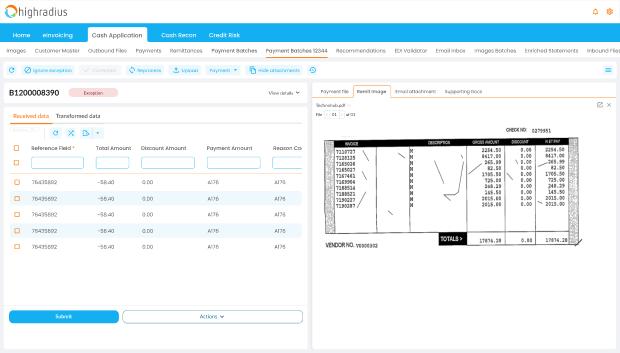
Money came through banks. Explanations came through emails, files and customer portals. Someone had to gather the pieces, identify the invoices, explain the short payments and update the ledger. A portal looked modern until an analyst had to visit it, download its contents and repeat the exercise elsewhere. Digital delivery had preserved a distinctly manual job.
This is the territory HighRadius occupies. Cash application means matching money received to the invoices it settles. The task sounds clerical. Its consequences travel: unresolved payments muddy collections, deductions and the view of available cash. A company can have received its money and still be behaving as though the customer owes it.
Danone’s presentation reported a 95% auto cash-posting rate and a 75% cost reduction after automation. Those are customer-reported results from a particular deployment, rather than a universal promise. The useful detail is the sequence: capture the evidence, connect it to the payment, then send the result back to SAP. Improving the handoffs mattered more than typing faster.
Eleven years before the first cheque
Sashi Narahari founded HighRadius in 2006, initially selling accounts receivable software installed on customers’ own servers. Its company history dates the move to cloud software to 2010 and the introduction of its Rivana AI platform to 2014. The chronology matters. HighRadius had a specific finance problem before it had today’s fashionable vocabulary.
It remained bootstrapped until 2017. When Susquehanna Growth Equity invested $50 million that September, HighRadius reported more than 350 clients. The money was intended to expand an existing business globally. A $125 million Series B followed in January 2020; a $300 million Series C in March 2021 valued the business at $3.1 billion. That figure belongs to that financing date.
Today’s homepage reports more than 1,500 customers, spanning large enterprises and midsize organizations. Consumer goods, manufacturing and distribution are natural settings for the problem: many buyers, many documents, many deductions. HighRadius also names customers across other industries. Its buyer is the finance organization trying to make those transactions manageable.
The unglamorous art of making records agree
The product range follows the money. Order-to-cash covers credit, invoicing, collections, deductions and cash application. Treasury handles cash positions, forecasts and payments. Accounts payable works on supplier invoices and approvals. Close and reconciliation, plus consolidation and reporting, address the accounting work that follows. A B2B payments suite includes gateway and fee-management tools.
HighRadius connects these applications to ERP systems. At Danone, SAP remained the financial source of truth. That is an important buying distinction: the software extends the machinery already recording the business. Its advertised prebuilt integrations include SAP, Oracle, NetSuite and Microsoft Dynamics. Integrations still need to fit the customer’s records and processes.
- 01CaptureBank data + remittance
- 02MatchPayment + open invoices
- 03ResolveDeductions + exceptions
- 04PostUpdate the ERP
HighRadius also offers LiveCube, a no-code platform with a spreadsheet-like interface, and FreedaGPT, a generative AI assistant. These address a familiar obstacle: finance users may know the question they want answered without wanting to commission another IT project. The interface is only one part of the proposition. Behind it, data has to be captured, interpreted and routed to the appropriate workflow. That makes a product demonstration most useful when it includes an awkward document or a disputed payment, rather than an immaculate example chosen for the occasion.
The expertise includes document extraction, matching and prediction. A December 2024 patent announcement describes correcting OCR mistakes such as confusing an O with a zero. It is an appropriately tiny detail: an impressive financial model is little comfort when the invoice reference is wrong.
Billtrust and Esker also offer AI-driven receivables and order-to-cash automation. AI alone therefore explains little about the choice. HighRadius’s positioning rests on connecting a wider collection of finance workflows and measuring their results. Buyers should compare the particular workflow, integration and exception handling they need. A longer product menu is useful only when the dishes belong together.
The surrounding work is substantial enough to attract partners. A February 2025 HCLTech alliance pairs finance and accounting services with HighRadius software. In 2024, HighRadius acquired billing and collections provider Cforia. Both moves reflect a business where software has to meet operational habits, rather than merely appear on a screen.
A price tag with a condition attached
In February 2026, HighRadius announced outcome-based pricing: zero implementation fees, zero subscription fees until go-live, then a fraction of realized gains. The wording matters. The offer includes payment for value delivered. The announcement supplies no standard gain-share percentage.
HighRadius says the change followed a controlled, 24-month experiment comparing customers with formal success criteria against customers without them. The latter, it says, went through implementation and enhancement loops that frustrated both sides. Its account does not provide sample sizes or numerical comparative results. It is evidence of the company’s thinking, rather than proof that a pricing model causes better outcomes.
The most interesting unit of progress here is a task that no longer lands on someone’s desk.
The mechanism is a document called Mutually Agreed Success Criteria, or MASC. Buyer and vendor establish baselines, targets and executive sign-off. That is an unusually practical centrepiece for a company selling AI. The argument over whether software works begins before the software arrives.
A deadline, and a document worth copying
In February 2025, Narahari set a 2027 goal of more than 90% automation across all products. At that announcement, HighRadius identified cash application and forecasting as already achieving 90% touchless automation. “Users will only work on exceptions,” he said. The broader deadline remains a target.

Its careers pages describe pragmatism, fast decisions, KPIs and frugality. The practical lesson for a buyer is equally plain: choose one troublesome workflow, count its manual work, define acceptable errors and agree who judges success. Then test the result. Make the exception queue part of that test; the remaining work needs an owner too. With inaccessible documents, unreliable records or disputed savings baselines, both automation and gain sharing become harder to assess. The document is worth copying before the software is worth buying.