The most revealing word in Hemal Somaiya's recent writing may be “subtracting.” Marketing usually prefers addition: another channel, another campaign, another dashboard to admire during a meeting about the previous dashboard. Somaiya has been making the case for a more selective kind of ambition. Choose the channels that deserve the money. Connect the people doing the work. Give the customer a reason to pay attention.
It is a practical argument from someone whose career has taken her through consulting, corporate brand leadership and company building. As co-founder and Chief Executive and Strategy Officer at PharmaForceIQ, she works on the machinery behind marketing decisions: how information becomes a recommendation, how that recommendation reaches a team, and how a business determines whether the effort was worthwhile. The glamour, such as it is, comes after the plumbing.
Her September 2026 article carried an unusually economical instruction in its title: Stop Adding, Start Subtracting. For a technology executive, that is an interesting sales pitch. The attraction of software is often the promise of doing more. Somaiya's argument asks a harder question: which activities have earned the right to continue?
A career on both sides of the brief
Before helping build PharmaForceIQ, Somaiya held marketing leadership roles at Merck, AstraZeneca and Boston Scientific. She also worked in strategy consulting at IMS Consulting Group, now part of IQVIA. Her consulting work covered market research, commercialization, business development, company evaluation and acquisition questions. That mix put her close to the decisions businesses make before a campaign ever acquires a slogan.
Consulting and brand management offer different views of the same problem. A consultant must make a recommendation persuasive. A brand leader must live with what happens when colleagues try to implement it. Somaiya's later emphasis on execution makes sense against that professional background. A sensible plan still needs usable information, coordination and an owner willing to revise it.
Her education crosses related boundaries. She holds an Executive MBA in Entrepreneurship and Innovation from MIT Sloan School of Management and an MBA in Business and Clinical Regulatory Affairs from Claremont Graduate University. Entrepreneurship, operating decisions and the constraints of a regulated business all appear in the subjects she subsequently chose to discuss in public.
There is a pleasingly unceremonious detail in her own professional description. She calls herself “in permanent beta.” It is a software phrase with rather better manners than most declarations of expertise. It leaves room for the next lesson. In the same biography, she describes an interest in helping companies, teams and individuals develop their potential, and in combining analytical work with strategic and creative thinking.
“I'm in permanent beta, always excited to learn and take on new challenges.”
Hemal Somaiya
The unopened email is part of the story
In October 2021, while identified as a global brand lead at Merck KGaA, Somaiya joined Chris Conner on Life Science Marketing Radio. Her example of artificial intelligence was refreshingly concrete. An email goes unopened. The system can choose a different subject line and adjust the subsequent content sequence using the recipient's previous responses.
There were pre-approved messages available to work with. That detail matters. Her example concerned making better decisions within an existing business process, including its approval requirements. It brought the discussion down from a grand promise about artificial intelligence to the everyday task of deciding what to send next. Anyone who has ignored a crowded inbox can understand the appeal of fewer irrelevant attempts.
She also appeared on Reltio's panel about AI in digital marketing alongside executives from Verizon, Unilever and Amazon. The company names differ; the commercial questions travel well. How does a team organize its data? Where does an automated decision help? What changes when the customer responds differently from the plan? These are managerial questions as much as technical ones.
Building a company around the handoff
PharmaForceIQ grew out of its founding team's experience inside companies and in consulting. Its proposition joined data, campaign deployment and measurement in a connected service. Somaiya brought the perspective of someone who had worked on the buying side of marketing decisions. Fellow founding leader Stephen Onikoro brought his own background in commercialization strategy and operations.
The company's history describes an initial commercial client, expansion into additional portfolios and clients, and an emphasis on continuing service. It is the sort of progression that can disappear beneath a tidy startup biography. The practical challenge is keeping the connection intact as more teams, more campaigns and more expectations enter the picture. A diagram never has to negotiate a handoff. People do.
In September 2024, PharmaForceIQ announced a majority investment from Eir Partners. The announcement set out investment in people, processes and technology, with customer experience part of the expansion agenda. Chairman John Blakeley and Eir managing director Neil Vangala were among the people involved in describing the next phase. For Somaiya and her colleagues, the platform was becoming a business to scale as well as a proposition to explain.
- 2024Eir Partners majority investment
- 2025MM+M and PM360 recognition
- 2026Aktana joins PharmaForceIQ
On stage, the conversation gets human
A photograph from the 2025 Pharma CX Summit places Somaiya in the familiar furniture of business debate: four high stools, microphones and a large screen promising tools and technologies. She joined Vaibhav Malankar, Avinash Prabhakar and moderator Elaine Gamble for a discussion of coordinated marketing. The setting is technological; the difficulties are often thoroughly human.
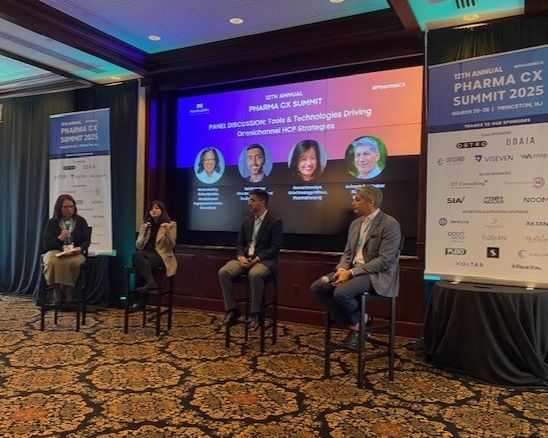
The company's recap emphasized defining the business problem, connecting field and digital activity, and approaching change management carefully. A separate 2025 Fierce Pharma Engage panel recap stressed fitting new technology into existing workflows and building feedback loops. The theme is consistent: the intended users need to find a tool useful enough to make it part of their working day.
That is where an elegant product demonstration meets office life. A recommendation may be mathematically impressive and still arrive too late, lack context or require someone to open yet another system. Somaiya's public discussions repeatedly return to coordination and adoption. Those concerns give her technology argument a recognizable human scale. The person receiving the recommendation has a schedule, colleagues and competing demands.
The acquisition that joined two halves
On January 7, 2026, PharmaForceIQ announced its acquisition of Aktana. The transaction brought together PharmaForceIQ's digital orchestration capabilities and Aktana's field recommendation technology. Derek Choy, an Aktana co-founder and former chief product officer, became PharmaForceIQ's head of product. The business case was to connect brand strategy with the work of teams interacting directly with customers.
The acquisition announcement described an underlying collection of more than 100 million field suggestions and more than 5,000 executed tactics, accumulated over twelve years. Those figures describe Aktana's experience base, rather than Somaiya's personal output. They help explain the attraction of acquiring an established capability: a working history can carry information that a fresh diagram cannot supply.
In their subsequent joint interview, Somaiya and Choy discussed combining digital and field activity within a shared system. Her emphasis was on giving teams context and coordinating personal interactions with digital communication. The relationship still mattered. Better information was meant to help the people responsible for it decide where to spend their time.
the signal→02Coordinate
the action→03Measure
and adjust
A conceptual guide to her published approach, rather than a product performance chart.
Recognition, followed by another revision
Two 2025 honors recognized her work. MM+M selected Somaiya for its Women of Distinction class, announced in March. PM360 named her an ELITE 100 honoree in the Disrupter category in May. Both recognized a career spanning established companies and a founding role in a technology business. Neither required her to stop asking what should change next.
Her published argument has continued to develop. A December 2022 article addressed omnichannel marketing. A November 2023 piece focused on affinity data, the information that helps explain an audience's preferences and behavior. By September 2026, she was calling for channel audits, closer integration with existing sales tools and faster movement from information to action. The vocabulary evolves around a persistent concern with relevance.
On October 12, 2026, her attention turned to “share of answer” in Pharmaceutical Commerce. The visible premise was that AI tools are changing how people find information, and brands must reconsider how they appear in those answers. It extends the same question into a new setting: where is the audience going now, and what does that mean for the work a marketing team should do?
There is a useful tension in this career. Somaiya builds a business that adds capabilities while arguing that its customers should become more selective. The two ambitions can coexist if greater capability produces better choices. An executive can buy another tool in an afternoon. Deciding which habits to retire tends to require more nerve.
“Permanent beta” is an apt phrase to return to. It describes a willingness to keep revising after the degree, the corporate title, the investment and the award. Somaiya's public career has moved from making brand decisions to building systems that help other teams make them. Her current challenge is to keep those systems close enough to ordinary working life that the next useful action becomes easier to see.