Before Harshal Shah could sell a line of code, he had to sell an answer to a rather awkward question: would his company still be around in a few years? Prospective employees asked it. Prospective customers had their own version. A new technology business can promise almost anything. Persuading someone to stake a career, or a budget, on the promise is a different occupation altogether.
Shah remembers that uncertainty as an early obstacle at Elsner Technologies and its app business, MyAppGurus. Good candidates worried about joining a young firm. Buyers wanted evidence. He describes an ecommerce app project whose successful launch helped change the business's prospects. The breakthrough, in his telling, arrived through delivering something useful. A working application is a remarkably persuasive business card.
That problem of trust has followed him into a very different market. Today, the Ahmedabad entrepreneur runs Elsner and co-founded Link Publishers. His public conversations now include artificial intelligence, brand authority and the future of search. Underneath the new vocabulary sits a familiar concern: why should anybody believe you?
A company has to outlive the excitement
In an October 2026 reflection on Elsner's twentieth anniversary, Shah returned to 2006: a small team in Ahmedabad, with ambition that exceeded its experience. His account gave the present-day business three markers of scale: more than 200 people, over 9,600 projects and a presence across more than ten countries. These are the founder's figures, and he attached them to an unusually collective anniversary message.
He dwelt on the people who stayed after the novelty of starting something had worn off. Early mornings, uncertain deadlines and small victories occupied more of his recollection than personal triumph. Read that way, the anniversary becomes a story about repetition: enough people turning up often enough for a small company to become an established one.
There is something appealingly unfashionable about this. Technology enjoys a launch. Businesses also need the following Tuesday. Shah's account gives that less photogenic day its due.
The education before the letterhead
Before Elsner, Shah worked at Reliance Communications and Tata Consultancy Services. He studied at the Dhirubhai Ambani Institute of Information and Communication Technology, known as DAIICT; his LinkedIn education entry lists 2002 to 2004. His own short biography describes a belief in continuous improvement, along with interests in reading, travel and writing about web technology.
That combination helps explain the range of his public work. He has the vocabulary of a developer, the responsibilities of an employer and the habit of explaining what technology means to a business buyer. The questions change depending on which chair he occupies. A developer asks whether a feature works. A client asks whether it is worth paying for. A founder must make room for both.
His biography also records a Young IT Entrepreneur Award from Ahmedabad University in 2013. Alongside the award, he includes his earlier employers and education. The result is a career account built from institutions, practical work and an appetite for learning, rather than an origin legend requiring a garage.
The unglamorous art of handing work over
By March 2019, Shah could describe Elsner's delivery process in considerable detail. A business development team first established the client's objectives and drew up the scope, resources, timing and cost. Design translated the agreement into a blueprint. Development built the product. Quality assurance looked for defects. A client demonstration preceded launch.
- Scope
- Design
- Build
- Test
- Demo
- Launch
He emphasized keeping the customer informed throughout. It is a modest detail with large implications. Every handover offers a chance for the original intention to become slightly less recognizable. A clear process helps the person paying for the software follow its progress through several teams.
His interests then included data analytics and blockchain, while his preference for development was agile working. Looking back, the process sounds more enduring than the technology forecast. Specific tools can lose their novelty quickly. The need to agree what a customer wants, build it and check it survives rather well.
Clues left in public
There is another, smaller record of Shah's technical world. A Stack Overflow account bearing his name and identifying him as Elsner's founder contains answers about iOS, Android, PHP and Laravel. The subjects are pleasingly concrete: labels, authentication, audio sessions and data displayed in tables. Even an expansive business biography occasionally returns to the problem of making something appear correctly on a screen.
His Drupal profile likewise connects his name to Elsner and describes an interest in business automation. These profiles give his public identity a practical texture. The large categories of digital transformation sit alongside the small problems that make a software project behave badly on a Thursday afternoon.
The writing runs beyond developer communities. His TechWyse author page carries a 2016 article about building an online brand. His YourStory author biography identifies him with mobile development and IT consulting. Across these outlets, he appears as someone interested in explaining the commercial use of technology as well as commissioning its construction.

The meeting after the meeting
At brightonSEO in April 2025, Shah's scheduled session was titled “Future-proofing link building in the age of SearchGPT.” The conference programme placed him at the Brighton Centre on April 10, representing Link Publishers. His proposed subject was how brands should adapt their link-building work as AI changes search, with greater attention to authority and credibility.
The setting matters. Here was a founder from a software services background discussing the conditions under which another business gets discovered. Building the website and helping people find it had become neighboring parts of his working life. The customer who needs an online shop may soon need help attracting attention to it, too.
In his account of the conference, Shah lingered on conversations away from the stage. During a coffee break, he joined a discussion about whether AI made outreach impersonal and showed a matching dashboard on his phone. Over lunch, a conversation with speaker Rakesh Patel prompted notes about participating in relevant online discussions.
He also recalled a small-agency owner talking about podcast mentions, and described sharing a spreadsheet for tracking link campaigns. These are telling choices for a conference recollection: a phone demonstration, a lunch conversation, a file someone else can use. His version of networking includes bringing something practical to the table.
When the product is being believed
Link Publishers brings the reputation question into Shah's product work. He is its co-founder alongside Het Balar. The company's explanation of his Brighton presentation describes an approach built around relevant publishers, useful content, brand mentions and a recognizable author identity. Its argument is that a business needs a coherent reputation across the places where people encounter it.
“Algorithms might change, platforms will evolve, but brand credibility and brand authority will remain forever.”
Harshal Shah, on his approach to search
That is Shah's conviction, rather than a guarantee about any search engine. It also gives his career a satisfying continuity. The young services business needed people to believe it could deliver. The marketing platform helps clients think about how they are perceived. The tools differ; credibility remains expensive to acquire.
His publishing activity shows how closely he follows that territory. Link Publishers lists his articles on backlink quality, domain authority tools and comparisons of SEO metrics. At Elsner, recent bylines move into AI visibility and tracking appearances in generative search. He is writing about a market while participating in it, with all the commercial interest that entails.
More companies, more places to listen
Elsner's venture list includes EcomVA, Link Publishers, ERPOcean and MyAppGurus. Its current company description extends from ecommerce and development into enterprise systems, AI and data work. That breadth gives Shah several ways to encounter the same customer: through a storefront, a business process, a marketing campaign or the software connecting them.
He explains the expansion as a consequence of hearing recurring business problems. Experience with customers reveals needs that may fit an existing company or justify a separate product. His test includes whether the difficulty is real, whether customers will pay to solve it and whether the opportunity warrants years of attention. An idea, in that account, has to earn its own company.
The leadership consequence is equally practical. Shah describes moving from doing everything toward giving other people context, authority and responsibility. His stated ambition is to build sustainable technology businesses that help customers grow while creating opportunities for employees. Several ventures make that delegation a daily requirement.
The next room is already filling up
Closer to home, Shah has also participated in Ahmedabad's digital marketing community. A public meetup account records him discussing the need for accuracy and relevance when using AI in content. At Elsner's January 9, 2026 town hall, he joined the management team to discuss the year's priorities. The audiences differ, but both settings put him in the business of explaining where the work is going.
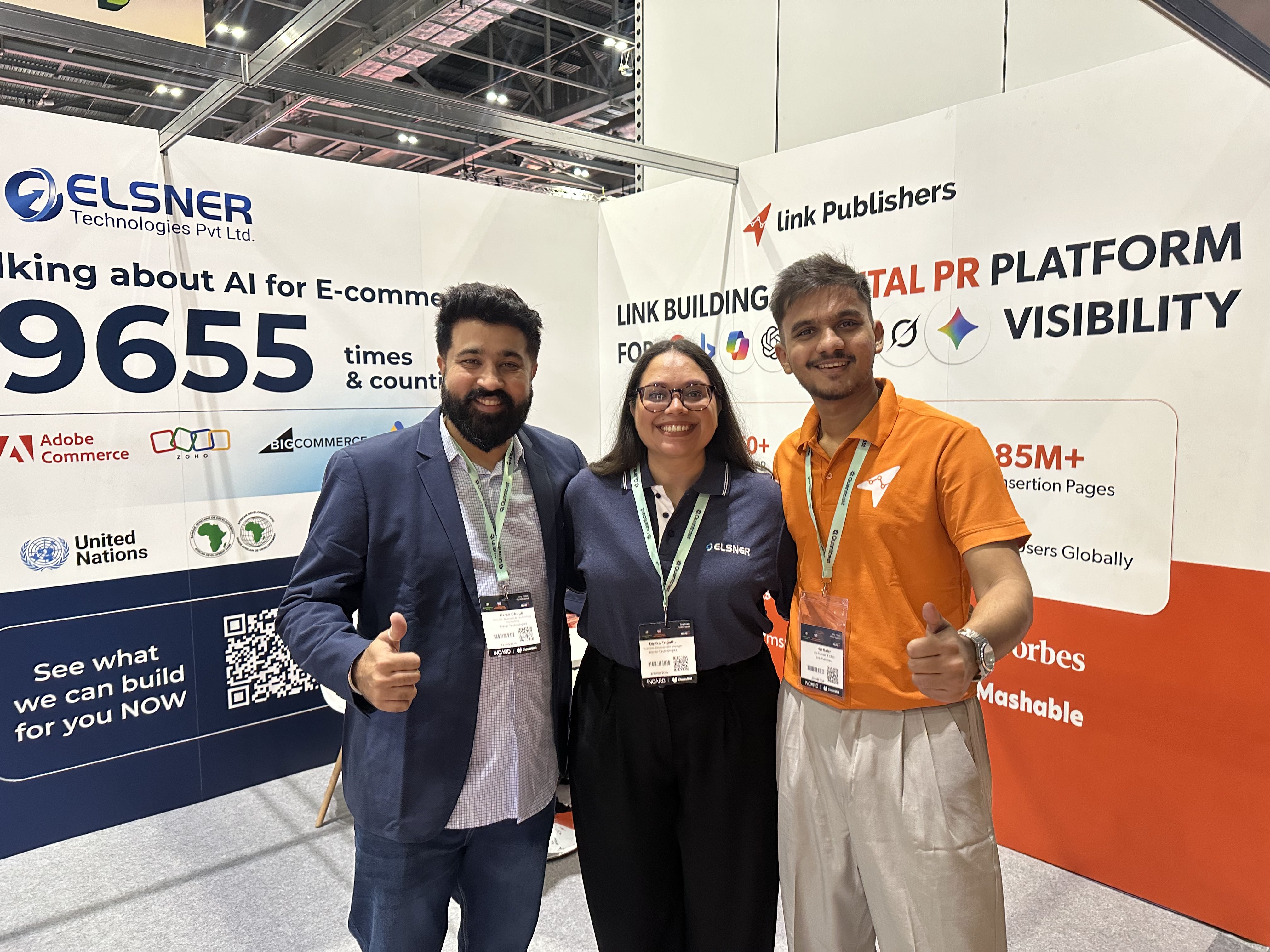
His October 2026 activity brought him back to brightonSEO with Balar and Link Publishers. A London meetup invitation, meanwhile, favored a small room and candid discussion about AI and search. There is a useful consistency between the invitation and the conference memories: he keeps making time for conversations that can wander beyond a prepared presentation.
After twenty years, Shah's public story still returns to people deciding whether to work together. Software gives those decisions a shape. A project can become a reference, a conversation can become a product, and an employee can become someone trusted to lead. For all the changes in the technology, the founder still has to persuade the next person in the room.