Andrew Raso was selling PlayStations at school before he was selling search engine optimisation to businesses. At 15, he had already found an audience with a fairly clear idea of what it wanted. Mini bikes imported from China and sold on eBay followed. Both ventures offered a chance to spot an opening, find a customer and make something happen.
Years later, describing his own particular talent, he chose an answer that had very little to do with search algorithms. He could get along with people. Mothers, chief executives, marketing managers, fellow entrepreneurs: he believed he could find a patch of common ground with almost anyone. A conversation could end with a new friend and, with luck, the beginning of some business.
“I am a great relationships builder,” he said in 2015. It was an assessment that fit the young company he and Mez Homayunfard were building. It also contained the outline of a problem he would eventually have to solve. A pleasant conversation can win an account. An employer sometimes has to conduct a rather less pleasant one.
A customer before there was a company
Raso and Homayunfard established Online Marketing Gurus in Sydney in 2012. The early address was his parents’ spare room. His recollection of the first stretch includes more than a year without salaries and difficulty finding enough money for their own marketing or petrol. A business dedicated to helping other businesses get noticed was having to be economical about getting noticed itself.
Raso had worked in digital agencies and believed clients were being given unnecessary complexity and too little clarity about results. Search marketing was a service many owners needed but could not easily inspect. That left an opening for someone willing to explain the work and accept questions about whether it was working.
The first sales effort was fairly literal. Raso has described walking into retail shops in suits to ask whether they needed marketing. He recalls an early website costing $270. There is something endearingly direct about the picture: a digital business, dressed for an appointment, trying its luck at the physical door.
His later descriptions give those beginnings a practical emphasis. There were cold approaches and repeated refusals. There was also time available to spend on the problem. Raso’s willingness to sell came before the infrastructure that would make the selling easier. The company had to earn its next improvement.
The other agency’s customer
The founders found another route to clients through businesses that already knew them. Web designers, creative agencies and public relations firms had customers who needed SEO. Those firms did not necessarily provide it themselves. Raso called them and offered a referral arrangement, with a commission paid once a customer signed.
For an agency short of cash, that sequence mattered. A marketing expense followed a sale. The referring company gained something useful to offer its customer, and OMG gained an introduction warmer than another unexpected knock at the shop door. Raso says this channel sustained the company for years before it used paid advertising.
By 2015, the partnership model was a point of pride. Raso and Homayunfard received Anthill’s 30under30 recognition, and Raso singled out winning Equinix as a sales achievement. His description of his social ease belonged in that context. Knowing how to make someone comfortable had a commercial purpose, and the business was giving that ability a structure.
There is an unglamorous intelligence in the arrangement. Rather than asking every small agency to acquire another capability, the founders made it worthwhile to introduce a specialist. Raso’s instinct for people had found a repeatable route to revenue. The next question was what the company would do after the introduction.
What a click can conceal
Raso’s career also developed on the page. He contributed business and marketing articles, with work appearing in Entrepreneur and Content Marketing Institute. His subjects were often the small mechanisms of online persuasion: content creation, conversions, discoverability and the uncomfortable gap between a useful measure and an attractive number.
In a 2016 article about engagement, he questioned the habit of treating reach, time on a page and social shares as dependable evidence of attention. A reader could open a tab and walk away. Someone could share an article without reading it. The numbers might be accurate while the interpretation went wandering.
He suggested looking more closely at actions, scrolling and comments. The underlying question was sensible: what had the audience actually done? Marketing has a generous supply of numbers available for display. Choosing one requires an opinion about what the work was supposed to achieve.
That concern appears again in Gurulytics, OMG’s own reporting platform. Clients can look at campaign performance and communication with their account manager in one place. Rankings and traffic sit alongside the relationship through which the work gets explained. The dashboard gives the customer more to ask about, which is part of its point.
From getting noticed to showing the work
An editorial view of OMG’s relationship between referrals, service and reporting.
Building that visibility came with its own difficulties. Raso has described relying on an outside technology partner, encountering expensive rebuilding problems and bringing development capability in-house. A promise of transparency still needs software, maintenance and people who can be trusted with both. Even a dashboard has a backstage.
A bigger map, a harder conversation
The agency’s ambitions extended beyond Australia. By the time Raso discussed its international strategy in an interview released in January 2020, the United States and Singapore were part of the story. The discussion covered differences between markets and the importance of testing before committing. An overseas customer could need the same category of service and still require a different approach.
In 2023, Raso relocated to Dubai to help lead the Middle East expansion. He has since stressed the value of getting on the ground and hiring locally. Buying attention in another country was only one part of the job. Someone still had to understand the market and build the relationships around the service.
OMG’s current public biography describes more than 200 specialists operating across Australia, the United States, Singapore and the UAE. It names clients including Vodafone, LG, Calvin Klein and Fujitsu. Those are company credentials, but they also describe the distance between the founder’s first selling job and the organisation he now helps lead.
The larger organisation asked something different of him. In 2021, he described days filled with international calls, executive meetings and conversations with department heads. He also introduced a weekly coffee with a randomly selected employee and managing director Wasif Kasim. The subject could be a concern, a personal conversation or simply soccer.
He preferred having people around him and talking face to face. It was consistent with the relationship builder’s account of himself. The coffee initiative created a small, deliberate opportunity to meet someone outside the usual chain of meetings. A growing company can contain plenty of communication and surprisingly few ordinary conversations.
By December 2025, Raso was describing another side of leadership. He had once wanted to make everyone happy and treat team members as personal friends. He said he had learned to value difficult honesty and to aim for fairness, approachability and consistency. Hiring close friends had supplied some of the lesson.
“I would rather be respected than liked”
Andrew Raso, on a principle he adopted as a leader
His account also included mistakes made when success encouraged him to assume too much. He spoke about nearly going broke, pursuing new opportunities while overlooking what already worked, and learning to cut losses. The confidence that helps a founder begin can make it harder to notice when an idea has stopped deserving another attempt.
The adjustment he described was specific. Capable executives need responsibility, along with coaching and accountability. The founder has to stay close enough to know what is happening. For Raso, delegation had become a continuing relationship that included checking, challenging and helping. Friendship alone was being asked to carry more than it could manage.
The questions he wanted to ask
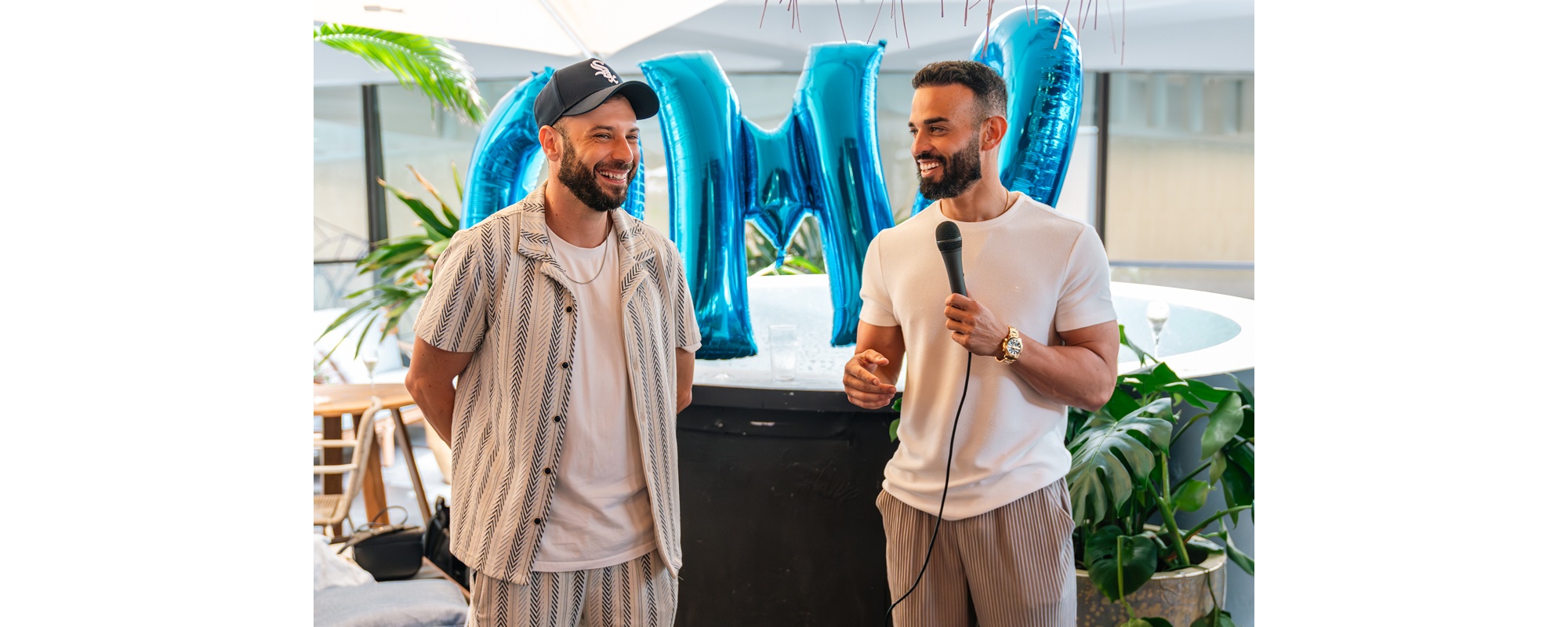
In June 2025, Raso added a microphone of his own with Never Not Building. The podcast put him opposite other founders and operators, asking about the choices behind their companies. Its conversations have included Finder co-founder Jeremy Cabral, property entrepreneur Scott O’Neill and criminal defence lawyer Jahan Kalantar.
Raso has explained the project in personal terms: he wanted the kind of local founder conversation he wished had been available when OMG was young. He was interested in decisions, close calls and things guests would do differently. Access to successful people becomes more useful when someone asks about the moment before the result looked inevitable.
There is continuity with his earlier work here. Asking a prospective client questions, leading a team and interviewing a founder all depend on noticing where the rehearsed answer ends. The podcast gives that curiosity a public setting. It also lets him return to beginnings while operating a company well beyond its own.
His next scheduled appearance points toward another change in his trade. On November 25, 2026, he is due to give a Business Show Australia keynote in Sydney on AI-driven search. The title makes a forceful claim about traditional SEO. The practical issue underneath it is familiar from his career: how businesses get found when the routes to customers change.
Raso began with a knack for spotting demand and getting along with the person in front of him. He now has an international agency, a reporting platform and a podcast through which to pursue those interests. The more revealing development is smaller: learning to let a conversation become uncomfortable without abandoning the relationship. For someone who once offered nearly everyone a friendship, that is a consequential revision to the pitch.