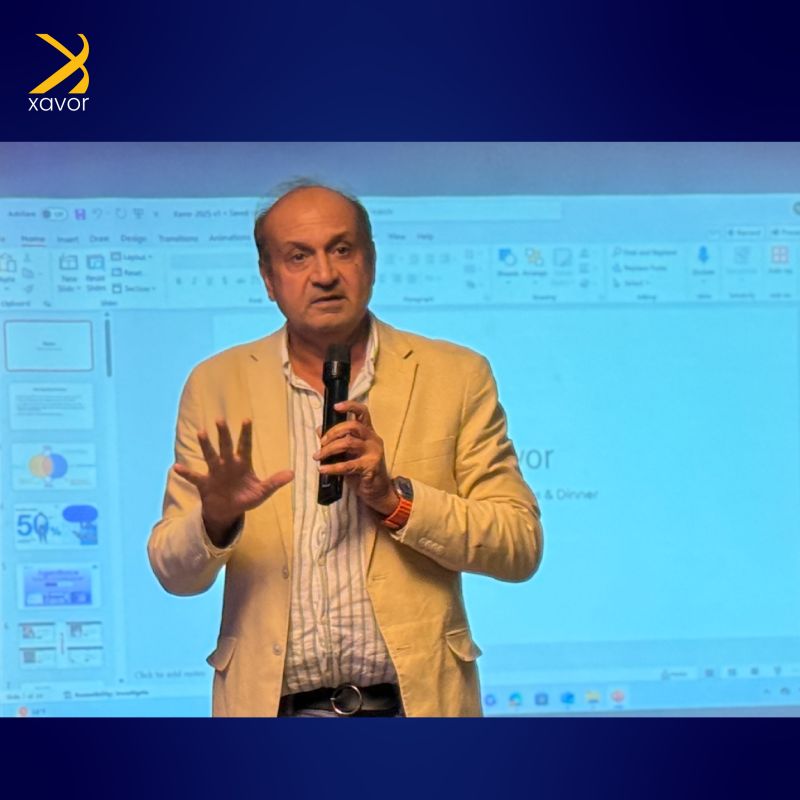
A founder listens to his younger employees and discovers that they would like him to hurry up. It is a small scene, familiar enough in a technology company, but Hugh Rashid seems to have taken something useful from it. Reflecting on an Xavor all-hands discussion about artificial intelligence in July 2025, he described being surprised by how much the younger members of his team knew. They understood the possibilities. They wanted speed.
Rashid had founded the company thirty years earlier. He could have treated their impatience as an occupational hazard of youth. Instead, he described it as a lesson. The company would need to move faster. He also saw an opening for Pakistan’s technical talent to advance into AI rather than follow the established path of traditional IT services.
There is a pleasing complication here. The founder is also the student. That arrangement turns up repeatedly in Rashid’s career: running a company while pursuing management education, teaching innovation while working in enterprise technology, and gathering specialists together so they can ask each other better questions. His professional life has made room for both the working system and the conversation about what it ought to do.
A company first. More school followed.
Dr. Humayun Rashid, who also uses Hugh, founded Xavor in California in 1995. The company’s work grew to include enterprise solutions, product engineering, cloud computing and design. Its current operations connect an Irvine headquarters with teams in China and Pakistan. The geography matters because Rashid’s own work has crossed those settings, particularly through the company’s Shanghai operation and his teaching in Chinese universities.
His education followed a business path: a BBA at the University of Texas at Austin, an Executive MBA at the University of California, Irvine, and a management doctorate at Case Western Reserve University, completed in 2008. The last degree came well into Xavor’s existence. By then, questions about managing people and introducing technology belonged to his working life as well as his academic one.
Looking back, he described the doctorate as a change in how he approached leadership. “Applying creativity and design thinking to leadership and strategy completely changed how I see my role as a leader,” he said. The emphasis is revealing. His account of the degree centers on how to think about a problem, including whether the familiar framing deserves to survive.
- 1995Founds Xavor
California - 2007Studies the language
of organizational change - 2008Management doctorate
Case Western Reserve - 2018Startup jury
Seedstars Shanghai
When the software arrives, who explains the change?
A piece of Rashid’s 2007 research gives that interest a concrete setting. He examined communication during an enterprise resource planning implementation at a global entertainment and media company. The business was attempting to move its home-video division toward greater process efficiency as profit margins came under pressure. Software was part of an organizational change with consequences for how people understood their jobs.
His research used employee interviews to examine the relationship between management’s broad account of the change and employees’ efforts to understand it locally. He described a push-pull communication model: leaders supplied the overall purpose, while a deeper conversation helped departments make sense of what the new arrangement meant for them.
Read alongside his later career, the paper offers an early view of a recurring concern. A technically functional system sits inside an organization full of interpretations. People have to decide what a new process means, how to use it and how it connects to the work they already know. The implementation plan has to encounter that reality sooner or later.
It is a subject with little of the glamour of a product launch. Nobody gathers around a conference table to admire a beautifully clarified misunderstanding. Yet Rashid chose to study the space between an executive announcement and the understanding it was supposed to create. For someone building a software business, that was a practical place to look.
Ten minutes, then the room gets a turn
In Shanghai, Rashid’s activities brought him into contact with people approaching technology from different directions. His roles included leadership of AmCham Shanghai’s technology and innovation committee and management of Xavor’s Shanghai operation. He also taught innovation and entrepreneurship at universities including Fudan, Wuhan, Chongqing and Peking. The subject traveled between business meetings and MBA classrooms.
On February 22, 2017, he opened an AmCham event about moving from engineering-led work toward user experience design. The participants included Tongji design dean Lou Yongqi, IBM designers, Michael Lai of TANG Consulting and Arthur Lou of the China Institute for Innovation. Rashid’s opening remarks placed design within a wider business conversation about products, services and complex problems.
The cast of participants helps explain the kind of discussion he was convening. Design was being considered alongside corporate operations, engineering and strategy. A technology executive could hear from a university dean; a consultant could encounter a different account of what a customer needed. Those exchanges put several professional vocabularies in the same room.
At another event, this time about industrial IoT and manufacturing in China, Rashid made a modest scheduling decision. Speakers would have ten minutes each for their opening presentations, leaving more time for the panel and questions. He acknowledged that each could comfortably fill an hour. The audience, nevertheless, was going to get a turn.
That detail is more vivid than another list of conference appearances. It shows how he arranged a conversation about a very broad subject: narrow the opening, let the specialists establish their positions, then make room for people to test those ideas against actual concerns. Even expertise benefits from someone watching the clock.
A factory meets a different kind of brief
Xavor’s China operation described its ambition in unusually tangible terms: work with traditional manufacturers to develop smart products. Its stated ingredients included sensors, electronic hardware, cloud platforms, data and AI. Product lifecycle management, one of the company’s established areas, concerns the complicated business of managing products and their information across development and change.
The China vision extended into prototyping, new digital experiences and business models. That put Rashid at a junction between a manufacturer’s existing expertise and unfamiliar possibilities. The product still had to work. The surrounding experience, and the way the business delivered it, also became part of the brief.
He returned to those questions as a moderator of a discussion featuring Youngjin Yoo and SAP’s Nicolas Leclercq. The conversation examined digital platforms and user experience, including how organizations build support for change across functions. Finance and human resources belonged in the discussion alongside engineering and marketing. The departments approving resources and shaping working practices had a stake in whether an idea reached the world.
Rashid also appeared on the jury at Seedstars Shanghai in June 2018. Judging startup pitches placed him on another side of the same problem: listening to a proposed business and considering how its pieces fit together. Teaching a concept, moderating its discussion and evaluating a pitch each demand a slightly different kind of attention.
at Xavor
and management
and entrepreneurship
The teacher gets a new assignment
By the company gathering documented in December 2024, AI was explicitly part of the discussion about Xavor’s service delivery and future growth. Rashid spoke alongside colleagues presenting work across web development, robotics, data, product lifecycle management and cloud services. The company was approaching the subject through several kinds of existing work.
The July 2025 reflection added a more personal detail: his surprise at younger colleagues’ understanding. Across a career involving lecturing and convening, he had spent plenty of time introducing ideas to other people. Here, he was describing what came back from them. He connected their energy with a broader ambition for Pakistan’s technology workforce.
His public writing in 2026 continued the discussion of how organizations adapt. In June, he used the metaphor of an elephant learning to dance to examine Microsoft’s position in the AI era. The essay argued that an established company’s assets can also constrain how it approaches change. That is his assessment of the company, and a question consistent with his longstanding interest in organizational habits.
In August, he turned toward technical professionals. His essay “Thinking Is the Work Now” argued that as AI makes many outputs easier to produce, judgment and the ability to frame problems become more consequential. He asked readers to consider whether a stated requirement addresses the right problem and what effects a solution might have beyond its immediate target.
“Thinking is the work now.”
Hugh Rashid · August 2026 essay
The argument reads as a continuation of earlier concerns. Employees needed to understand an enterprise system. Manufacturers needed to consider the experience around a product. Technical professionals, in his recent writing, need to examine the purpose behind an assignment. The tools change across these settings. His attention keeps returning to the people making decisions around them.
Outside work, Rashid lists reading, travel and ocean cruising among his interests. The water offers a different setting from the classrooms and corporate meetings that occupy his professional biography. Back at Xavor, the lesson he described from younger colleagues remains an appealing place to leave him: thirty years after founding a technology company, still capable of hearing something that makes him reconsider the pace.