A technology company can buy software rather more easily than it can assemble the people who know what to do with it. Sheetal Pansare learned to put the second problem first. Asked about Futurism Technologies’ early challenges, the founder pointed to finding and organizing the right people. For a business called Futurism, it was a pleasingly earthbound answer. The future apparently required recruitment.
Pansare founded Futurism in 2003. Today he is its president and global CEO, working across a business that combines technology consulting with engineering and ongoing operational support. His recurring phrase, “People, Process, And Technology,” supplies a useful order of operations. The machinery comes third. That ordering helps explain a career spent selling ambitious change through the practical business of getting different specialists, systems, and customers to work together.
There is a particular tension in his work. The language points forward: artificial intelligence, connected factories, autonomous agents. The customer still has an existing business to run. Someone must keep the records straight, the applications connected, and the service available. Pansare’s career occupies the space between those two demands. It is a less cinematic setting than the invention of a single gadget, and a rather consequential one.
The future starts with a staffing problem
His education fits the technical side of that job. Pansare lists a master’s qualification in computers from the University of Pune. His professional responsibilities expanded well beyond the machine itself: company strategy, management, and the task of deciding which technologies deserved investment. An early account of Futurism’s development records an information technology services business unit in 2006, infrastructure management in 2016, and an AI, machine learning, and Internet of Things unit in 2017.
Those dates give the business a longer technological memory than the recent conversational AI boom. They also describe an accumulation of responsibilities. Writing an application, maintaining its infrastructure, and extracting something useful from its data are related jobs, but they require different expertise. Adding each capability makes a larger promise to the customer. It also makes the founder’s original staffing problem more interesting.
Pansare has described an operating model built largely around an internal team. In his account, data specialists, engineers, security advisers, and consultants work within the business rather than through a general outsourcing arrangement. The organizational choice matters to the story: he wants Futurism to carry a project across several stages. That ambition depends on people being able to pass work between disciplines without passing responsibility into the distance.
“We almost do everything in-house.”Sheetal Pansare
His preferred commercial approach is incremental. Find an improvement that produces business value, deliver it, and use that progress to support further work. He has described this as a path toward transformation that can help fund itself. It is a proposal about sequencing and cash flow, rather than a guarantee that every project pays for the next. Even the future benefits from a sensible payment schedule.
An editorial illustration of his stated approach, not a measured performance chart.
A campus, a summit, and the rooms between
The public milestones include places where software was not the main attraction. On January 22, 2015, Pansare was a chief guest at the inauguration of INTERACTION 2015, an intercollegiate computer science event at Modern College in Ganeshkhind, Pune. The three-day program drew 200 students from 27 colleges. It places the company leader in a room with the next cohort of people who might build, test, and question technology.
In September 2016, he shared a photograph from an international summit at the Hilton in Washington, DC, shaking hands with Idaho’s then-governor, Butch Otter. The picture has the familiar crowded quality of a conference encounter: suits, name badges, and several conversations competing for the same patch of floor. It is a human counterpoint to the polished vocabulary of enterprise technology.
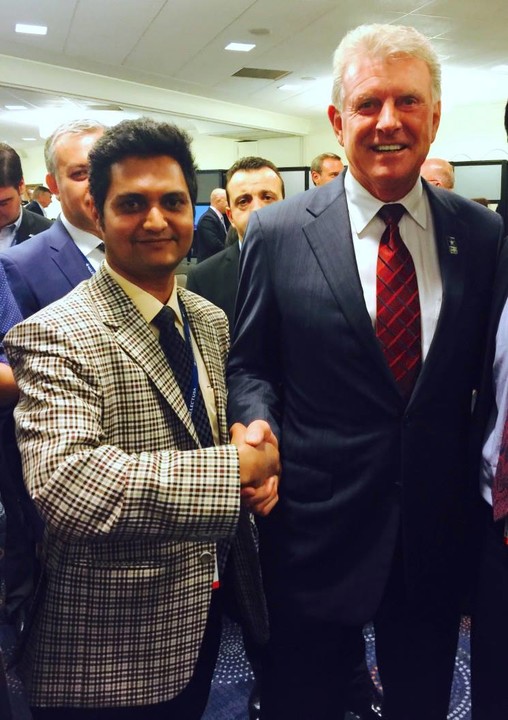
The next month, he published a short note about hearing President Barack Obama speak live at an international summit in Washington. He described the experience as inspiring. These are modest personal entries: a photograph, an encounter, a reaction. They show what he chose to preserve alongside his technical writing. The encounters belong in the story as encounters; the handshake is already interesting enough.
Beyond the shop window
By June 2021, Pansare was articulating a specific problem for online retailers. Putting up a website was only one part of operating a business online. Customer expectations kept moving. A store also needed ways to understand behavior, personalize the experience, and manage the business behind the screen. Futurism was preparing to present its Diginyze commerce platform at Ecom World Conference that year.
His explanation concentrated on machine learning, AI, and business intelligence inside the platform. The emphasis was on helping merchants offer more personalized experiences and retain control over their online operations. This was a product expression of the wider consulting proposition: bring several related capabilities into a working arrangement. A checkout button may be small, but it has a remarkable talent for acquiring dependencies.
The retail example makes his role easier to understand. Pansare is responsible for an organization that must translate a broad technological possibility into a customer’s particular requirements. A merchant cares about whether the shop works for its customers. The consultant must connect that concern to software, data, and ongoing execution. The vocabulary becomes useful when it reaches the transaction.
Connection comes with a security bill
The same company was building a security proposition alongside its commerce work. In 2021, Pansare discussed expanding relationships with managed service providers and resellers through a security partner program. Those connections were a distribution strategy: work with other service businesses that already help enterprises manage technology. The founder’s network extended beyond direct customer relationships to the organizations supporting those customers.
In February 2023, his attention turned to encryption across cloud environments. He described the risks surrounding business information as it moves between applications, devices, and networks. His examples included employees sharing information through messaging tools, mobile devices carrying company data, and traffic passing across internal systems. The discussion stayed close to the everyday routes through which business gets done.
Read beside the retail proposition, that security emphasis provides a necessary companion. More connected services create more journeys for information. Those journeys need controls as well as convenience. In Pansare’s account, encryption belongs within the operating picture, alongside access management and oversight. A business that becomes easier to reach must still decide who is allowed through the door.
- 2003Futurism Technologies founded
- 2021Diginyze presented in the company’s Ecom World plans
- 2026Futurism AI announces Autonomous Agents
The people still have work to do
Pansare’s discussion of AI in April 2024 returned to the customer. He described using information from different points in a customer’s journey to identify patterns and inform decisions. His examples concerned recommendations, marketing, and the connection between what a business knows and what it offers next. The interest was in an application of intelligence that a customer might actually encounter.
He also urged marketers to develop their own competence: try tools in real projects, follow developments, and take part in professional networks. That advice places a continuing obligation on the person using the system. Better predictions still have to be interpreted within a business. Creativity and strategic judgment remain part of the job. Buying access to a tool does not confer those skills at checkout.
There was a parallel development inside the company. In March 2024, Futurism announced a second consecutive Great Place to Work certification. Its account emphasized learning, communication, flexibility, and inclusion, with chief people officer Saily Vyas speaking for the team. The dated recognition gives a concrete workplace milestone to set beside Pansare’s emphasis on internal capability. The people behind the services also have careers to build.
A factory floor, then another handoff
At Hannover Messe in April 2025, Futurism’s announced portfolio covered industrial AI, smart factories, digital energy, digital twins, connected equipment, and security for operational environments. Pansare’s accompanying statement emphasized intelligent manufacturing. The setting moved the proposition from the online shop to the industrial operation, where data and software meet physical equipment and established production processes.
In September 2026, Futurism AI announced Autonomous Agents, designed to coordinate work across enterprise systems. The announcement described application integration, workflow building, decision support, and security controls. These were stated product capabilities and intentions. Their place in Pansare’s story is the next expression of a familiar concern: how to move from information to a completed piece of work.
His ambition reaches beyond a particular platform. He has spoken about building a more connected world for the next generation. The work that makes that ambition tangible is smaller and more exacting: assemble a team, choose a useful first project, connect the systems, support the customer. Across more than two decades, the technologies have changed. The need to organize people around a result has proved remarkably durable. Futurism is an expansive name. Pansare’s most revealing answer still begins with the people available to do the work.