Office supplies are an unlikely opening act for a career in artificial intelligence. They do, however, have one advantage as a business education: everyone notices when they fail to arrive. In 1999, Tianwen Liu, known professionally as TW Liu, co-founded AsiaEC.com, an online office-supply and services business in China. Before the cloud platforms and industrial computing came the ordinary problem of getting an organisation what it needed.
Office Depot acquired AsiaEC in 2006. By then Liu had already started the enterprise that would occupy the next quarter-century of his working life. iSoftStone began operations in Beijing in October 2001. Its business was helping other businesses with technology: consulting, software, systems and the work required to keep them running. The office stationery had changed. The customer still expected delivery.
Following Liu through those years offers a less theatrical view of technology entrepreneurship. There are acquisitions, university connections, public listings and factory visits. There is also a recurring question: how does an ambitious technical idea become something an organisation can actually use? His career keeps returning to that awkward stretch between a proposal and a working operation.
An engineer learns the customer’s language
Liu comes from Jingshan in Hubei. He studied at the institution now known as Huazhong University of Science and Technology before pursuing graduate education in the United States. He holds a master’s degree in electrical engineering from the University of Massachusetts and an MBA from MIT, where he was a Sloan Fellow. The combination put engineering and management in the same professional toolkit.
His early jobs gave him practical exposure to both. From 1991 to 1993 he worked as an IT consulting manager at Digital Equipment Corporation. Between 1993 and 1995 he was a senior project manager at Bechtel. From 1996 to 1999 he led the China systems-integration department of Siemens Business Services. These were jobs concerned with delivering projects inside large organisations, where a promising piece of software is only part of the assignment.
Then came AsiaEC. Leaving an established company to co-found a procurement business was a change in scale and responsibility. It also kept him close to corporate customers and their routines. By 2001, he was building iSoftStone alongside that earlier venture’s development. There was no tidy interval in which one success was filed away before the next ambition began.
That overlapping chronology matters. The Office Depot acquisition happened five years after iSoftStone started. Liu’s entrepreneurial history therefore contains two businesses developing across the same period, rather than a simple exit followed by a leisurely search for the next idea. Even his early milestones resist the neatness of a conference biography.
iSoftStone was already five years old when the earlier venture was acquired.
The long way from Beijing to Wall Street
iSoftStone’s expansion included buying capabilities in the United States. It acquired Akona in 2008, Ascend Technologies in October 2010 and Adventier Consulting Group in 2011. Those names mark the practical construction of an international business: local teams, client relationships and consulting expertise added to a company whose operations began in Beijing.
In December 2010, iSoftStone reached the New York Stock Exchange. The offering sold 10.8 million shares at $13 each, raising about $140.8 million. It had roughly 10,000 employees at the time. For Liu, the listing placed a business founded nine years earlier in front of a different audience, one that assessed its performance through quarterly results as well as client delivery.
The stock-market chapter did not proceed in a straight line. In August 2014, a merger took iSoftStone private. Liu was part of the buyer group, alongside funds managed by China Everbright Investment Management and other management members and shareholders. The transaction ended the company’s life as a publicly traded business in New York.
A second public-market chapter arrived in March 2022, when iSoftStone listed on Shenzhen’s ChiNext market under stock code 301236. The offering raised RMB 4.63 billion. These are separate events, eight years apart, in a longer operating history. A bell-ringing photograph makes a satisfying milestone. Keeping an enterprise going between the photographs is the more substantial occupation.
The university connection that kept working
Liu’s relationship with MIT continued after graduation. In 2011, he appeared on the MIT Sloan CIO Symposium’s CEO keynote panel alongside HubSpot co-founder Brian Halligan and Deloitte technology executive Eric Openshaw. That same year, iSoftStone joined MIT’s Industrial Liaison Program. The connection became part of the company’s work on urban development.
At the 2013 MIT China Conference in Beijing, Liu discussed the demands of increasingly complicated smart-city projects. His description reached beyond software into consulting, systems integration and engineering. He called them “new challenges for iSoftStone,” a useful admission from a chief executive: a larger opportunity could require abilities the company still needed to develop.
He also wanted officials involved in urbanisation projects to encounter international ideas about planning and management. In 2014, he spoke about helping China build “sustainable and more livable future cities.” The ambition linked his American education to problems in Chinese cities, with executive education and exchanges among the proposed ways of moving knowledge between them.
That is a particular kind of alumni relationship. The university appears here as a continuing connection to expertise, rather than simply a line beneath his name. It also helps explain the breadth of his public agenda. Running an IT services company had led him into questions about how cities are planned, operated and understood.
“sustainable and more livable future cities”
TW Liu on China’s urban development, 2014
A factory has little patience for adjectives
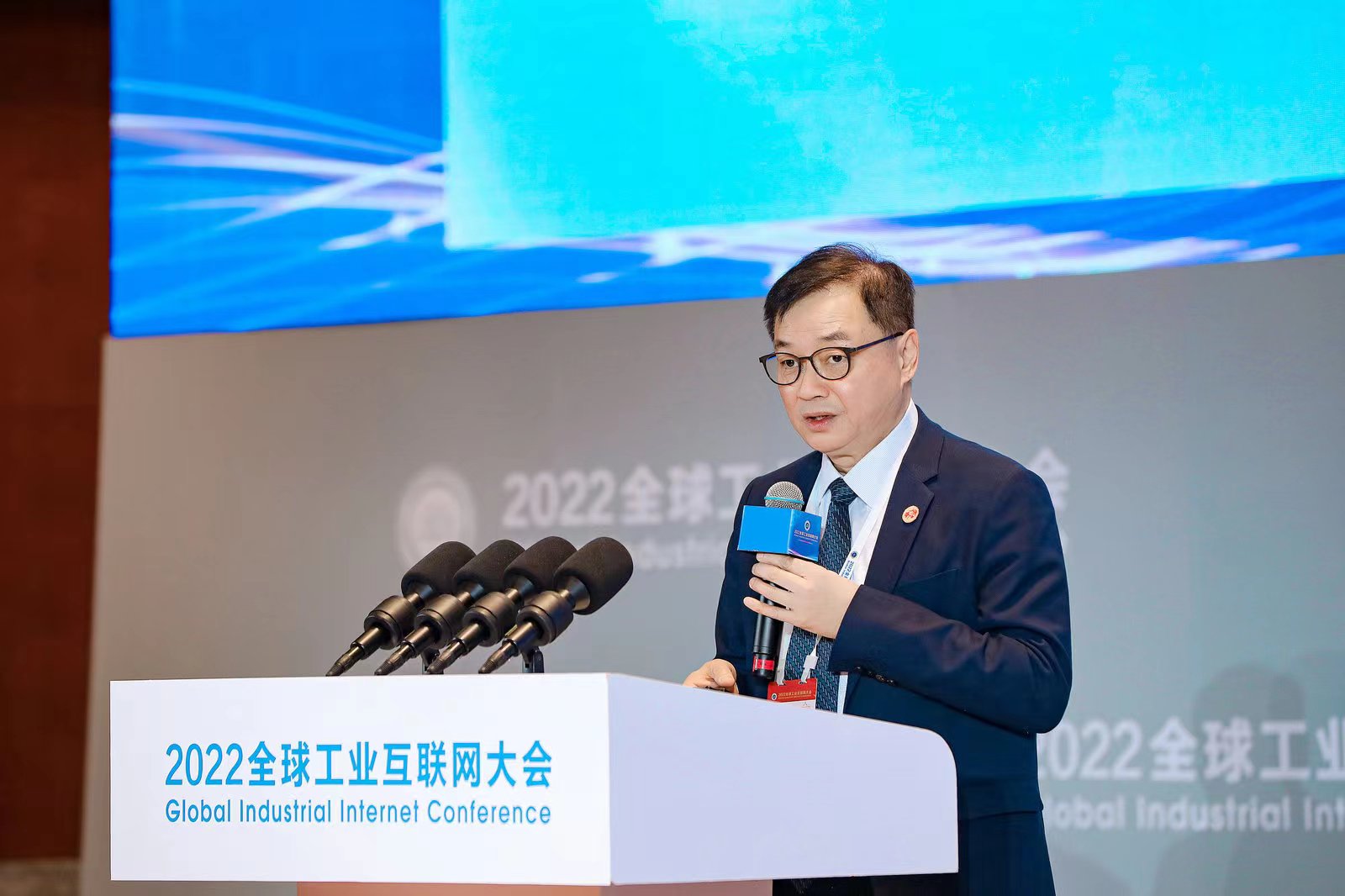
By November 2022, Liu was speaking at the Global Industrial Internet Conference in Shenyang. His keynote concerned the digital foundation of industrialisation. The setting brought his attention from city-scale systems to manufacturing, where the question of whether technology works becomes unusually tangible.
“Real-world business is used to gauge its effectiveness,” he said of the industrial internet. He described reusable, lower-cost solutions intended to help customers reduce costs and inventory, improve efficiency and raise quality. The vocabulary has less sparkle than a futuristic demonstration. It is also much closer to the concerns of the person responsible for a production line.
iSoftStone was developing an industrial metaverse platform, iSSMeta, tested in sectors including cement and aluminium. Here the grand name sat beside decidedly physical materials. The company’s work encompassed digital twins and the systems that let manufacturers represent, monitor and manage industrial processes. The attraction was practical application in an existing business.
Liu also stressed collaboration among companies and institutions. Manufacturing technology involves equipment, software, operational knowledge and customers who already have production to manage. His argument placed partners inside the work of implementation. For someone whose career began in consulting and systems integration, that emphasis has a recognisable history.
Hubei enters the picture again
The geographical thread became more personal in March 2026. Liu said iSoftStone’s Wuhan headquarters project in Optics Valley was expected to enter use that month. The company had been developing its Hubei presence since 2012, with Wuhan at its centre and activity in Yichang, Xiangyang and Jingmen.
At the time, iSoftStone had 6,600 employees in Hubei. Liu connected the decision to invest there with both affection for his home province and commercial strategy. That pairing gives the expansion a human dimension without requiring a sentimental origin myth. A founder can have more than one reason for returning to a place.
In November 2025, he had been elected president of the Hubei business chamber in Beijing. He described a responsibility to connect businesses in the capital with opportunities in Hubei and said he intended to bring more investment and business activity to the province. The role extended his connections beyond the company’s immediate customer base.
The Wuhan project also brings the story back to delivery. A regional investment becomes meaningful through offices, technical teams and work undertaken there. The employee figure gives that relationship a scale the word hometown cannot supply on its own. Hubei is part of his biography and part of the company’s operating map.
iSoftStone employees in Liu’s home province
Now the software business includes the machinery
At a Beijing-Hong Kong digital-economy forum in January 2026, Liu described a strategy connecting computing power, models and terminals. The company was expanding its emphasis from software services toward integrated hardware and software. In everyday terms, its ambitions now included more of the equipment and infrastructure on which enterprise AI depends.
In June, he welcomed a Huawei Cloud delegation to the company’s Beijing headquarters as the two businesses launched an AI joint innovation centre. In September, he led iSoftStone’s delegation to Huawei Connect in Shanghai. The company introduced the commercial release of Merak AI AgentOS 1.2 at a related forum. These were developments involving teams and partners, with Liu setting the wider direction.
Then, on October 10, he accompanied Apex chairman Huang Chenhong on a visit to iSoftStone Huafang’s Tongzhou intelligent shared factory. The two sides planned cooperation across AI infrastructure research and development, manufacturing and supply chains. After years of discussing systems, the latest scene in his public working life was an actual factory.
There is an appealing circularity to that destination. AsiaEC dealt with the supplies organisations needed to work. iSoftStone grew through the services and systems they needed to operate. Its current AI strategy reaches further into the machinery itself. The products are different, and the business is far more complicated. A customer still has to be able to use what arrives. That modest test has survived every change in the catalogue.
A schematic of the three elements Liu connected at the January 2026 Beijing-Hong Kong forum.
Continue the trail
- iSoftStone · company website
- Tw Liu · LinkedIn profile
- iSoftStone · YouTube channel
- MIT Sloan CIO Symposium · 2011 programme
- MIT China Conference · 2013 remarks
- Hubei investment · March 2026
- Tongzhou factory visit · October 2026
- iSoftStone · company LinkedIn
- iSoftStone · company X
- iSoftStone · company Facebook