Consider a store with a million products. The shopper sees a search box, a price, a reassuring little stock indicator. Behind that ordinary screen, someone has to reconcile product descriptions, supplier updates, customer-specific prices, and orders arriving through different channels. A beautiful button cannot settle a disagreement between a warehouse and a website. That disagreement is where Elsner Technologies becomes interesting.
- Builds online stores and connects the systems behind them.
- Works across Magento, Shopify, WooCommerce, Zoho, and Odoo.
- Mixes custom projects, dedicated developers, support, and paid plugins.
- Its clearest case studies concern operational bottlenecks.
A million products, one inventory problem
PCNation, the technology retailer and IT solutions provider, supplies a useful example. In Elsner’s account, its enormous catalog came with manual updates, separate online and offline order information, and stock records that were not always current. Pricing varied by customer and partnership. Each complication was manageable in isolation. Together, they made ordinary selling harder to coordinate.
Elsner describes building a Magento system that automated updates from external product data, brought order information together, and improved inventory visibility. The company reports support for more than a million products and operations running ten times faster through automation. Those are Elsner’s reported outcomes. The practical detail is the connection: fewer places where someone must carry information from one system into another.
data→Product
catalog→Online
store
Every arrow is a handoff someone has to own. Conceptual illustration.
The ice cream test
The same idea appears in an apparently unrelated business: Hocco Ice Cream. Here the obstruction was customer information and workflow. Elsner’s published case describes CRM automation using Zoho CRM, Zoho Flow, WhatsApp integration, forms, and dashboards. Cases could be created as interactions arrived; reporting made lead conversion and case resolution easier to follow.
Elsner reports an 80% reduction in manual data-entry effort. An ice cream brand and a computer retailer have little in common on the shelf. In the office, both can accumulate work at the point where information changes hands. That is a useful way to read these projects: find the repeated transfer, then ask whether a person still needs to perform it.
Illustrative index, before = 100. Based on Elsner’s reported relative reduction; not recorded hours.
From a website to a working business
Harshal Shah founded Elsner in 2006. Its Indian private limited company was incorporated in 2009. Today, its website identifies Ahmedabad as headquarters and lists international offices, including Fremont. The offer has widened from development into enterprise systems, AI, and marketing. Its About page reports more than 650 Magento websites delivered, suggesting a substantial history with that platform.
A merchant can hire Elsner to build a Shopify store, migrate a Magento installation, customize WooCommerce, or connect commerce with business software. Other services include web and mobile applications, interface design, search optimization, advertising, and maintenance. Customers span retailers, distributors, direct-to-consumer brands, and enterprises whose requirements extend beyond a standard storefront.
The breadth explains its place in the market. Platform vendors supply the software foundations; Elsner configures, extends, and connects them for particular businesses. Its published alliances include Shopify, Adobe Commerce, Zoho, and Hyvä. A specialist agency, an independent developer, or an internal team can be an alternative. The choice turns on the shape of the problem. A theme adjustment and an inventory integration ask different things of a supplier. Buyers should compare relevant implementation experience, responsibility for testing, and the plan for maintaining connections after launch. Elsner’s proposition is especially relevant when the assignment crosses several systems and disciplines.
“I feel like the Elsner team is part of my team”
Doug Robb / Director, Communovate
Customer testimonial published by Elsner
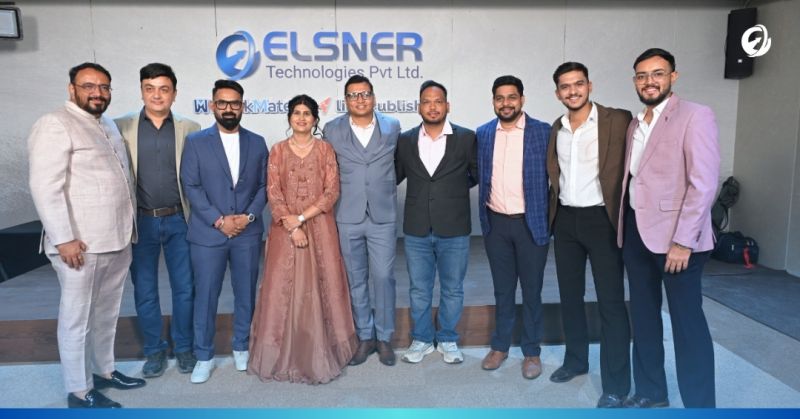
That relationship also depends on delivery habits. Elsner’s stated values emphasize listening, respect, ownership, and feedback. Its public team gallery adds less formal evidence of company life: badminton, meditation, festival celebrations, and a twentieth anniversary. For a buyer, the more useful expression of those values is whether a named person answers a question and takes responsibility for the next step.
The price of a handoff
There are several doors into the business. Elsner sells fixed-scope projects, time-and-material engagements, and dedicated hiring. A well-defined job suits the first model. Changing requirements favor the flexibility of the second, with corresponding exposure to additional hours. Dedicated hiring supplies a resource for ongoing work and requires the customer to remain involved in directing it.
Its Clutch listing gives a minimum project size of $5,000 and an hourly band below $25. Treat those as directory indicators, rather than the price of a particular transformation. Requirements, integrations, testing, and support determine the actual engagement. A low hourly figure says very little about how many hours a poorly specified project will consume.
Smaller fixes have shelf prices. Elsner Store lists a Zoho Books and WooCommerce integration at $99 for a regular license, with installation available as an extra. It synchronizes customers, products, orders, and inventory. Magento 2 Speed Booster is listed at $100 for its Community option with 90 days of support. Buying a plugin addresses a narrower task than commissioning an integrated business system. It also gives a buyer something concrete to evaluate: which records move, which direction they move in, and how errors become visible. The WooCommerce connector lists synchronization logs and manual sync options. Those mundane controls matter when an automated transfer needs checking.
AI still needs an accurate stock count
Elsner’s recent announcements extend the same argument into AI. In August 2026, it announced an expanded AI agent development practice. An October announcement emphasized readiness for AI-assisted shopping: structured product information, dependable inventory, supported interfaces, and controlled transactions. The attractive conversational interface still depends on the accuracy and permissions of the systems underneath it.
The lesson a reader can copy is modest: choose one repeated handoff, record its current effort, name its owner, and define what improvement means before commissioning automation. A simple store with working standard tools may need little custom engineering. A business with unreliable records needs to fix those records alongside its integrations. Elsner’s most persuasive examples begin with a recognizable operational problem. The useful buying question follows naturally: which piece of work should become easier on Monday?
Follow the work
Explore the company, its products, and the conversations around them.