A website can introduce a record label. It can also collect payments, route applications and let different people do different jobs. Both arrive in a browser. Calling both “a website” is where the purchasing conversation starts to go sideways. Sunlight Media, a Los Angeles development and marketing agency, has made that confusion unusually tangible by publishing prices for work it actually contracted.
The exercise offers a useful way into a business with a sprawling menu: websites, stores, apps, search marketing, photography and more. Its central proposition is straightforward. A client can hire the people who build its digital presence, then keep working with them on attracting customers and maintaining the machinery. The interesting question is how much machinery the client needs.
The difference is in the job
Sunlight’s May 2026 benchmark covers eight WordPress builds and one custom application, contracted from mid-2025 to early 2026. The WordPress median was $3,600. A roughly five-page record-label site cost $2,500; a dance and education platform, with courses, booking and ticketing, cost $16,000. The separate application came in at $55,000. These are anonymized company figures, not a survey of competing agencies.
The recurring bill matters, too. The benchmark lists managed hosting from about $24 monthly and pay-as-you-go maintenance at $85 an hour. Build prices exclude ongoing hosting and maintenance. For a buyer, the practical move is to compare both the initial scope and the continuing commitment.
Before the agency, there was the soundcheck
Angelo Frisina’s first office was wherever a touring musician could open a laptop. In his public accounts, the drummer describes learning and doing web work around travel, hotels and soundchecks. It was portable work that fitted into the peculiar gaps of life on the road. Eventually those gaps were too small for the demand.
“The problem with being a solo developer is bandwidth,” he writes in his founder profile. He could manage only one or two projects at a time. Other customers needed someone sooner. That was the constraint that gave way first: the amount of work one person could accept. In 2011, he started Sunlight Media.
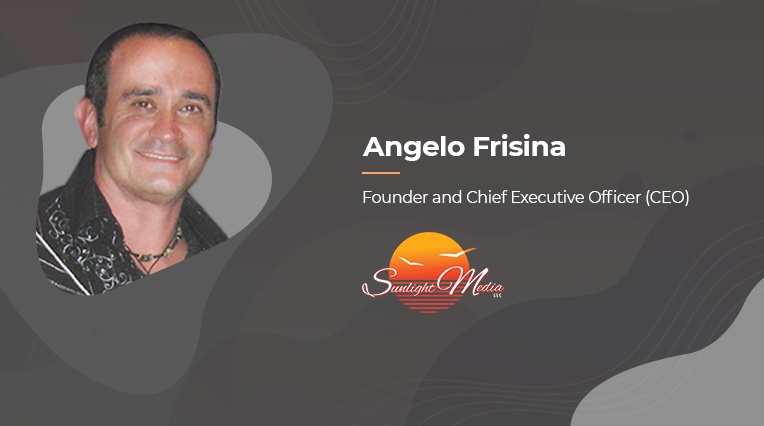
In a Website Planet interview, Frisina describes assembling freelance designers, developers and marketers, then moving toward project management and quality assurance. Other project managers subsequently took on more coordination, freeing him to concentrate on business development. The change was gradual. A freelancer who had been declining work built a structure that could accept it.
That origin gives the agency’s service pitch a practical character. The founder had already encountered the difference between being able to perform a task and being able to promise its delivery. Hiring more people expanded the calendar, but also created a new job: making sure everyone understood what the client had bought.
The permit desk behind the portfolio
Film Santa Monica supplies a concrete example of the agency’s more involved development work. Sunlight says the portal, built for Santa Monica Travel & Tourism, launched on September 1, 2025. It used Laravel PHP to support film-permit applications, payment processing and administration.
Applicants, coordinators and administrators have different access. Staff can manage permits, licenses, location assets, customer information and fee structures through an administrative dashboard. The public-facing portal is designed for mobile use. This is a service workflow expressed through a website: people submit information, money changes hands and staff handle what happens next.
- 01ApplyApplicant submits a permit request
- 02PayIntegrated card payment processing
- 03ManageStaff access permits and administration
For an organization considering similar work, the example makes a useful distinction visible. The design brief must describe who can see, change and approve information. A collection of attractive sample pages would leave much of that assignment unwritten.
A store is a different conversation again
Sunlight’s ecommerce practice includes Shopify, Magento and WooCommerce. Its Shopify offering covers custom storefront design, navigation, checkout and search optimization. It names Jerrod Unruh as its Shopify theme specialist, with work spanning first-time merchants, retailers moving online and existing stores seeking an overhaul.
The agency points customers with larger catalogs or custom business-to-business requirements toward its Magento service. That choice illustrates a broader feature of the business: it sells work across several established platforms. The customer does not have to begin by knowing which software name belongs in the brief.
The WordPress practice similarly extends beyond choosing a theme. Sunlight offers custom themes and plugins, with Tapas Roy identified as a senior developer. That can matter to a business whose staff need a particular editing arrangement or whose site must perform a function beyond the standard installation. The useful buying question is what employees must be able to change after the developer leaves the meeting.
Getting found is part of the assignment
The agency serves an eclectic customer mix. Its published client list includes USC, Atlantic Records, Gary Numan, the City of Monrovia and the Japan Foundation Los Angeles. Those names sit alongside smaller professional-service and wellness businesses. The shared requirement is a digital presence that supports an actual activity: presenting work, taking inquiries, selling products or administering a service.
Sunlight combines development with SEO, paid search, social media and email marketing. Its law-firm offering, for example, includes practice-area content, local business-profile work and reporting on calls and form submissions. Those are specific parts of a lead-generation assignment. A search position is useful to the client only insofar as the resulting visitors can find and use the service they need.
There is an acquisition lesson in the agency’s own history. In his Kimp interview, Frisina says early customers came through family, friends and professional contacts. He then invested time in learning SEO to bring more visitors to the company’s site. The sequence is worth copying: use relationships to establish a base of work, then develop a channel through which people outside that circle can discover it.
The people behind the service menu
A list of capabilities can make an agency sound like a vending machine. Sunlight’s team descriptions offer a more revealing picture. Project manager Denver Schantz is also a dance teacher and performer. PPC manager Brett Williams is described as concentrating on acquisition costs and advertising returns, including campaign testing and conversion tracking.
The mobile-app service adds another discipline. Sunlight offers native iOS and Android development, along with cross-platform work using Flutter and React Native. Its published process includes requirements, wireframes, development, release and maintenance. It also offers work on existing applications. For a customer, that means the conversation can start with a product already in use, rather than requiring an entirely new build.
This range makes coordination part of what the agency sells. A merchant commissioning a store and an ad campaign needs the destination page and the advertisement to make sense together. A public-facing portal needs its design and permissions to agree. The company’s emphasis on project management is therefore more than a personality trait; it describes work that sits between the specialties.
The $49 door into the business
Sunlight also advertises a separate AI Website Builder. Its Business plan costs $49 a month, while Ecommerce costs $99. The listed features include hosting, SSL, mobile-responsive design, contact forms and custom-domain connection. The higher plan adds a store and tools such as abandoned-cart recovery. Both are advertised as monthly subscriptions that can be canceled.
This offer changes the entry point. A customer who can build within the supplied system can choose a recurring software expense. A customer requiring a commissioned design or unusual functionality can discuss agency services. The two offers should be judged against their respective assignments; a monthly builder fee does not describe the price of a bespoke application.
The founder’s current positioning also leaves room for AI within custom work. He describes using tools including Claude, ChatGPT and Gemini while keeping people responsible for delivery. That is an accountability claim a prospective customer can make concrete: identify who reviews the work, who accepts feedback and who takes responsibility for corrections.
The agreement is part of the product
Frisina’s interviews return repeatedly to communication. In his Website Planet interview, he stresses reducing misunderstandings through clear discussion. He describes discussing features, refining the scope and then producing a formal proposal. The document gives both sides something more useful than a shared feeling that the project sounds exciting.
“It’s important to communicate clearly, to avoid any discrepancies or misunderstandings.”
Angelo Frisina / Website Planet interview
On Penji’s Fully Managed podcast, he identifies three conditions for a suitable engagement: a workable budget, a project within the team’s abilities and clear communication. He says the agency may decline or refer work when those conditions are missing. The same conversation describes customers outside Southern California, including Hong Kong, Japan and Europe. Geographic reach does not remove the need to agree on the assignment.
Sunlight fits between the independent freelancer, the do-it-yourself builder and the broader agency a company might hire for ongoing digital work. Its appeal is the combination of development, marketing and support. That combination has less value when a buyer needs only a simple temporary presence, or cannot yet explain what the site must accomplish.
There is a modest, useful lesson here for the next sales call. Describe the people using the site. Describe their tasks. Agree on what happens after launch. Then ask for the price. A quote becomes easier to judge when everyone is talking about the same job.